[directorist_add_listing]

Former Met Police Officer Jailed for Role in £5m Money Laundering Network

A former Metropolitan Police officer who abused his position to assist a criminal network in laundering £5 million has been sentenced to nine years in prison. Neil Sinclair, 62, was found to have provided confidential police information and facilitated the transfer of illicit funds across the UK and the United Arab Emirates over a five-year period.

Between February 2016 and March 2021, Sinclair helped move £1.5 million to the UAE and more than £3.5 million within the UK under the direction of an organised crime group based in Dubai. The offences occurred while he was both a serving officer and later a member of police staff.

The Independent Office for Police Conduct (IOPC) launched an investigation into Sinclair’s activities in September 2020 after a referral from the Metropolitan Police. He was charged the following year and, in June 2025, pleaded guilty to three counts of misconduct in public office and two counts of entering into an arrangement to facilitate the acquisition, retention, or control of criminal property.

Sinclair had originally stood trial with six other defendants who were not part of any police force but faced related money laundering charges. Following his guilty pleas, he was sentenced at Southwark Crown Court on 31 October 2025.

Amanda Rowe, director of the IOPC, described Sinclair’s conduct as “a deliberate and prolonged pattern of criminal behaviour.” She said: “The police are responsible for disrupting and dismantling organised criminal gangs, but this officer chose to join them. He played a key role in a substantial money laundering operation and abused his position to provide the gang with confidential police information. This was a profound breach of the trust placed in him by both the public and the force.”

Sinclair retired from the Metropolitan Police in 2017 but returned as a member of police staff in 2019. He was formally dismissed in October 2021 following the conclusion of misconduct proceedings.

The IOPC said the case demonstrated the seriousness with which corruption within law enforcement is treated and highlighted the importance of maintaining public confidence in policing. Rowe added that Sinclair’s sentence “sends a strong message that facilitating criminal activity will not be tolerated.”

The investigation is one of several in recent years that have uncovered instances of police corruption involving the misuse of information systems for criminal purposes. Authorities have continued to stress the need for robust vetting and monitoring processes to prevent similar breaches of trust in future.


London’s EV Charger Rollout Slows as 2030 Target Looms

London’s progress toward building a comprehensive electric vehicle (EV) charging network is under renewed scrutiny, as updated government figures show the city has installed just over 26,600 public charge points—around 70% of the target set by the Mayor for 2030.

According to the latest Department for Transport (DfT) data, 4,749 new public chargers were added to London’s network since October 2024, bringing the total to 26,668. Mayor Sadiq Khan’s manifesto commitment aims for 40,000 charge points by 2030, meaning the city still needs to install more than 13,000 units in the next five years.

The rollout has made significant progress since 2015, when electric vehicles represented just 0.2% of the capital’s fleet. That figure has now reached 6.8%, according to Transport for London (TfL). Yet critics argue that the pace of infrastructure development risks falling short of the rapid increase in EV ownership.

Hina Bokhari, leader of the Liberal Democrat group on the London Assembly, said London’s rollout “needs to work much faster” to meet the Mayor’s 2030 goal. “While the mayor drags his feet, Londoners who are clearly itching to make the switch don’t have the confidence they’ll be able to charge swiftly and easily,” she said.

Bokhari added that London’s high rate of EV adoption compared to the rest of the UK makes the need for robust charging infrastructure particularly urgent. “With ten years for all new cars to be EVs, we need the charging network in place now. Build it and they will come,” she said.

A spokesperson for the Mayor defended the progress, stating: “The number of EV charge points across London is steadily climbing, and the Mayor will continue supporting delivery partners to meet his target of 40,000 by 2030. Sadiq is committed to delivering the infrastructure needed to support the green transition, working together to build a greener and better London for all.”

During a Budget and Performance Committee hearing in September, senior City Hall officials reiterated that the target remained achievable.

Across the UK, over 15,000 new charging devices were installed in the past year—a 23% national increase. Minister for Decarbonisation Keir Mather said the figures reflected growing confidence in the UK’s electric transition. “There’s never been a better time to go electric,” he said. “We’re helping drivers save with discounts of up to £3,750 on new electric cars — all part of our Plan for Change.”

Vicky Read, Chief Executive of ChargeUK, noted that the industry is investing “billions of pounds in high-quality charging,” emphasising that the majority of drivers rely on public networks. “We need the right mix of affordable, accessible charging at home, work, and en route to ensure everyone can make the switch,” she said.

Concerns have been raised that the end of current incentives—such as exemption from the London Congestion Charge—could slow the rate of EV adoption in future years. Meanwhile, the capital faces the logistical challenge of integrating charging points into dense residential areas, where on-street charging infrastructure is crucial.

Despite steady progress, London’s success in meeting its 2030 target may depend on sustained investment, faster planning approvals, and continued collaboration between public and private partners.

Former Belvedere Pub Cleared for Redevelopment into 30 Apartments

Full planning permission has been granted to redevelop The Great Harry, a former public house in Belvedere, into a residential scheme comprising 30 private apartments.

Located on a 0.7-acre freehold site along Parsonage Manorway, the property is currently being marketed for £2.25 million. The existing two-storey detached building includes a basement, forecourt car park, and a small garden area in the south-east corner.

The redevelopment, approved under planning reference 22/03153/FULM, allows for the demolition of the current structure and construction of a mix of one-, two-, and three-bedroom self-contained flats. Plans also provide for car parking, cycle storage, refuse facilities, and landscaped outdoor spaces designed to enhance residential amenity.

The proposal, described as a “100% private residential scheme,” follows a four-year process involving planning submissions and appeals. No listed building, conservation area, or community asset restrictions apply to the site. The property is not on the register of Assets of Community Value and has no listed or locally listed structures nearby.

Currently designated under the Sui Generis use class, the former pub has an Energy Performance Certificate (EPC) rating of C. The listing notes there are no Section 106 planning obligations attached to the development, and the Community Infrastructure Levy (CIL) charge is still to be confirmed.

An option is also available to purchase the site through a Special Purpose Vehicle (SPV), which could provide potential stamp duty savings for buyers. The property is fully serviced, with access to water, gas, electricity, and telecommunications.

At present, the site is not subject to business rates, which the marketing information describes as offering “an additional holding cost benefit during the planning and pre-development phase.”

The approved residential scheme is designed to deliver “generous car and cycle parking provision” and “attractive landscaped outdoor amenity spaces,” according to the marketing details. The development is situated within a residential area that agents describe as having “strong demand” and “excellent market potential.”

Vehicular access is available from both Parsonage Manorway and Luddesdon Road, with the site positioned between Eastry Road and Luddesdon Road. The area benefits from good transport connections, with Barnehurst, Bexleyheath, and Belvedere railway stations all within approximately 0.9 miles.

No information has been released regarding demolition or construction timelines, and further details about the internal condition of the existing building or specific design elements of the new development have not been disclosed.

Interested parties are invited to contact the appointed land team for viewings or further information on costs. The listing includes a disclosure that the vendor is an employee of the selling agency.

Buyers will be required to provide proof of identification, funds, and solicitor details prior to completing any sale, in accordance with standard legal requirements.

Islington School Seeks Support to Save Wildlife Pond for Future Generations

A north London primary school has launched an appeal to restore its deteriorating wildlife pond, warning that a vital outdoor learning space could be lost without urgent repairs.

Tufnell Park Primary School in Islington has relied on its pond for more than 25 years as a hub for hands-on science and nature education. The site, which is officially designated a Site of Importance for Nature Conservation, has helped generations of pupils learn about local ecology through activities such as observing tadpoles and identifying pond life.

However, the pond is now leaking, and the wooden platform used for pond-dipping and wildlife observation is collapsing, making it unsafe for children to use. The school said the damage has already affected wildlife: last spring, it lost all its tadpoles because the water level fell too low to sustain them.

Natalie Hitchcock, the school’s volunteer pond garden coordinator, said that without repairs this winter, another breeding season will be lost. “If we can’t restore the pond, we won’t see newts, frogs, or toads return in the spring,” she said. “That means no tadpoles — and no meaningful pond-based learning for our pupils. The impact reaches beyond the children; the entire ecosystem that depends on this small space is under threat.”

The school has partnered with national conservation charity Froglife to raise funds for the project and has produced a short video explaining its importance to the school and wider community. The campaign has so far secured £4,500 in materials through grants but still needs an additional £5,000 to cover the cost of professional restoration and installation.

The appeal is aimed at local residents, community groups, and businesses who may be able to support the restoration effort. Hitchcock said that with proper maintenance, the pond could serve as a sustainable nature resource for decades to come.

Headteacher Martin Scarborough described the pond as one of the school’s most valuable learning environments. “This pond offers our pupils a rare opportunity to experience real curiosity and connection with the natural world — something that’s increasingly hard to find in an inner-city setting,” he said.

“As our school continues to grow and welcomes more children, outdoor learning like this will become even more important. It supports wellbeing, environmental awareness, and a sense of calm in a busy urban environment.”

Tufnell Park Primary, which could eventually accommodate up to 600 pupils, integrates its wildlife garden and pond into lessons across the curriculum. Teachers use it to teach science topics such as habitats, life cycles, and ecosystems, as well as to foster creativity and mindfulness.

The restoration work will involve relining the pond to prevent leaks, rebuilding the platform, and replanting the surrounding habitat to encourage native species. The school also plans to improve accessibility so that all children, including those with mobility challenges, can take part in outdoor activities.

Scarborough said the campaign is about more than just a physical repair. “This is an investment in the wellbeing and education of every child in our community,” he said. “It’s about preserving something that inspires curiosity and care for the natural world — values that last long after the school day ends.”

The fundraising campaign remains open, and the school hopes to complete the restoration before spring 2026 to ensure the pond is ready for the next breeding season.

Residents and organisations interested in supporting the project can donate directly through the school’s campaign page or contact the school office for details.

Anyone who wishes to donate can go to superkind.org/campaign/tufnell-park-primary-school-parent-teachers-association-tufnell-park-primary-pond-restoration

Andrews Thrilled by Brentford’s Buzzing Form

Brentford boss Keith Andrews admits he’s relishing the way his side are performing as they chase a fourth straight victory across all competitions against Crystal Palace.

The Bees have picked up three wins from their last four Premier League fixtures, including last weekend’s impressive triumph over Liverpool, and stormed into the Carabao Cup quarter-finals with a commanding 5–0 demolition of Grimsby Town in midweek.

The Irishman also heaped praise on in-form striker Igor Thiago, who has found the net six times in nine league outings.

“He’s in a brilliant place right now — great rhythm, confidence high, enjoying his football. He’s been vital to everything we’ve done,” Andrews said.

“It’s fantastic to see him nominated for Premier League Player of the Month — it’s thoroughly deserved.

He’s already shown he can mix it with the best. He’s a real handful for defenders; I don’t think too many centre-backs will fancy going up against him.”

A set-piece battle looks likely at Selhurst Park, and Andrews is more than ready for it.

Brentford and Palace have thrown the ball into the opposition box more than any other sides in the Premier League this season — 47 and 38 times respectively. Both clubs sit on 13 points from nine games, both are through to the last eight of the Carabao Cup, and both embrace the art of the long throw.

Playing to our strengths and why not!  With Brentford turning the throw-in into a genuine weapon, football’s lawmakers IFAB are reportedly reviewing potential time limits on the move. Andrews, was not phased by this talk.

With very little between both clubs in term of league position, Brentford’s form is better which may give them the edge.

National Student Safety issue highlighted in Midlands Bouncer incident

The national issue of safety for university students has been highlighted recently following an incident at a Nottingham nightclub.

A Nottingham nightclub bouncer has been suspended following a viral video that appeared to show a clubber being struck in the face and falling to the ground outside a popular city venue.

The footage, filmed outside Unit 13 on Burton Street, was uploaded to TikTok on Thursday, 30 October, and has since been viewed more than one million times. It appears to show a security guard approaching a man dressed in orange prison overalls before reportedly punching him, causing him to fall onto the road. Nottinghamshire Police confirmed that the man suffered a head injury as a result of the incident.

The altercation took place on Wednesday, 29 October, during a Halloween-themed event at the club. Police have said they are investigating the matter and are appealing for witnesses to come forward.

In a statement, Unit 13 said the member of security staff seen in the footage had been suspended immediately. A spokesperson told the press: “We are aware of an incident involving a member of our security team and a member of the public outside the Unit 13 premises on 29 October 2025. We take all incidents of this nature extremely seriously. The member of security that was involved has been suspended with immediate effect and an ongoing investigation is now underway.”

PC Lindsey Webster of Nottingham Police said: “The victim suffered an injury to his head that could’ve quite easily been far more serious. He was reportedly assaulted by a member of door staff outside a nightclub in the city centre, which we know will have been witnessed by multiple people. If you were in the vicinity of this incident and witnessed it first hand, we’d ask you to please get in touch with our officers, so that we can establish the full facts about what happened.”

The force has also appealed to the public not to share footage of the incident online. “We’re aware of videos circulating online reporting to be of this incident, which we’d ask people to please take down and not share on social media,” police said in a statement. “Doing this could seriously prejudice what is an ongoing investigation, so we’d ask anyone with footage of this incident to please share it with the police directly.”

The Nottingham nightclub bouncer suspended case has sparked widespread discussion online, with police and club officials both stressing the importance of allowing the investigation to proceed fairly and without interference from social media.

In the minds of many commentators in the security and safety spheres, this incident highlights the urgent need for more grassroots safety options for students and other elements of the community.

Monica Ghuman, project manager of the Student Safety App said this in a comment to the Midlands Gazette: “It’s exactly these kinds of incidents that make the need for better protections for students in this country plain and simple.

“Sometimes threats come from unexpected places, even places where we might normally think are there for our safety. Sometimes the best people to protect students is other students. That’s why the Student Safety App is there. To offer that kind of interconnected protection. Students reporting on situations to keep students safe.”

Explaining the functions of the Student Safety App, Ms Ghuman said “It’s a kind of personal safety toolbox — a resource designed specifically for students, both on and off campus. It’s something you can rely on at any time of day, wherever you are.

“The main idea is to give students a real-time view of what’s happening around them, so they can stay alert and make informed decisions. Its core feature is incident reporting — students can see alerts about nearby incidents as they happen — but it’s also much more than that. It brings together everyone involved in the student experience: the university, accommodation providers, local services, and of course, students themselves.”

The App is now available on both Google Play Store and also on Apple’s IOS. More information can be found here, and an interview with Ms Ghuman for the Midlands Gazette earlier this week is available here.et

Double Murderer Refuses to Attend Old Bailey Sentencing

A man who murdered his pregnant girlfriend has declined to attend his sentencing hearing at the Old Bailey.

Shaine March, 47, of Surrey Quays, south-east London, stabbed Alana Odysseos, 32, 19 times at her Walthamstow home on 22 July 2024. Ms Odysseos was in the early stages of pregnancy with her third child at the time of the attack.

March, who had previously been convicted of murdering a 17-year-old boy in 2000, admitted to killing Ms Odysseos on the seventh day of his trial. His admission followed the withdrawal of support from defence experts for a diminished responsibility claim. Jurors were not informed during the trial of his earlier conviction.

On Friday, members of Ms Odysseos’s family attended the Old Bailey for sentencing by Mr Justice Murray. However, defence barrister Sandip Patel KC told the court that March had refused to leave his prison cell, stating to staff: “It’s only sentencing.”

Prosecutor Louise Oakley highlighted that March was legally required to attend the hearing. She explained that if he did not participate via videolink from prison, the court had the authority to compel his presence.

She added: “At the moment I do not have information to suggest he is unfit or unwell. He could be brought using reasonable force. It is important to the family he is present at the hearing to hear the effect he has had on that family.”

In response, Mr Justice Murray briefly adjourned the hearing to allow further inquiries to be made. He indicated that he was “reluctant” to grant March the option of attending the sentencing remotely by videolink.

The case has drawn attention due to the severity of the crime and March’s prior life sentence, raising concerns about public safety and the management of offenders released on licence.

March’s refusal to attend means that the judge may need to decide whether to enforce his presence or proceed without him, a step that is relatively unusual in high-profile sentencing hearings.

Forest Gate Baker Challenges Newham Council Over Home Business Ban

A baker in Forest Gate is challenging Newham Council after being ordered to stop operating her home-based business.

Fatima Yusuf has run her cake business, The Bakeress, from her Claremont Road kitchen since 2010. She lives there with her mother and says the business is “my livelihood, my only income.”

Fatima told the Local Democracy Reporting Service (LDRS): “We’re literally running a small home business and the council has never had a problem for over ten years.”

The council issued a planning enforcement notice in August, citing a lack of planning permission. Under planning law, a change in the use of a property requires approval, even if no structural alterations are made. The notice followed a neighbour’s complaint and an inspection by council officers.

The enforcement notice stated that running a commercial enterprise in a residential street “undermines the success of nearby designated centres” and caused “unacceptable harm” to neighbours due to noise and disturbance.

Fatima disputes these claims, saying her business has never caused problems. “We never make noise, there’s no car pollution,” she said. She has also collected signatures from 16 neighbours affirming that her bakery has not caused parking or noise issues.

She described the council inspection as “very intrusive,” adding: “They went to my attic, my bathroom, my bedroom, my shed and my late father’s bedroom, which was very private.”

One neighbour, Cathy Stack, defended Fatima and her mother, describing them as “very quiet, pleasant, amenable neighbours.” She said: “They haven’t turned it into a factory, or a kitchen or a shop. It’s still their family home. They are careful to keep it as unobtrusive as possible.”

Cathy added: “Yes, people do stop outside, but they go in, they come out, it’s minutes. You hear a few pans here and there, but you get that noise with people making breakfast. Where’s the evidence that it is causing major disruption?”

Fatima has appealed to the government’s Planning Inspectorate, which will gather statements from her, the council, and other interested parties before making a decision early next year.

A Newham Council spokesperson said the authority has a legal duty to enforce planning legislation. “Our enforcement team learned that a home was being used as a commercial premises, without the required planning permission,” they said.

The spokesperson added: “As is standard for such an investigation, the entire house was inspected. The owner was issued with an enforcement notice which includes details on how to appeal, including the option that planning permission ought to be granted for the change of use.”

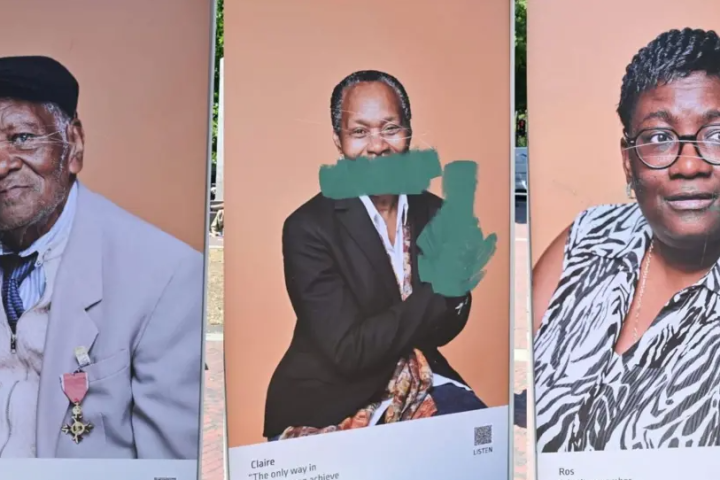
Windrush Exhibition Moved to Home Office Following Vandalism in Brixton

A Windrush exhibition celebrating the lives of Caribbean migrants to the UK, which was vandalised while on display in south London, is now being shown at the Home Office.

The public art installation in Brixton’s Windrush Square was defaced on 3 July, an act described as “distressing” by local community groups. The exhibition was created to recognise the history, contributions, and legacy of the Windrush generation in Britain.

Mike Tapp, Minister for Migration and Citizenship, said bringing the exhibition to the Home Office was a way to “own the mistake.” He added: “Displaying this here, at the Home Office, where the Windrush scandal began and where errors were made, carries real significance.”

He reflected on the impact of meeting those featured in the exhibition, saying: “Hearing their stories will stay with me forever. These are remarkable people who, in my view, showed extraordinary courage. Turning anger into something so positive is a lesson we can all take, not just in the UK, but globally. You have to own mistakes to fix them, and only then can justice be delivered.”

The Windrush Untold Stories exhibition includes 20 portraits alongside first-hand accounts of people who arrived from the Caribbean between the late 1940s and 1970s.

Exhibition photographer Amit Lennon described the relocation of the portraits to the Home Office as “an incredible turnaround.” He wrote on social media: “The last time I was in that building was to photograph Theresa May as home secretary, when she had initiated the ‘hostile environment’ policy that caused so many injustices for Windrush migrants. Many compensation claims are still unresolved, but credit to the current ministers for highlighting these stories in the heart of government.”

Friends of Windrush Square condemned the vandalism, calling it “not only an attack on public art but a blatant act of racial hatred aimed at a community that has contributed so much to the life and spirit of the UK.”

The Metropolitan Police arrested a man in connection with the incident on suspicion of vandalism, racially aggravated criminal damage, and possessing articles with intent to destroy or damage property. He has been released on bail while further inquiries continue.

Police have stated that they do not believe the defacement was racially motivated, and the BBC understands that mental health issues may have been a factor in the incident.

The exhibition’s relocation to the Home Office symbolises a shift in how the UK government engages with the legacy of the Windrush scandal, offering a space to acknowledge past errors while celebrating the resilience and achievements of the Windrush generation.

This move has been welcomed by campaigners, who hope that displaying the portraits and personal stories within a government setting will provide recognition, respect, and a reminder of the lessons learned from one of the UK’s most significant immigration injustices.

Skip to content Skip to content