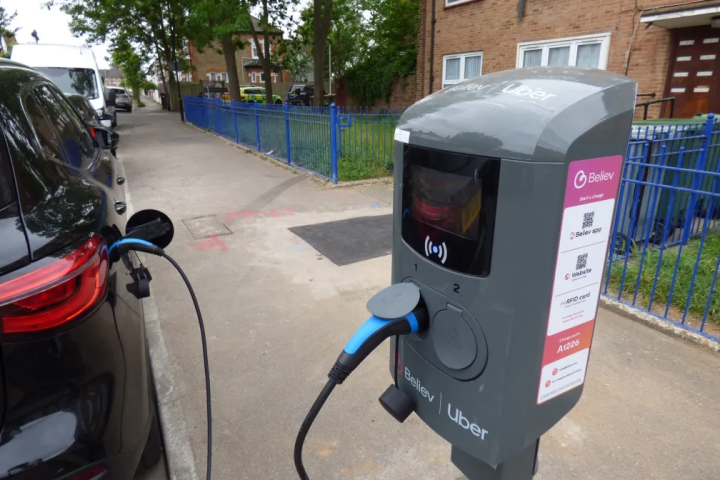
London’s progress toward building a comprehensive electric vehicle (EV) charging network is under renewed scrutiny, as updated government figures show the city has installed just over 26,600 public charge points—around 70% of the target set by the Mayor for 2030.
According to the latest Department for Transport (DfT) data, 4,749 new public chargers were added to London’s network since October 2024, bringing the total to 26,668. Mayor Sadiq Khan’s manifesto commitment aims for 40,000 charge points by 2030, meaning the city still needs to install more than 13,000 units in the next five years.
The rollout has made significant progress since 2015, when electric vehicles represented just 0.2% of the capital’s fleet. That figure has now reached 6.8%, according to Transport for London (TfL). Yet critics argue that the pace of infrastructure development risks falling short of the rapid increase in EV ownership.
Hina Bokhari, leader of the Liberal Democrat group on the London Assembly, said London’s rollout “needs to work much faster” to meet the Mayor’s 2030 goal. “While the mayor drags his feet, Londoners who are clearly itching to make the switch don’t have the confidence they’ll be able to charge swiftly and easily,” she said.
Bokhari added that London’s high rate of EV adoption compared to the rest of the UK makes the need for robust charging infrastructure particularly urgent. “With ten years for all new cars to be EVs, we need the charging network in place now. Build it and they will come,” she said.
A spokesperson for the Mayor defended the progress, stating: “The number of EV charge points across London is steadily climbing, and the Mayor will continue supporting delivery partners to meet his target of 40,000 by 2030. Sadiq is committed to delivering the infrastructure needed to support the green transition, working together to build a greener and better London for all.”
During a Budget and Performance Committee hearing in September, senior City Hall officials reiterated that the target remained achievable.
Across the UK, over 15,000 new charging devices were installed in the past year—a 23% national increase. Minister for Decarbonisation Keir Mather said the figures reflected growing confidence in the UK’s electric transition. “There’s never been a better time to go electric,” he said. “We’re helping drivers save with discounts of up to £3,750 on new electric cars — all part of our Plan for Change.”
Vicky Read, Chief Executive of ChargeUK, noted that the industry is investing “billions of pounds in high-quality charging,” emphasising that the majority of drivers rely on public networks. “We need the right mix of affordable, accessible charging at home, work, and en route to ensure everyone can make the switch,” she said.
Concerns have been raised that the end of current incentives—such as exemption from the London Congestion Charge—could slow the rate of EV adoption in future years. Meanwhile, the capital faces the logistical challenge of integrating charging points into dense residential areas, where on-street charging infrastructure is crucial.
Despite steady progress, London’s success in meeting its 2030 target may depend on sustained investment, faster planning approvals, and continued collaboration between public and private partners.