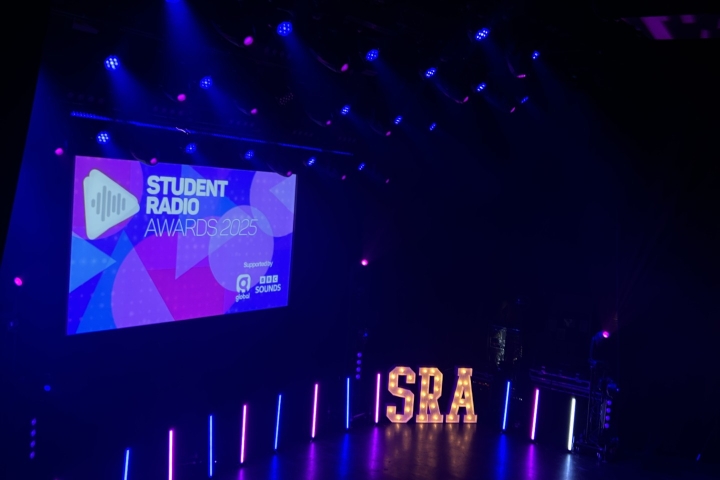
Thirty years on, the Student Radio Awards have grown from a niche celebration into one of the most important nights in British broadcasting. The scale may have changed, but the spirit remains the same: a room full of young people with more ideas than sleep, gathering to celebrate what happens when creativity, caffeine, and courage meet a microphone.
Many of the biggest names in radio today once stood exactly where this year’s nominees did — nervous, hopeful, and holding a demo reel that felt like a ticket to somewhere bigger. The Student Radio Association has spent three decades giving young broadcasters that chance. Every year, professionals from across the industry turn up not only to hand out trophies, but to scout the next generation of voices that will shape the sound of the nation.
This year’s awards were hosted by Greg James and Jordan North, two presenters whose careers began on the other side of the stage lights. James first made his mark with Livewire at the University of East Anglia, and it was at the 2005 Student Radio Awards that he won Best Male Presenter — an accolade that directly led to his first job at BBC Radio 1. North’s story followed a similar path, starting out with Spark, where his mix of warmth and wit first took shape. Both have been open in describing student radio as the “unofficial apprenticeship” that launches so many into professional broadcasting.
It is also proof, if any were still needed, that radio is very much alive. As James himself put it, people have been predicting its death for twenty years, and yet it keeps finding new ways to reinvent itself. The Student Radio Awards stand as a yearly reminder that the medium’s future is not fading, but flourishing.
Among this year’s winners, there was no shortage of imagination or technical bravery. The Diversity, Equality, and Inclusion Award went to RAW, who credited their entire station for celebrating cultural events and weaving heritage into everyday programming. It was a moment that summed up what student radio does best: reflecting the real, varied lives of its listeners.
The Best Multiplatform Initiative award went to Fuse FM for their Alive! Festival: Enchanted Forest project — an idea that, in their own words, “got out of hand in the best possible way.” The team described the award as something that belonged to everyone at the station, calling themselves lucky to be part of such a creative and slightly chaotic community.
Over at Nerve Radio, the team behind Summer Ball won Best Event Programming after deciding to break from pre-recorded coverage and take their broadcast live from the field. That decision meant solving some highly practical problems — such as how to get ethernet and power into a tent — but the result was a thirteen-hour live transmission of the student union’s biggest festival. They credited their student union for making it possible and seemed to take just as much pride in the engineering as in the airtime.
Finally, University Radio York took home Best Technical Achievement for their New Show Scheduler: Barad Dur. The judges described it as a “brilliant achievement” that rivals what many professional stations can offer. The team themselves were quick to laugh at the strange and often chaotic nature of student radio technology, calling it a “Frankenstein’s workshop” built on years of inherited fixes and creative problem-solving. They spoke with genuine pride about how every generation builds on the last, each one leaving something slightly better — and slightly weirder — for those who follow.
That mix of chaos and collaboration might be the real secret of student radio. It is never perfect, but it is endlessly inventive. It teaches young broadcasters not just how to present a show, but how to solve problems, manage teams, and keep calm when a cable fails fifteen seconds before air. In other words, it teaches the art of broadcasting itself.
Thirty years in, the Student Radio Awards are no longer just a showcase for student talent. They are a snapshot of the future of radio. In the voices on those airwaves, in the makeshift studios and improvised solutions, you can already hear the sound of what comes next.