Long before borders, boats and written history, people were already moving animals across the islands of Southeast Asia. New research shows pigs were among the most successful travellers.
A genomic study published yesterday in the journal Science reveals how thousands of years of human migration carried pigs across Indonesia and deep into the Pacific –quietly reshaping ecosystems along the way.
The international research team, led by Professor Laurent Frantz of Queen Mary University of London and Ludwig Maximilians University of Munich, analysed DNA from more than 700 pigs, both modern and archaeological. The results trace a detailed map of how people transported animals across islands once thought to be biologically isolated.
Breaking the Wallace Line
For more than a century, the Wallace Line has marked one of the world’s sharpest natural boundaries, separating Asian wildlife from Australasian species. Leopards and monkeys dominate one side: marsupials and cassowaries the other.
Pigs don’t follow the rules.
They appear on both sides of the divide, stretching from Southeast Asia to Polynesia. Genomic evidence now shows why: people carried them.
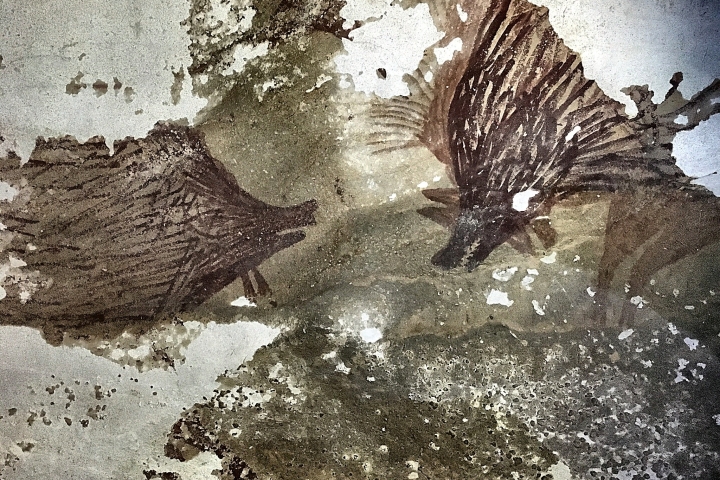
The earliest traces point to Sulawesi, where humans may have been moving warty pigs as far back as 50,000 years ago – possibly to establish hunting populations. These early communities are also responsible for some of the world’s oldest cave paintings, many of which depict pigs.
From farming to feral
Around 4,000 years ago, pig movement accelerated as farming societies expanded out of Taiwan. Domestic pigs travelled through the Philippines and Indonesia, into Papua New Guinea and onwards to Vanuatu and remote Polynesia.
Later still, European colonialism added new pig lineages to the region.
Many animals escaped, forming feral populations that interbred with earlier arrivals. On the Komodo Islands, hybrid pigs – descended from animals introduced thousands of years apart – are now a crucial food source for the endangered Komodo dragon.
A conservation dilemma
Today, pigs occupy very different roles across the Pacific: sacred animals in some cultures, destructive pests in others, and in some ecosystems so embedded they are hard to classify as invasive at all.
That complexity poses difficult questions for conservation.
Professor Laurent Frantz said:
“It is very exciting that we can use ancient DNA from pigs to peel back layers of human activity across this megabiodiverse region. The big question now is, at what point do we consider something native? What if people introduced species tens of thousands of years age, are these worth conservation efforts?”
Dr David Stanton added:
“This research reveals what happens when people transport animals enormous distances, across one of the world’s most fundamental natural boundaries.”
Professor Greger Larson said:
“When people have landed a hand, pigs were all too willing to spread out on newly colonised islands in South East Asia and into the Pacific.”
Human history, written in DNA
The study, involving more than 50 researchers from institutions across Europe, Southeast Asia and the Pacific, highlights how deeply human movement is written into the natural world.
Long before global trade, people were already shaping ecosystems – one pig, one island, one journey at a time.