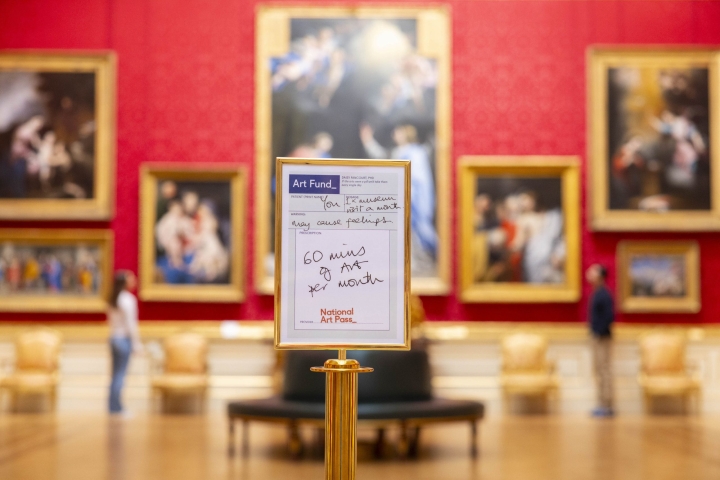
Regularly engaging with art at museums and galleries could have a significant impact on public health according to Daisy Fancourt, Professor of Psychobiology and Epidemiology at University College London. In partnership with Art Fund, the national charity for museums and galleries who run the National Art Pass, Professor Fancourt is calling for a Recommended Dose of Art (RDA) – at least 60-minutes with art in a museum or gallery every month – to improve physical and mental wellbeing.
The RDA is the headline proposal of a new report commissioned by Art Fund in partnership with Professor Fancourt, The Recommended Dose of Art: A Prescription for Health and Wellbeing. The report brings together evidence of the wide-ranging benefits of engaging with art, from reducing stress hormones such as cortisol to lowering the risk of developing dementia and helping adults remain physiologically younger.
Yet new research commissioned by Art Fund and carried out among 2,000 UK adults reveals nine in 10 (89%) people currently miss out on the recommended intake, equivalent to an estimated 49.5 million adults. It also revealed a huge knowledge gap when it comes to the benefits of consuming art as just 17% considered supporting mental wellbeing to be a benefit of visiting museums and galleries, falling to 7% understanding it as a benefit to physical health.
The report cites evidence showing that engaging with art is deeply linked to our mental and physical wellbeing at every level, from the workings of our cells and molecules to cognition, memory and mood.
Regular visits to museums and galleries could nearly halve the risk of developing depression over the following 10 years. Research is also positive for the impact on loneliness, as older adults who go to museums, galleries or concerts have 32% lower odds of reporting loneliness 10 years later, compared to those who aren’t so culturally active.
Viewing original artworks in a gallery can have a much greater effect on our wellbeing than looking at reproductions, as in-person viewing can lead to around a 22% greater reduction in the stress hormone cortisol compared with viewing reproductions of art.
Findings also show that health span, the time that people are functionally fit and free from illness, may also be extended by engaging with art. By keeping people active and engaged, studies indicate that by the age of 80, adults who never engaged in the arts are 1.3 times more likely to be frail. And the combined mental, cognitive, and physical benefits of cultural engagement may even bring benefits for longevity, as studies have shown that culturally-engaged people have a 31% lower risk of dying at any point over the next 14 years (not withstanding other variables like wealth, health, demographics and disabilities).
The Recommended Dose of Art: A Prescription for Health and Wellbeing (2026) was commissioned by Art Fund, which champions art as vital for a healthy society and gives access to hundreds of museums and galleries across the UK through the National Art Pass.
To make it easier to build regular visits into everyday life and help the nation get their RDA, Art Fund’s National Art Pass offers free or discounted entry to hundreds of museums, galleries and exhibitions across the UK through an annual membership, as well as 50% off major exhibitions. Participating venues include the Wallace Collection (50% off exhibitions), V&A (50% off exhibitions), Beamish (50% off entry), Brighton Museum & Art Gallery (Free entry), Cardiff Castle (free entry), Dovecot Studios (50% off exhibitions), Chatsworth (50% off entry), Tate (50% off exhibitions), Tredegar House (free entry), Yorkshire Sculpture Park (free entry) alongside many more.
National Art Pass members support the work of Art Fund, the national charity for museums and galleries, in championing and supporting museums across the UK. The National Art Pass is available from £62.50 or £39.50 for under 30s, from https://www.artfund.org/national-art-pass.
Professor Daisy Fancourt, Professor of Psychobiology and Epidemiology at University College London, said:“Regular engagement and meaningful encounters with art are now recognised as an important contributor to our health and wellbeing, and the evidence suggests they should be viewed as health-promoting behaviours, alongside having a balanced diet, regular exercise and spending time outdoors. Guidelines like eating our 5-a-day of fruit and vegetables and getting our 10,000 steps have proven effective in helping us to prioritise other health-promoting behaviours in our busy lives. Adding regular arts engagement to this list could be a simple and joyful way of investing further in our health and wellbeing.”
Jenny Waldman, Director of Art Fund, said: “We often think of museums and galleries as places to visit as an occasional treat, but evidence shows they are untapped resources that can be enjoyed as part of a healthy lifestyle. With hundreds of museums across the UK offering free entry to their collections, everyone can get their Recommended Dose of Art without spending a penny. And the National Art Pass provides free and discounted entry to hundreds more museums, making regular visits and special exhibitions more affordable.”
Dr Xavier Bray, Director of The Wallace Collection, said: “An art gallery is like a sanctuary – a place where one can leave behind the worries of life, let oneself enter different worlds, and allow the imagination to take over. We see this first-hand at the Wallace Collection in the way visitors pause, look and engage with our collection. Gazing at Fragonard’s ‘The Swing’, coming face to face with Frans Hal’s ‘The Laughing Cavalier’, marvelling at Rubens’ ‘The Rainbow Landscape’… museums such as ours have become havens in a sea of digital saturation, sparking curiosity and surprise, encouraging common ground and shared experience, and allowing for genuine reflection and unhurried time.
We are delighted to host the launch of the ‘Recommended Dose of Art’ and hope it inspires more people to discover their own private haven in a museum or gallery, and to make visiting part of their regular lives.”