
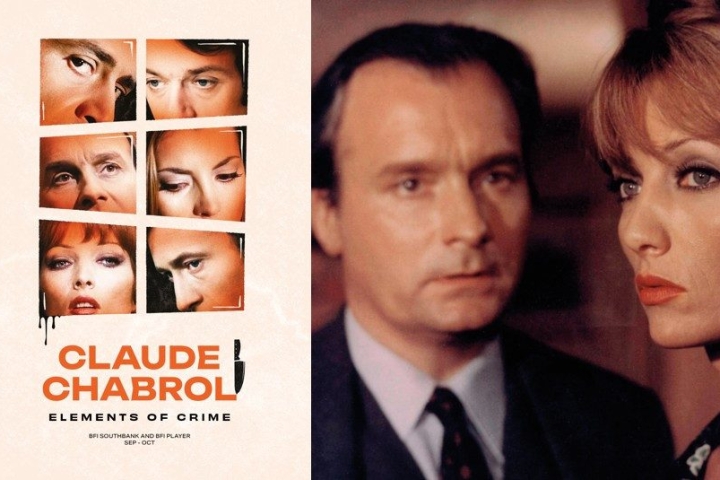
Often considered one of the French New Wave’s most neglected filmmakers, BFI Southbank season curator Catherine Wheatley argues that Claude Chabrol might also the be most important. This autumn BFI celebrates Claude Chabrol’s cool, precise, entertaining and deliciously wicked thrillers with a BFI Southbank season, Claude Chabrol – Elements of Crime running from 1 September – 6 October, including the BFI Distribution rerelease of La Femme infidèle (1969) returning to cinemas in the UK and Ireland on 11 September. The first of Chabrol’s great run of bourgeois psychological thrillers, La Femme infidèle is one of three of the director’s films that BFI Distribution has acquired. Le Boucher (1970) and Les Biches (1968) will also be available for cinemas to book to complement the season and La Femme infidèle’s release. A curated Chabrol BFI Player online collection will also be available for audiences UK-wide, spanning a selection of 10 films from across his prolific career.
Over a career spanning some 50 years and 80-odd films season curator Catherine Wheatley argues that ‘few directors have mapped the darkness beneath respectable surfaces with quite the wit, precision and relentless productivity of Claude Chabrol’, successfully creating one wicked thriller after another. The season highlights 20 titles, from his daring 1958 debut, Le Beau Serge to 2007’s The Girl Cut in Two, shining a light on some of Chabrol’s darkest and most compelling films.
Dubbed the ‘French Hitchcock’, Wheatley adds that ‘beneath the elegantly composed surfaces of Claude Chabrol’s bourgeois thrillers lies something altogether more poisonous: a cinema of corrosive irony, wicked wit and simmering violence.’ His work skewers the French bourgeoisie, exposing a ‘seam of malice’ that runs through French society. Chabrol’s masterful films share affinities with acclaimed thriller writers including Georges Simenon, Patricia Highsmith and Ruth Rendell, each of whose work he has adapted. Chabrol has also been recognised as a kindred spirit to the most recent generation of Korean filmmakers with Bong Joon Ho and Park Chan-wook both citing him as a key influence on their work, with what Wheatley describes as Chabrol’s ‘peculiar cocktail of the mundane and murderous, the ordinary and the obscene.’
A number of films in the season are screening on 35mm. Often cited as the first French New Wave film Chabrol’s first feature, Le Beau Serge (1958), announced Chabrol’s preoccupation with the darker side of human nature. Shot on location in his mother’s hometown, the film uncovers violence and despair in the ordinary everydayness of provincial life. The Hatter’s Ghost (1982), Chabrol’s underrated and often overlooked adaptation of Georges Simenon’s novel stars French screen legends Michel Serrault and Charles Aznavour as two men playing a murderous game of cat and mouse. The Cry of the Owl (1987) is a thrilling adaptation of Patricia Highsmith’s novel, where the boundaries between victim and perpetrator blur when the object of a man’s voyeuristic gaze looks back. Chabrol is arguably at his most Hitchcockian here in this homage to Rear Window. The Bridesmaid (2004), is a heady tale of amour fatale, adapted from Ruth Rendell and starring Benoît Magimel and Laura Smet as a shy, somewhat passive young man who meets a woman at his sister’s wedding, falling hopelessly into an all-consuming affair.
Rereleased by BFI Distribution in cinemas in the UK and Ireland on 11 September, La Femme infidèle (1969), starring Stéphane Audran and Michel Bouquet, traces the fallout following a husband’s discovery of his wife’s affair and his quiet, unnerving devastating act of revenge. It has recently been remade as Minotaur by Russian auteur Andrey Zvyagintsev.
Other titles in the season include À double tour (1959), Chabrol’s second feature, a lurid and transgressive adaptation of Stanley Ellin’s novel, starring Jean-Paul Belmondo which prefigures the look and feel of later Hitchcockian thrillers. The Third Lover (1962) is a precise study in voyeurism and manipulation that anticipates the claustrophobic domestic dramas that would define Chabrol’s greatest period to come. Les Biches (1968), a gender-swapping riff on The Talented Mr Ripley is a polarising work, loved and loathed by queer audiences, with a story that mines the seduction of privilege and marks the beginning of Chabrol’s creative and personal partnership with Stéphane Audran.
Cited by Bong Joon Ho as a key influence on his Oscar®-winning Parasite, Que la bête meure (1969), is a thriller that keeps pulling the moral rug from beneath its audiences’ feet. The film follows a father whose son has been killed by a hit-and-run driver and who sets out to identify and murder the culprit before running into complications. As a series of murders unsettle a local village, a schoolteacher and a butcher (a remarkable performance by Jean Yanne) strike up a tender, tentative friendship in Le Boucher (1970), Chabrol’s masterpiece. Frequently compared to Park Chan-wook’s Decision to Leave, La Rupture (1970) finds Chabrol working in a more overtly melodramatic mode and all the more disturbing and unhinged for it, in a film about the institutions that fail women and the men who exploit them.
In Chabrol’s most pitiless examination of bourgeois self-preservation, Juste avant la nuit (1971), a man accidentally kills his mistress and returns to his ordinary life, waiting, with mounting dread, to be found out. But nobody seems to be looking. Ten Days’ Wonder (1971), Chabrol’s adaptation of Ellery Queen’s novel, is a glorious, deranged melodrama of Greek tragedy proportions, featuring Orson Welles and Anthony Perkins as a toxic father and son. Inspired by a real sensational crime story in a newspaper, Wedding in Blood (1973) stars Stéphane Audran and Michel Piccoli as two married lovers who plot to murder their respective spouses.
The first of seven collaborations with Isabelle Hupert, Violette Nozière (1978) is a nonjudgmental portrait of a fascinating anti-heroine, with Chabrol less interested in motive than in the social conditions that produce criminal acts. Story of Women (1988) features one of Hupert’s finest performances as a working-class woman performing abortions under the German occupation, inspired by the true story of Marie-Louise Giraud, one of the last women to be executed in France. Adapted from Ruth Rendell, La Cérémonie (1995) starring regulars Huppert and Sandrine Bonnaire, is considered Chabrol’s late masterpiece: a film in which class resentment simmers and builds to an inevitable and shocking act of violence when a wealthy family’s new housekeeper and volatile local postmistress form an unlikely alliance.
The Colour of Lies (1999) captures the poisonous social atmosphere: the rumour, the prejudice and the quiet savagery of village life that is unleashed after a violent crime, turning the community on itself. Chabrol’s daughter and collaborator Cécile Maistre-Chabrol will introduce two of her father’s films, The Swindle (1997), on 2 October, starring Isabelle Huppert as one of a pair of con artists grifting their way along the Swiss-French border, until a mark with his own agenda complicates the arrangement as well as his penultimate feature, The Girl Cut in Two (2007), on 6 October. The film follows a naïve television weather forecaster who finds herself an object of possession torn between two men, a gnarled novelist and a capricious young heir, with fatal consequences.
Catherine Wheatley delivers the season introduction on 1 September with an illustrated exploration of Chabrol’s cinema, peeking beneath his elegant surfaces to reveal the rot lurking beneath. Considering his most acclaimed titles alongside lesser-known gems.
Other events include Philosophical Screens: Le Boucher on 9 September, with film philosophers Lucy Bolton, Ben Tyrer and season curator Catherine Wheatley taking a close-up look at Chabrol’s masterpiece that cuts to the heart of the themes which shaped the filmmaker’s entire body of work on the nature of violence.
Few directors have understood women as complex, dangerous agents of their own destiny quite like Claude Chabrol. Mean Girls: Claude Chabrol’s dangerous women panel on 23 September brings together experts, including filmmaker Prano Bailey-Bond (Censor), film scholar Virginie Sélavy and season curator Catherine Wheatley, to examine the extraordinary actresses such as Stéphane Audran, Isabelle Huppert and Sandrine Bonnaire at the heart of Chabrol’s work who have embodied these characters.
10 classic Chabrol titles will also be available UK-wide on BFI Player with Que la bête meure (1969), Le Boucher (1970), Cop au Vin (1985), Inspector Lavardin (1986), Betty (1992), L’Enfer (1994), The Swindle (1997), The Colour of Lies (1999) and Merci Pour Le Chocolat (2000) all available online from 7 September and La Femme infidèle (1969) from 2 October.
The BFI will also be releasing a selection of Claude Chabrol’s films on Blu-ray in 2027.
Tickets for Claude Chabrol – Elements of Crime go on sale to Patrons 3 August, Members 4 August and General Sale 6 August.