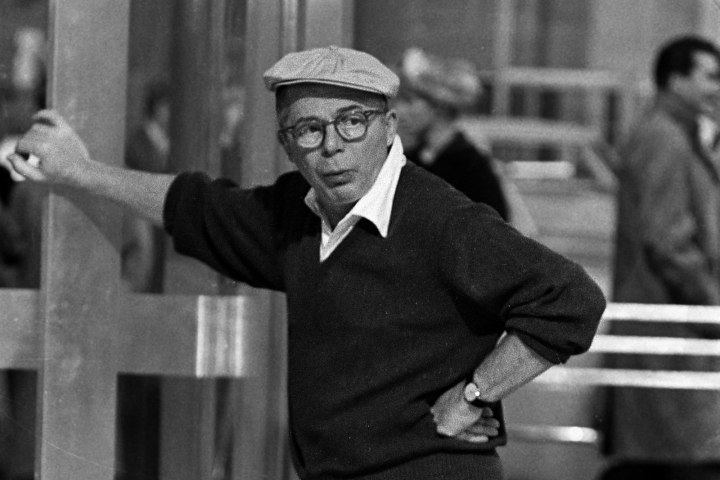
The BFI today announces programme details for a major two-month season celebrating the extraordinary career and legendary wit of one of the finest émigré directors to dominate the studio system, Billy Wilder.
Curated by the BFI’s Ruby McGuigan, ALMOST PERFECT: THE FILMS OF BILLY WILDER will run at BFI Southbank from 19 October – 31 December, and will feature more than 30 films, from smash hits like SOME LIKE IT HOT (1959), SUNSET BOULEVARD (1950) and THE APARTMENT (1960) to collaborations with other greats of the era such as BLUEBEARD’S EIGHTH WIFE (Ernst Lubitsch, 1938), BALL OF FIRE (Howard Hawks, 1941) and PEOPLE ON SUNDAY (Robert Siodmak, Edgar G. Ulmer, 1930).

The season will be programmed across four key themes: Billy Liar, where fake identities, half-truths and bald deception enable Wilder’s characters to bamboozle the system into submission; Class Warfare, exploring the characters who are constantly manoeuvring across class divides; A Crisis of Masculinity, full of anti-heroes that offer us a variety of sympathetic lenses through which to examine modern patriarchy, none of them rose-tinted; and In Pursuit of Fame and Fortune, which delves into the murky waters of Hollywood, media manipulation and the pitfalls of ambition.
Growing up in Vienna, Billy Wilder (1906 – 2002) was obsessed with American culture. From Hollywood icons to obscure jazz records, he absorbed the brash language, brazen consumerism and unfailing belief that with a lot of hard work and a little luck, anyone might be someone. But as every great storyteller understands, there is always a cost. He arrived in Hollywood through the network of Jewish creatives fleeing Nazism. Despite writing in a second language, his trademark zingers and complex characters quickly propelled him through the studio system’s ranks. But the ghost of Europe lying in rubble lingered, emerging in stories of culture clash, satirical takes on American capitalism and dissections of masculinity in the wake of war.
Wilder’s screenplays are crafted with audacity and care. His characters lie to their loved ones, itch with dissatisfaction and rail against the trappings of modernity. His words lend caustic humour to the bleakest of set-ups, diffuse tension with incisive bite and convey misery and ecstasy on a knife’s edge. Never one to shy away from a taboo or sugarcoat a feeling, he captured the American imagination by exposing its flaws, as only a true fan can. Wilder always denied the ‘cynic’ label; he pointed to the hope threaded throughout these tales of human fallibility. There is redemption in love, pride in the pursuit of justice, and forgiveness always just within reach. After all, Hollywood loves a happy ending.
There will be several contextual events taking place as part of the season, beginning with Billy Wilder: America’s Witness on 4 November. This event will act as an introduction to the season, with season curator Ruby McGuigan, film writer Christina Newland and author of Mr Wilder & Me, novelist Jonathan Coe delving into the writer-director’s affinity for Hollywood and the critical lens he cast upon it. For audiences aged 25 and Under there will also be An Introduction to Billy Wilder on 9 November; the event, which is part of BFI Southbank’s ongoing £4 ticket offer to audiences aged 16-25, will map Billy Wilder’s silver-screen-worthy life from Vienna to Hollywood and back again, spotlighting his stylistic trademarks and celebrating his most beloved characters.
Billy Wilder identified as a writer first and claimed 80 percent of a picture lay on the page. On 25 November, we invite both casual fans and aspiring screenwriters to flex their own writing muscles at a social event Thou Shalt Not Bore: How to Write Like Billy Wilder. Following Wilder’s writing tips, we’ll host playful exercises building character back stories, narrative arcs and comedic dialogue over cocktails and a jazzy soundtrack. On 27 October we’ll take a look at Billy in Berlin with a screening of THE MAN IN SEARCH OF HIS MURDERER (Robert Siodmak, 1931), a rarely seen Wilder-penned noir made by Robert Siodmak; following the screening will be a talk by Dr. Jon Hughes, Royal Holloway University, which will focus on a generation of émigrés who went on to transform Hollywood.
Ruby McGuigan, BFI Programme Development Manager and Almost Perfect: The Films of Billy Wilder season curator said, “In many ways, Billy Wilder is the definition of the American Dream. A refugee-turned-Hollywood titan; a plucky teenager who scammed, charmed and bulldozed his way to a life of wealth and critical acclaim. A legendary raconteur – both on the page and propping up a Beverly Hills bar – Wilder’s talent for exaggeration and imagination lit up the screen, with his work being immortalised by Hollywood icons such as Marilyn Monroe, Jack Lemmon, Audrey Hepburn, Gary Cooper, Barbara Stanwyck and many more. Wilder leaves behind an incredible cinematic legacy, and we’re thrilled that audiences will be able to experience these timeless films as they were meant to be seen, on the big screen and alongside fellow cinemagoers this autumn.”

ALMOST PERFECT: THE FILMS OF BILLY WILDER – FILMS SCREENING IN THE SEASON, ARRANGED BY THEME:
BILLY LIAR
In an image obsessed world, self-preservation requires a degree of performance. Fake identities, half-truths and bald deception enable Wilder’s characters to bamboozle the system into submission.
HOLD BACK THE DAWN (Mitchell Leisen, 1941)
The unhappy partnership of Billy Wilder and Mitchell Leisen gifted us gems against all odds, including this heart wrenching romance.
THE MAJOR AND THE MINOR (Billy Wilder, 1942)
Ginger Rogers finds herself trapped in disguise as a twelve-year old in this deliciously absurd comedy.
FIVE GRAVES TO CAIRO (Billy Wilder, 1943)
A destitute soldier hiding in plain sight is forced to improvise when he is mistaken for a German spy.
A FOREIGN AFFAIR (Billy Wilder, 1948)
Jean Arthur is a fish out of water in post-war Berlin, a world of crumbling nightclubs, illicit affairs and corruption.
SOME LIKE IT HOT (Billy Wilder, 1959)
Escaping the mob in drag, two men join a travelling jazz troupe and fall under the spell of Marilyn Monroe.
THE FORTUNE COOKIE (Billy Wilder, 1966)
A high-profile accident serves up a golden ticket to riches and sympathy for a reluctant cameraman.
THE PRIVATE LIFE OF SHERLOCK HOLMES (Billy Wilder, 1970)
Wilder’s fresh perspective on our most famous detective led to interference and backlash, but left us with a beautifully humane mystery.
WITNESS FOR THE PROSECUTION (Billy Wilder, 1957)
With killer performances and more twists than a telenovela, Wilder’s Agatha Christie adaptation is a rollercoaster.
STALAG 17 (Billy Wilder, 1952)
A WWII prisoner of war camp is beset by paranoia knowing a rat lies in their midst.
LOVE IN THE AFTERNOON (Billy Wilder, 1957)
Audrey Hepburn takes on a new persona to impress a worldly man with a bad reputation.
CLASS WARFARE
Whether escaping the rat race or shackled to it, Wilder’s characters are constantly manoeuvring across class divides. Stories exploring culture clash, capitalism and the lives of ‘ordinary’ people in the shadows of wealth.
PEOPLE ON SUNDAY (Robert Siodmak, Edgar G. Ulmer, 1930)
Spotlighting ordinary people escaping their hum drum lives, this silent classic launched multiple significant careers.
MAUVAISE GRAINE BAD SEED (Billy Wilder, 1934)
Wilder’s debut showcases his recurring themes, through the eyes of a rich kid turned car thief.
BLUEBEARD’S EIGHTH WIFE (Ernst Lubitsch, 1938)
A husband’s chequered past sparks this screwball story of marital retribution, packed with brilliance and bite.
MIDNIGHT (Mitchell Leisen, 1939)
A showgirl faking wealth and status is drawn into a plot to break up a relationship, and she looks fabulous doing it.
BALL OF FIRE (Howard Hawks, 1941)
Barbara Stanwyck teaches Gary Cooper a thing or two about slang, and life in general, in this sparkling comedy.
SABRINA (Billy Wilder, 1954)
Falling in love with Audrey Hepburn is easy, even for society boys well above her class bracket.
AVANTI! (Billy Wilder, 1972)
An untimely death finds an All-American-Businessman dragged to Italy, where priorities are noticeably different.
NINOTCHKA (Ernst Lubitsch, 1939)
A devoted servant to the Russian people, Ninotchka is a fish out of water in hedonistic Paris.
THE EMPEROR WALTZ (Billy Wilder, 1948)
Wilder’s musical outing finds him returning to his native Austria, Bing Crosby and Joan Fontaine in tow.
A CRISIS OF MASCULINITY
Wilder’s anti-heroes offer us a variety of sympathetic lenses through which to examine modern patriarchy, none of them rose-tinted. Obsession, jealousy and insecurity run riot in the face of corporate and domestic expectation.
DOUBLE INDEMNITY (Billy Wilder, 1944)
Wilder’s breakout film features an indomitable Barbara Stanwyck and plenty of moral turpitude.
IRMA LA DOUCE (Billy Wilder, 1963)
Jack Lemmon and Shirley MacLaine reunite in this comedy built on infatuation, insecurity, satire and a sprinkling of sugar.
KISS ME, STUPID (Billy Wilder, 1964)
An aspiring songwriter constructs a deranged ruse to hide his wife from a successful lounge singer while vying for his attention.
THE LOST WEEKEND (Billy Wilder, 1945)
A man unravels over the course of a few days, in this hallucinatory journey that drew controversy and acclaim.
THE APARTMENT (Billy Wilder, 1960)
Everyman C.C. Baxter finds love from beneath the heel of his corporate overlords.
THE SEVEN YEAR ITCH (Billy Wilder, 1955)
Marilyn Monroe’s comedic charms guild this absurdist comedy about a man left alone with his imagination.
BUDDY BUDDY (Billy Wilder, 1981)
A jaded hitman finds himself shackled to a depressed divorcee in Wilder’s final film.
IN PURSUIT OF FAME AND FORTUNE
Nobody loves Hollywood like Hollywood, and nobody knew Hollywood like Wilder. Delving into the murky waters of media manipulation, a ravenous public and the pitfalls of ambition, these films celebrate and denigrate the drive for success.
SUNSET BOULEVARD (Billy Wilder, 1950)
An ageing star finds her isolated world exposed in a biting satire that ruffled the feathers of Hollywood’s elite.
ACE IN THE HOLE (Billy Wilder, 1951)
A journalist commits to never letting the truth, or morality, get in the way of a good story.
THE SPIRIT OF ST. LOUIS (Billy Wilder, 1957)
Wilder’s take on the biopic offers an optimistic insight into a driven aviator determined to fly the Atlantic solo.
FEDORA (Billy Wilder, 1978)
A prescient takedown of celebrity commodification, Wilder revisits the plot of an ageing star turned recluse.
ARISE, MY LOVE (Mitchell Leisen, 1940)
A pilot facing execution is rescued and sent on the run with the plucky journalist who saved him.
ONE, TWO, THREE (Billy Wilder, 1961)
A Coca-Cola salesman finds himself in hot water when his All-American charge marries a Communist.
THE FRONT PAGE (Billy Wilder, 1974)
A journalist desperate for the quiet life is pulled in for one last scoop.