The much-anticipated 27th European Athletics Championships commenced in spectacular fashion on Monday evening, marking the very first time a British city has staged the continent’s premier standalone track and field event. Welcoming over 1,600 elite athletes from 49 nations, the newly redeveloped Alexander Stadium provided a thrilling backdrop for an opening day that delivered on every conceivable front. From a stunning home-soil victory in the women’s 100-metre sprint to a masterful, historic comeback by middle-distance royalty, Monday’s inaugural session set an incredibly high bar for the week of competition ahead.
As the dusk settled over the Midlands, the capacity crowd was treated to five highly compelling medal finals. The evening was defined by displays of supreme dominance in the field events and breathless tactical warfare on the track. With the championships running through to Sunday, 16 August, Birmingham has already established itself as a fitting theatre for European athletics history.
Ingebrigtsen’s Masterclass: A Sensational Comeback
Perhaps the most highly scrutinised narrative heading into these championships was the fitness of Norwegian phenomenon Jakob Ingebrigtsen. Stepping onto the track for the first time in 324 days following major Achilles tendon surgery, questions lingered regarding his ability to immediately rediscover his formidable championship pedigree. His last competitive appearance in anger was a disappointing 10th-place finish in the 10,000 metres at last year’s World Championships in Tokyo, leaving the 25-year-old with a significant point to prove.
In the men’s 5000m final, Ingebrigtsen unequivocally answered his critics, delivering a true masterclass in measured, middle-distance running. Content to sit patiently within the pack during the early stages, the Norwegian bided his time before unleashing a devastating, trademark surge in the final lap. He crossed the line in 13 minutes 15.29 seconds to secure his record-extending seventh European championship gold medal.
Germany’s Florian Bremm pushed valiantly during the final bend but was forced to settle for silver with a time of 13:15.60, while France’s Etienne Daguinos secured the bronze in 13:16.09. However, the race firmly belonged to the returning Norwegian.
“Coming from the lowest of lows to be European champion again means the world to me. Not even I believed it could happen coming here,” Ingebrigtsen candidly admitted to reporters post-race. “I doubted myself every day coming into this and every minute leading up to the last lap today, but I’m always hoping to do my best. I am starting to feel more like myself.” His victory ensures his unbeaten streak at the European Championships, which began as a fresh-faced teenager in Berlin back in 2018, remains perfectly intact.
Home Delight: Amy Hunt Snatches 100m Crown
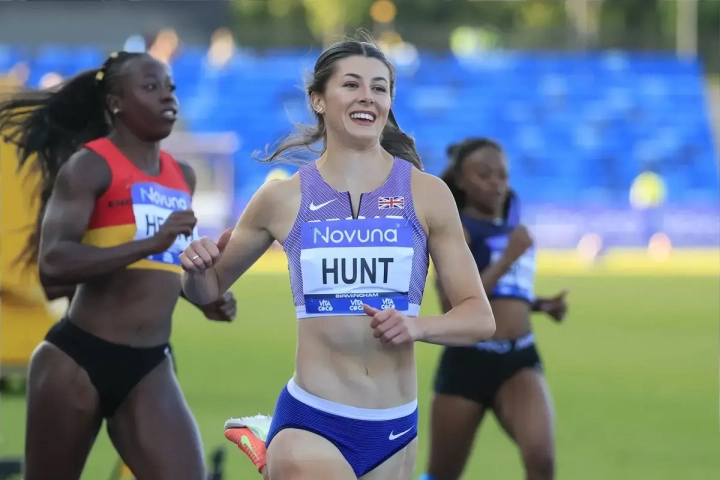
The deafening roar of the Birmingham crowd was undoubtedly reserved for the women’s 100m final. In an event that was widely expected to be fiercely contested, Great Britain’s Amy Hunt delivered the defining performance of her career thus far to claim the ultimate prize on home soil.
Executing a flawless start and maintaining her top-end speed beautifully through the transition phase, Hunt stopped the clock at a flat 11.00 seconds to claim the gold medal. The victory was a crowning moment for the British sprinter, who held off a formidable challenge from Poland’s Ewa Swoboda. The Polish star crossed the line marginally behind in 11.02 seconds to take silver, while Belgium’s Delphine Nkansa earned a hard-fought bronze medal with a personal best time of 11.06 seconds.
For the host nation, Hunt’s triumph provided the perfect crescendo to the opening night, although it was a mixed evening for the broader British sprinting contingent. Defending champion and compatriot Dina Asher-Smith could not replicate her previous championship form, ultimately finishing in fifth place. Nonetheless, Hunt’s victory ensures the host nation is immediately placed on the gold medal tally.
Dominance in the Shot Put Circle
While the track events provided late-night drama, the shot put circle witnessed two historic displays of individual supremacy. In the women’s event, the Netherlands’ Jessica Schilder cemented her legacy by claiming a third successive European title.
Schilder was utterly peerless throughout the competition. She registered a massive winning throw of 20.73 metres on her final attempt, concluding a dominant Dutch one-two finish. Her teammate, Jorinde van Klinken, secured the silver medal with a personal best of 19.64 metres, while Germany’s Olympic champion Yemisi Mabry rounded out the podium positions with a throw of 19.50 metres.
Schilder’s achievement carries immense historical weight; she becomes the first woman to win the European shot put title on three consecutive occasions since the Soviet Union’s Nadezhda Chizhova dominated the event between 1966 and 1974. “I shouldn’t be saying this, maybe, but this was the easiest. There was quite a gap with the other competitors,” Schilder remarked confidently, reflecting on her dominant margin of victory.
The men’s shot put final provided a similar narrative of supremacy, courtesy of Italy’s Leonardo Fabbri. Defending his title in remarkable style, Fabbri delivered a one-man throwing exhibition. Any of his three valid attempts would have been sufficient to secure the gold, but it was his third-round effort of 22.31 metres that decisively ended the contest. The mark stands as the second-longest winning throw in the history of the European Championships, superseded only by his own championship record set in Rome two years prior.
Fabbri’s victory was sweetened by the presence of his training partner, Zane Weir, who secured the silver medal with a solid opening throw of 21.12 metres. The Italian duo, who train under 1996 European indoor champion Paolo Dal Soglio, proved entirely untouchable. Sweden’s Wictor Petersson claimed the bronze medal with a sixth-round effort of 20.91 metres, agonizingly displacing Great Britain’s Scott Lincoln. For Lincoln, it was a painfully familiar scenario, marking the fourth occasion he has finished just outside the medals in fourth place at a major international event.
Norwegian Collective Brilliance in the Relay
The evening’s track action concluded with the frenetic mixed 4x400m relay final, an event that perfectly encapsulated the unpredictable thrill of team athletics. Once again, it was Norway who stood atop the podium, adding a second gold medal to their opening-day haul.
The Norwegian quartet featured three-time 400m hurdles world champion Karsten Warholm, who ran a blistering leg alongside teammates Amalie Iuel and Andreas Ofstad Kulseng. It was left to the fast-finishing Henriette Jæger to anchor the team, and she duly delivered, holding off the chasing pack to cross the line in a new championship record time of 3:09.62.
The Great Britain & Northern Ireland quartet, comprising Ben Jefferies, Charlotte Henrich, Toby Harries, and Yemi Mary John, pushed the Norwegians valiantly but ultimately settled for the silver medal with a time of 3:10.47. The Netherlands completed the podium, taking bronze in a season’s best 3:10.77.
Looking Ahead to the Week
As the floodlights dimmed on the newly renovated Alexander Stadium, the atmosphere in Birmingham was one of overwhelming anticipation. This week marks the first time that a British city has staged the standalone European Athletics Championships, though Birmingham is no stranger to top-tier athletics. Having hosted the 2007 European Athletics Indoor Championships, the 2003 and 2018 World Indoor Championships, and the unforgettable 2022 Commonwealth Games, the city’s sporting infrastructure is world-class. The Alexander Stadium, which was heavily renovated between 2019 and 2022, can comfortably host the massive crowds flocking to witness Europe’s elite.
The 2026 championships have boldly introduced “One-Day-Deciders” for several events, a format designed to heighten the drama by scheduling heats and finals on the exact same day. This structural shift promises a relentless pace of competition throughout the remainder of the week.
With Norway currently leading the medal table courtesy of their double gold, the pressure now shifts to the other traditional European powerhouses to respond. Tuesday’s schedule is equally packed, featuring the men’s hammer throw, the men’s long jump final, the highly anticipated men’s 100m final, and the women’s 5000m. If the opening day is any indication, the 2026 European Athletics Championships will be an unforgettable celebration of continental sporting excellence.
Summary of Day 1 Gold Medalists
| Event | Winner | Nation | Winning Mark / Time |
| Men’s 5000m | Jakob Ingebrigtsen | Norway | 13:15.29 |
| Women’s 100m | Amy Hunt | Great Britain & N.I. | 11.00s |
| Men’s Shot Put | Leonardo Fabbri | Italy | 22.31m |
| Women’s Shot Put | Jessica Schilder | Netherlands | 20.73m |
| Mixed 4x400m Relay | Norway | Norway | 3:09.62 (CR) |