The dust is still settling on a muggy Wednesday evening in Georgia, yet the inquest into England’s latest major tournament heartbreak is already operating at full capacity. For exactly thirty minutes at the Mercedes-Benz Stadium, Thomas Tuchel’s side stood on the very precipice of sporting immortality. An Anthony Gordon strike ten minutes into the second half had given the Three Lions a priceless advantage in their FIFA World Cup semi-final against reigning champions Argentina. The fans in the stands dared to dream. The players on the pitch dug their heels in. However, what followed was a grimly familiar unravelling, a late, devastating collapse that has not only condemned England to a 2-1 defeat but has also sparked intense scrutiny over a visible, fractious rupture between two of the squad’s most pivotal figures.
No words are big enough right now to overcome this empty feeling in the stomach. We were close, really close to another final but it wasn’t enough. We’ve given everything over these last 7 weeks and to fall short is hard to take!
I know the expectations are high and rightly so,… pic.twitter.com/exz5Pe95hb
— Harry Kane (@HKane) July 16, 2026
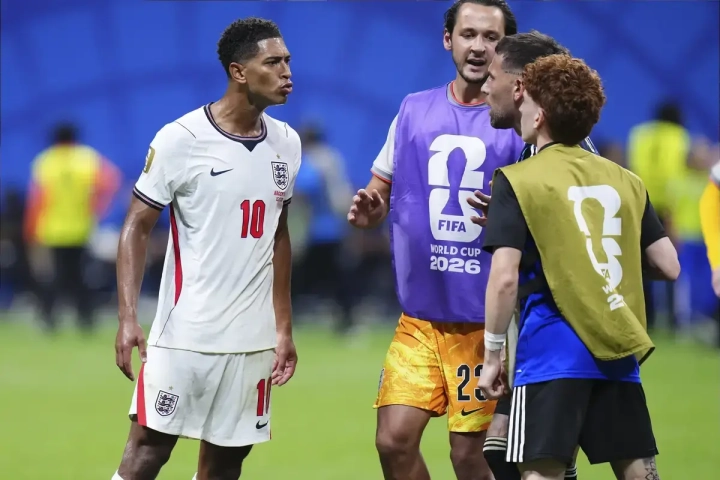
In the merciless theatre of a World Cup semi-final, emotions run dangerously high, and frustrations are magnified by the lenses of thousands of global broadcasters. Following Enzo Fernández’s 85th-minute equaliser, the cameras caught a moment that threatens to define England’s 2026 campaign just as much as the football itself. Jude Bellingham, the dynamic fulcrum of this English generation, was seen launching a furious, six-word blast seemingly directed at his own goalkeeper, Jordan Pickford. The image of a fractured team in its darkest hour is one that will linger long in the collective memory, prompting deep debates over accountability, tactical passivity, and the sheer, exhausting weight of carrying a nation’s expectations.
The Turning Point: A Sucker Punch from Distance
To understand the sheer vitriol of the incident, one must rewind to the genesis of Argentina’s leveller. After falling behind, Lionel Scaloni’s side relentlessly cranked up the pressure, pinning England back into a desperate, deep-lying defensive block. Wave after wave of South American attacks were repelled, with Pickford himself called into action to pull off a string of top-class saves, while the woodwork came to England’s rescue on two separate occasions.
With just five minutes of normal time remaining, the resistance finally broke. Following a short corner routine, Chelsea midfielder Enzo Fernández found himself with a rare pocket of space outside the penalty area. Bellingham, displaying the relentless engine that has yielded him six goals in this tournament, was the sole English player who surged forward in a desperate attempt to close down the shot.
Valentin Barco ran onto the pitch to celebrate after Enzo Fernandez scored against England 👀 pic.twitter.com/gMYYZn7LxL
— BBC Sport (@BBCSport) July 16, 2026
Fernández unleashed a sweet, curling effort. Pickford hurled himself to his right-hand side, stretching full-length, but failed to make contact. The ball nestled into the net, entirely deflating the English resolve. Merely seven minutes later, in the second minute of stoppage time, substitute Lautaro Martínez headed home a pinpoint cross from Lionel Messi to complete the turnaround, breaking English hearts and securing Argentina’s place in Sunday’s final against Spain in New Jersey.
“It’s the Middle of the Goal!”
While the Martínez winner was the final nail in the coffin, the Fernández equaliser was the true catalyst for the collapse, both on the scoreboard and within the team’s internal harmony. Bellingham, having turned his back as the shot bypassed him, initially did not see the ball hit the net. It was only moments later, as he watched the replay unfold on the giant screens suspended inside the Mercedes-Benz Stadium, that his frustration boiled over.
Jude Bellingham Frustrated with Jordan Pickford: “It’s the middle of the goal.” pic.twitter.com/MmCkGSMTvF
— Goodvibes (@Dailygoodvib) July 16, 2026
Visibly furious, the Real Madrid star threw his arms down and appeared to scream, “It’s the middle of the goal!” The damning verdict was aimed squarely at Pickford’s inability to keep the shot out. Replays suggest that while Fernández struck the ball cleanly, the trajectory was not tucked right into the corner; it curled inwards, arguably leaving the Everton goalkeeper with a more than reasonable chance of making the save.
Bellingham’s eruption was the physical manifestation of a player who has carried an unimaginable burden over the past five weeks. As the talisman who practically dragged England through the earlier rounds, his raw, unfiltered anger highlighted the excruciating margins that separate global triumph from miserable failure.
Neville’s Scathing Verdict and the Public Divide
The incident immediately ignited a fierce debate across the footballing landscape, with high-profile pundits swiftly chiming in. Former Manchester United and England defender Gary Neville was unequivocal in his assessment of the goal, aligning himself perfectly with Bellingham’s on-pitch outburst.
Speaking on the Stick to Football World Cup Watch Party, Neville delivered a scathing critique of the England number one. “Not gone in the corner, that, he’s got to save that,” Neville stated firmly. “Got to save it. He’s past it.”
Neville’s blunt assertion that the 32-year-old goalkeeper is “past it” adds significant fuel to a fire that has been smouldering beneath the surface of the national discourse. However, placing the entirety of the blame on Pickford has not sat well with large swathes of the fanbase, triggering a polarising divide.
Pickford’s defenders are quick to point out the historical context. Just days prior, in the arduous extra-time victory over Norway, Pickford officially became the most capped England men’s player in World Cup history. Throughout his international tenure, he has been an undeniably reliable servant, frequently bailing out his defenders in high-stakes penalty shootouts and crucial knockout ties.
“The game would’ve been 1-4 if not for Pickford,” noted one prominent fan on social media, echoing a sentiment shared by many who felt the goalkeeper was hung out to dry by a retreating defence. “He has been carrying England through the tournament. He needed someone to carry him today but they all went into hiding.”
Tactical Passivity: The Root of the Frustration
While the Bellingham-Pickford clash provides dramatic tabloid fodder, the more nuanced autopsy of England’s defeat points directly toward the dugout. Thomas Tuchel’s tactical management following Gordon’s 55th-minute goal has been heavily scrutinised, with both the manager and his captain admitting severe structural failings.
“We got too passive after we scored,” Tuchel confessed to the BBC after the final whistle. “We conceded so many crosses and chances and shots. We were close but couldn’t keep the level up. We changed nothing after the goal, but the match changed completely.”
England captain Harry Kane echoed his manager’s grim assessment. “Once we went 1-0 up we seemed to just try and hold on, which at this level isn’t enough,” Kane reflected.
The statistics paint a damning picture of this passivity. England registered a mere five shots on goal throughout the entirety of the match, compared to a staggering 15 for Argentina. In the final thirty minutes, the midfield was entirely bypassed, leaving Bellingham isolated and the backline constantly under siege. When a team fundamentally abandons its attacking intent to protect a slender lead against the reigning world champions, individual errors, whether from a fatigued midfielder failing to close down a shooter or a goalkeeper misjudging a dive, become grim inevitabilities.
Passion Overspill: The Messi Altercation Clarified
Bellingham’s agitated state was not exclusively directed at his own teammates. The 23-year-old was visibly running hot throughout the notoriously physical encounter, which saw 19 fouls committed in the first half alone. At one point, he engaged in what appeared to be a heated, face-to-face argument with Argentina’s captain, Lionel Messi.
🚨🎙️ What happened between you and Messi?
🗣️ Jude Bellingham: “We were talking about a frictional shot, actually there was nothing bad at all, I’m sure everyone will do their job and blow it out of proportion, but for me there was nothing worth mentioning.
I thought there was a…
— MessiXtra (@MessiXtraHQ) July 16, 2026
Speculation immediately ran rampant, with certain media outlets fabricating sensationalist dialogue between the two superstars. However, Bellingham displayed immense maturity in his post-match media duties by swiftly shutting down the toxic rumours.
“I was actually discussing a foul,” Bellingham clarified, explaining the brief altercation. “Everyone might dramatise the moment, but nothing significant happened. I thought the previous scene was a foul, and Messi asked, ‘Then what about the foul I committed?’ So I replied, ‘You’re a player who can handle that level of challenge.'”
Bellingham went on to shower the 39-year-old Argentine with praise, adding, “It was an honour to play against Messi. I had no negative feelings toward him at all. Of course, it hurts a lot to be on the losing side, but just facing him was a special experience.”
The Bitter Reality of the Third-Place Play-Off
As the dust settles, England must now face the jarring reality of the third-place play-off against France. It is the fixture that no team ever truly wants to play, a melancholic curtain call for sides nursing freshly broken hearts.
This World Cup marks the fourth time in the past five major tournaments that England have reached the semi-final or final, firmly establishing them as one of the elite forces in international football. Yet, the ultimate prize remains tantalisingly, excruciatingly out of reach.
The brief, explosive clash between Jude Bellingham and Jordan Pickford is unlikely to result in any long-term animosity; it is simply the byproduct of elite, ultra-competitive athletes reacting to the traumatic evaporation of a lifelong dream. However, it perfectly encapsulates the agonising frustration of a team that keeps knocking on the door of greatness, only to find the locks changed at the very last moment. Tuchel’s task now is not just to repair a porous defence, but to mend the fractured morale of a squad that gave everything and still found it to be not quite enough.