When Manchester City officially unveiled Elliot Anderson today, having prized the England international away from Nottingham Forest for a staggering £116 million, it sent the traditional shockwaves rippling through the footballing ecosystem. It is a phenomenal figure, one that shatters the British transfer record and immediately places a monumental weight of expectation firmly onto the 23-year-old’s shoulders.
Yet, as eye-watering as modern transfer fees have become in 2026, looking at them in absolute numerical terms is fundamentally flawed. To truly understand the financial magnitude of a transfer, one must look past the raw numbers and examine the economic reality of the era in which it occurred.
Comparing a transfer fee from 1996 to one in 2026 using standard economic inflation (the changing price of a pint of milk or a loaf of bread in the supermarket) is a redundant exercise. General inflation does not reflect the staggering 3,500 per cent explosion in Premier League broadcasting and commercial revenues over the last three decades.
To accurately gauge what historical transfers would be worth today, football finance expert Kieran Maguire and Professor Jason Laws created the “Laws-Maguire Index”. By adjusting historical fees according to the purchasing power of clubs and the revenue generated within the league at that specific time, a fascinating alternate reality emerges.
Under this inflation-adjusted metric, Elliot Anderson’s £116 million fee only ranks as the 31st most expensive addition in the history of the Premier League. Even Alexander Isak’s gargantuan £125 million move to Liverpool in the summer of 2025 only places him 14th on the all-time list.
So, if the modern megadeals barely scrape the top ten, who are the true financial heavyweights of the Premier League era?
Here is a look at the most expensive signings in the history of the division, adjusted for football inflation.
- Alan Shearer to Newcastle United (1996)
- Original Fee: £15 million
- Inflation-Adjusted Value: £237 million
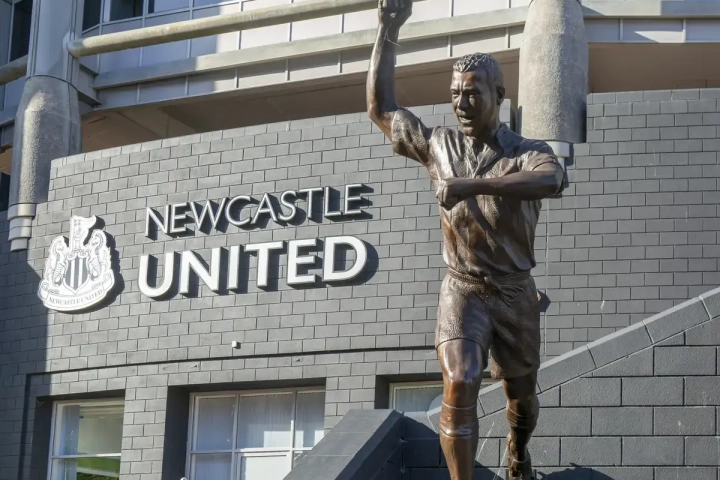
In the summer of 1996, Newcastle United made the ultimate statement of intent. Following the heartbreak of collapsing in the title race to Manchester United the previous season, Kevin Keegan convinced the world’s most lethal striker to turn down Sir Alex Ferguson and return to his native Tyneside.
The £15 million fee shattered the global transfer record. While £15 million today barely secures a highly rated academy prospect, in 1996, it represented a monumental, almost incomprehensible percentage of a club’s overall turnover. When adjusted for the astronomical growth of the Premier League, Shearer’s true cost equates to roughly £237 million in today’s market.
It makes the Newcastle legend the undisputed most expensive player in English football history, placing his domestic move above even the €222 million Paris Saint-Germain famously paid Barcelona for Neymar in 2017. Shearer repaid that immense outlay with 206 goals for the Magpies, cementing his legacy as the greatest goalscorer the division has ever seen.
- Juan Sebastián Verón to Manchester United (2001)
- Original Fee: £28.1 million
- Inflation-Adjusted Value: £199 million
At the turn of the millennium, Manchester United’s financial dominance over the rest of the Premier League was absolute, allowing Sir Alex Ferguson to aggressively target the finest talents in Europe. In 2001, he turned his attention to Lazio’s majestic Argentine playmaker, Juan Sebastián Verón.
Costing £28.1 million, the transfer was viewed as the final piece of the puzzle to conquer the UEFA Champions League. In today’s inflated financial climate, that commitment translates to an astonishing £199 million.
Unfortunately for United, Verón’s Premier League legacy is often unfairly defined by the word ‘flop’. While he produced moments of undeniable, sweeping brilliance in European fixtures, he frequently struggled to adapt to the frenetic, relentless hustle of the early noughties English midfield. He was eventually sold to Chelsea in 2003 for £15 million, taking a significant loss on the most expensive midfield investment in league history.
- Rio Ferdinand to Manchester United (2002)
- Original Fee: £33.3 million
- Inflation-Adjusted Value: £179 million
Just a year after the Verón gamble, Manchester United once again flexed their immense financial muscle, breaking the British transfer record to poach Rio Ferdinand from fierce rivals Leeds United.
Spending £33.3 million on a central defender in 2002 was practically unheard of. Adjusted for the league’s revenue growth, that fee stands at around £179 million today. While the initial sticker shock was profound, history remembers this deal as an absolute masterstroke. Ferdinand marshalled the United backline for 12 extraordinarily successful years, securing six Premier League titles and a Champions League winner’s medal, proving that premium investments can yield legendary returns.
- Stan Collymore to Liverpool (1995)
- Original Fee: £8.5 million
- Inflation-Adjusted Value: £166 million
Before the billions poured into the sport, the mid-90s produced several transfers that swallowed up a massive percentage of club wealth. In 1995, Liverpool broke the British transfer record to sign Nottingham Forest’s star striker, Stan Collymore, for £8.5 million.
In the modern landscape, that fee equates to over £166 million. Collymore formed a devastating, electrifying partnership with a young Robbie Fowler, famously scoring the dramatic late winner in the iconic 4-3 victory over Newcastle United at Anfield in 1996. While his tenure on Merseyside was relatively brief, departing for Aston Villa in 1997, the sheer audacity of the financial package ensures his place near the summit of this list.
- Fernando Torres to Chelsea (2011)
- Original Fee: £50 million
- Inflation-Adjusted Value: £149 million
The arrival of Roman Abramovich at Chelsea entirely disrupted the established financial hierarchy of European football. While the Russian billionaire funded countless massive deals, none were more dramatic than the £50 million deadline-day capture of Fernando Torres from Liverpool in January 2011.
Adjusted for today’s market, the Spaniard’s fee equates to just under £149 million. It remains a transfer debated fiercely to this day. Torres never replicated the terrifying, explosive goalscoring form he showcased at Anfield, often cutting a frustrated figure at Stamford Bridge. However, his iconic, tie-sealing goal against Barcelona at the Camp Nou, which propelled Chelsea to their 2012 Champions League triumph, is widely considered to have instantly repaid that astronomical fee in the eyes of the supporters.
- Dennis Bergkamp to Arsenal (1995)
- Original Fee: £7.5 million
- Inflation-Adjusted Value: £147 million
A transfer that fundamentally altered the DNA of a football club. When Bruce Rioch signed the “Non-Flying Dutchman” from Inter Milan in 1995 for £7.5 million, few could have predicted the elegant revolution he would spearhead.
That fee translates to roughly £147 million today. Bergkamp’s arrival predated Arsène Wenger, but he became the absolute cornerstone of the Frenchman’s visionary Arsenal sides. He provided the technical brilliance, the unteachable vision, and the ruthless edge that defined the Invincibles. It is arguably the greatest value-for-money transfer in Arsenal’s history, regardless of the inflation-adjusted price tag.
- Andriy Shevchenko to Chelsea (2006)
- Original Fee: £30.8 million
- Inflation-Adjusted Value: £144 million
In 2006, Andriy Shevchenko was universally recognised as one of the most fearsome, complete centre-forwards on the planet. Chelsea’s pursuit of the AC Milan icon culminated in a £30.8 million deal, a personal triumph for Abramovich, but a tactical headache for manager José Mourinho.
Costing the modern equivalent of £144 million, the Ukrainian’s spell in London was severely hampered by persistent injuries and a noticeable decline in his explosive pace. He managed just nine Premier League goals in 48 appearances, serving as a stark reminder that even the most expensive, glittering acquisitions carry no guarantee of success.
The Modern Reality
When you scan further down the inflation-adjusted list, you encounter the likes of Dwight Yorke (£12.6m in 1998, adjusting to £136m), Paul Pogba (£89.3m in 2016, adjusting to £133m), and Wayne Rooney (£25.6m in 2004, adjusting to £132m).
It provides a fascinating, sobering perspective on the modern transfer market. As we watch clubs in 2026 commit sums north of £100 million for stars like Elliot Anderson, Florian Wirtz, Alexander Isak, and Moisés Caicedo, it is easy to assume we are witnessing unprecedented financial excess.
In reality, while the absolute numbers have undoubtedly gained an extra digit, the sheer percentage of club revenues dedicated to these modern megadeals is significantly lower than the towering transfers of the 1990s and 2000s.
The next time a Premier League club triggers a highly publicised £100 million release clause, it is worth remembering that they are still operating in the immense, £237 million shadow cast by Alan Shearer three decades ago.