
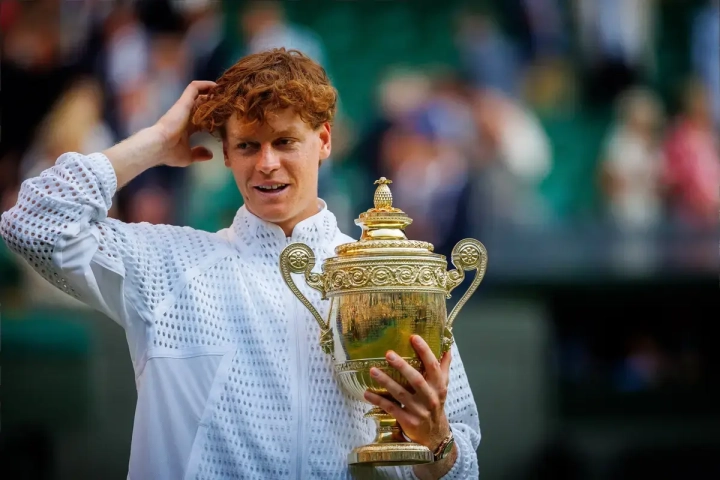
As the late afternoon shadows stretched across the hallowed turf of Centre Court on Sunday, Jannik Sinner fell flat on his back, staring up at the London sky. For the second consecutive year, the 24-year-old Italian had conquered Wimbledon. Yet this victory, a bruising 6-7 (7), 7-6 (2), 6-3, 6-4 triumph over French Open champion Alexander Zverev, felt profoundly different. It was not merely a successful title defence; it was an emphatic, supreme psychological exorcism.
Just a few short weeks ago, Sinner was the architect of one of the most devastating collapses in recent Grand Slam history, squandering a two-set and 5-1 lead against Juan Manuel Cerúndolo in the second round of Roland Garros. To rebound from such a crushing disappointment and immediately defend the most prestigious title in tennis speaks volumes about the sheer mental fortitude of the world number one.
In a final lasting three hours and 46 minutes, Sinner demonstrated exactly why he remains the undisputed king of the grass, securing his fifth major crown and becoming only the tenth man in the Open Era to successfully defend the gentlemen’s singles title at the All England Club.
The Context: A Tale of Two Summers
The narrative leading into Sunday’s showpiece was impossibly rich. On one side of the net stood Sinner, desperate to prove that his Parisian nightmare was a mere blip on an otherwise stellar 2026 campaign. On the other stood Alexander Zverev, a 29-year-old German playing the most liberated, aggressive tennis of his career.
Zverev had finally shattered his Grand Slam ceiling last month by capturing his maiden major title at the French Open. He brought a formidable 13-match major winning streak to Centre Court, determined to secure a rare Channel Slam. Historically, however, Zverev carried a heavy psychological burden into the final: he had lost nine consecutive matches to the Italian.
Watched by a packed Royal Box that included the Prince and Princess of Wales alongside Prince George and Princess Charlotte, the two titans of the modern game prepared for a battle defined by devastating serves and baseline attrition.
The Opening Act: Serving Masterclasses and a Tiebreak Thriller
From the very first exchange, it became abundantly clear that this would be a contest dictated by the slimmest of margins. Zverev, who had ruthlessly ended the fairytale run of British wildcard Arthur Fery in the semi-finals, started with remarkable intent. Operating behind a colossal first serve that regularly clocked over 132 mph, the German looked to overpower the defending champion.
The opening set was a masterclass in holding serve. Both men executed their service games with clinical precision, offering virtually no openings. Zverev saved the only break point of the set, relying on his heavy baseline groundstrokes to keep Sinner pinned back.
As the set inevitably drifted into a tiebreak, the tension inside Centre Court reached a fever pitch. The first 15 points of the breaker went strictly with serve, an extraordinary sequence of clutch execution under immense pressure. Both men saved set points, pushing each other to the absolute limit. Ultimately, at 8-7, Zverev constructed a brilliant rally before unloading a blistering down-the-line forehand winner. The German pumped both fists in a ferocious display of emotion, snatching the opening set and sending a clear message that his Parisian confidence was fully intact.
The Italian Resurgence: Levelling the Battlefield
Losing a grueling 73-minute opening set on a tiebreak would have deeply unsettled a lesser player, particularly one still carrying the psychological scars of a recent Grand Slam collapse. Sinner, however, is forged from a different kind of steel.
The second set followed an almost identical pattern to the first. Destructive, precise serving from both sides of the net dominated the proceedings. Sinner began to subtly adjust his return position, stepping further back to absorb the sheer velocity of Zverev’s delivery, whilst simultaneously relying on his own impeccable serve to keep the German at bay. The Italian fired down 15 aces throughout the match and won an astonishing 80 per cent of points behind his first serve.
As the second set reached its own inevitable tiebreak, Sinner’s tactical adjustments paid devastating dividends. Zverev, who had been flawless on serve for two hours, suddenly faltered. He opened the tiebreak with two uncharacteristic, sloppy forehand errors on his own delivery. Sinner, possessing the instincts of an apex predator, ruthlessly capitalised. The Italian dominated the breaker, securing it 7-2 to level the match and fundamentally alter the psychological momentum of the final.
The Turning Point: Slips, Breaks, and German Frustration
The third set marked the decisive turning point of the championship. Zverev, having expended a colossal amount of physical and emotional energy, finally began to show signs of fatigue against the relentless, scrambling defence of Sinner.
In the seventh game of the set, the physical toll of the encounter became sharply evident. After Sinner perfectly executed a delicate drop-shot winner, Zverev slipped awkwardly on the baseline, immediately clutching his knee in visible discomfort. A hush fell over the 15,000-strong crowd as Sinner displayed exemplary sportsmanship, immediately crossing the net to check on his stricken opponent.
Zverev was helped to his feet and bravely opted to continue, but the incident seemingly broke his rhythm. In the very next game, with the score delicately poised at 3-4, the unbreakable German serve finally crumbled. Up 40-30, Zverev delivered a costly double fault. Moments later, facing a break point, he looped a desperate forehand long. In a rare display of lost composure, Zverev angrily hurled his racquet across the pristine turf. Sinner stepped up and immaculately served the set out to love, sealing a two-sets-to-one lead with a thunderous ace.
The Final Push: Sinner Secures His Crown
Entering the fourth set, Zverev gamely attempted to mount a final, desperate challenge, hoping to prolong a contest that was rapidly slipping away. However, Sinner was now operating in a state of absolute flow. The world number one was striking the ball with terrifying clarity, hitting an incredible 58 winners to just 25 unforced errors over the course of the near four-hour marathon.
The decisive blow landed in the seventh game of the fourth set. Sinner broke Zverev’s serve to establish a 4-3 advantage, pairing his baseline dominance with intelligent, perfectly timed lobs and drop shots that exploited Zverev’s heavy legs.
Serving for the championship at 5-4, Sinner showcased the icy composure that has defined his rapid ascent to the summit of the sport. Despite a dramatic final game featuring arguably the two most spectacular, breathless rallies of the entire match, Sinner refused to be denied. On his first championship point, he slapped away a forehand winner, immediately collapsing onto the grass in a mixture of sheer exhaustion and unbridled euphoria.
Post-Match Reflections: Respect and Royalty
The trophy presentation was a heartwarming display of mutual respect between two of the finest athletes on the planet. Zverev, despite the bitter disappointment of falling short, was magnanimous in defeat, demonstrating an excellent sense of humour.
“First of all, Jannik, I don’t really like you anymore. I lost to you ten times in a row,” Zverev joked, drawing a chorus of laughter from the Centre Court crowd. “He showed once again why he’s the best player in the world. It was great to share the Centre Court with you on finals weekend, it’s a great honour to be here. Unfortunately, it didn’t go my way, but congratulations to you.”
For Zverev, the runner-up plate represents the conclusion of a profoundly successful summer. Before this year, he had never advanced beyond the fourth round at SW19 in nine previous attempts. At 29 years old, he has proven he is a genuine contender on all surfaces.
Sinner, clutching the iconic golden trophy, returned the praise warmly.
“As Sascha did, I’d like to start with you and your whole team and family. You reached one of your main goals, winning Grand Slams, and you made it happen in Paris,” Sinner noted. “Today you were so, so close. If you play like this, I’m very, very sure you’re going to have this one at home as well. Keep going, I know the goal is for you to be No.1 in the world. You’re very, very close, so I have to be very careful now.”
Sinner also took a moment to reflect on his own remarkable journey over the past month. Darren Cahill, part of Sinner’s coaching setup, encapsulated the achievement perfectly: “It goes to show the maturity of the player that we’re working with in Jannik, that he can take a kick in the guts like that, come back here, and work his a off.”
A Legacy Cemented
Jannik Sinner’s victory on Sunday is far more than just another trophy to add to his rapidly expanding collection. It is his 100th career Grand Slam match-win and his tour-leading sixth title of the 2026 season. More importantly, it solidifies his status as the premier force in men’s tennis.
While the shadows of a devastating Parisian collapse lingered briefly at the start of the grass-court season, Sinner has emphatically silenced any lingering doubts regarding his mental resilience. He absorbed the absolute best tennis Alexander Zverev could produce, weathered a first-set storm, and systematically dismantled his opponent with surgical precision.
As the tennis world prepares to transition to the North American hard courts for the final stretch of the season, the message from London is unequivocally clear: Jannik Sinner is the undisputed king of the grass, and removing him from his throne will require a superhuman effort.
The 2026 Wimbledon Championships delivered spectacular storylines, from Arthur Fery’s local fairytale to Linda Nosková’s emotional triumph in the women’s draw, but it was fittingly concluded by the world’s best player demonstrating exactly why he holds the number one ranking. The ghost of Roland Garros has been well and truly banished.