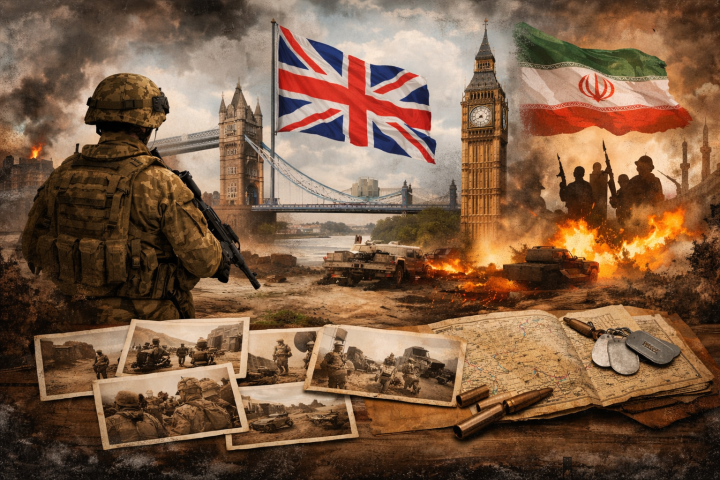
The world woke up on 28 February 2026 to a new, ugly chapter: a major US and Israeli assault on Iran, followed by Iranian retaliation across the region. What some will describe in cool, sterile language as “deterrence” and “degradation of capability” is, in reality, the rapid unravelling of a whole neighbourhood of nations, with civilians trapped inside it.
Within hours, the consequences stopped being theoretical. Reports emerged of a girls’ school struck in the chaos of the opening phase. People will argue over the precise numbers and the sequencing. But the moral centre does not depend on a perfect tally. A school was hit. Children died.
Britain must not enter this war.
And Britain’s restraint cannot be a polite sentence tucked into a spokesperson’s briefing. It has to be measurable. We should not allow our airbases, runways, territory, intelligence, logistics, or refuelling capacity to be used for this conflict. If we claim we are not involved, then we must not quietly become the hinge that makes involvement possible. You cannot outsource the killing and still keep clean hands.
Children, hatred, and the inheritance of violence
The casual way adults running the world talk about loss of life is the first thing that should shame us. “Collateral.” “Targets.” “Proportionate response.” We have normalised the language of acceptable death, as if someone else’s child is a negotiable unit. That is not strength. It is moral corrosion disguised as realism.
This is the moment politics should go quiet for a beat, because the human reality is too loud.
I am the father of three children, two daughters and a son. When I read about children killed in a school, my mind doesn’t go to strategy first. It does something more honest. It tries to place my own family inside that scene. If my daughters were in that building, if my son’s classroom became rubble, what would be left of my world?
And here is the truth that every missile briefing tries to bury: when children die, it doesn’t just break one family. It creates hatred that spills beyond a generation. It turns grief into identity. It seeds a long memory, passed down like an unwanted inheritance. You do not bomb a population into loving you. You do not flatten a neighbourhood into gratitude. You manufacture tomorrow’s rage while congratulating yourself about today’s “success”.
My own family history carries a warning label for anyone who thinks political decisions can be “managed” while ordinary people simply absorb the consequences. My immediate family was caught up in the Partition of India in 1947. My father was five years old. Estimates commonly exceed a million people killed, with millions more uprooted in one of the largest and most traumatic migrations in human history.
And Partition didn’t end when the borders were drawn. The ill feeling still lingers. In many communities, Muslims and Sikhs or Hindus rarely inter-marry even today, not because ordinary people are born to hate, but because trauma teaches families to fear what once harmed them. That is exactly my point about killing: it doesn’t stop at the grave. It travels. It settles into culture. It becomes a story told at dinner tables and a warning whispered to children. Healing can take a century, and even then it can remain incomplete.
No loss of life is acceptable. Not one.
The value of one life cannot be expressed in dollars. There is no exchange rate for a child. We can count financial costs because public money matters, but counting cost is not the same as valuing life. The world becomes more peaceful only when leaders, and the citizens who pressure them, start from the truth that human life is beyond price.
We have been here before: Iraq, Afghanistan, and the precedents that haunt us
Britain has been down this road before. We walked it in Iraq. We walked it in Afghanistan. Each time we were sold certainty and competence. Each time we got chaos, grief, and long consequences that came back home through trauma, distrust, division, and domestic strain.
Britain was not always a country that simply followed. Britain, for centuries, has been led by brains, strategy, and the hard discipline of long-term thinking. That is part of what made Britain Britain, for better and worse across history. We have evolved. We have learned. We have confronted past mistakes and tried, often painfully, to become better than the worst chapters of our own story.
Then came the era where we lost the thread.
Tony Blair’s decision to move as he did on Iraq, without the full weight and legitimacy of proper UN process, did more than drag Britain into a disastrous war. It damaged our credibility. It created a precedent. It made Britain look less like a strategic nation with its own compass, and more like a lap-dog nation that confuses loyalty with obedience.
That credibility loss matters now. Because credibility is a form of power. When you spend it recklessly, you don’t notice the weakness immediately. You notice it years later, when your warnings carry less weight, when your diplomacy lands softer, when your moral language is met with eye-rolls and cynicism.
Keir Starmer has a chance to change this. He has a chance to re-establish Britain as a serious country with a serious brain. Not a country that rushes to war because it fears being left out of the room.
And yes, it is hard to watch the way Britain has sometimes been publicly wrong-footed in its relationship with Washington, especially under Donald Trump’s political theatre. The point isn’t personal embarrassment. The point is structural reality: we can no longer follow reckless behaviour as though it is inevitable or wise. Re-establishing European ties, strengthening diplomacy, and engaging with global powers with Britain’s own interests at the front of the file is not betrayal. It is maturity.
Britain has resisted before: the “special relationship” is not a leash
It’s worth reminding ourselves that even at the height of the so-called special relationship, Britain has pushed back when its interests and judgement demanded it.
Margaret Thatcher is often remembered as America’s closest ally, but even she drew lines. When Ronald Reagan moved on Grenada in 1983 without proper consultation, Thatcher’s anger was real and direct. She did not quietly accept being treated as an afterthought. She challenged it because she believed it was wrong and because she understood a principle that too many leaders forget: alliance does not mean automatic obedience.
That moment matters now, not as nostalgia, but as precedent. Britain can say no. Britain can insist on process. Britain can refuse to be pulled into other people’s escalations simply because the phone rang from Washington.
War is not good for the economy: the lie that keeps getting recycled
We must stop repeating another myth that has been used as a deodorant for war: that war is “good for the economy”.
It isn’t.
Spending is not prosperity. You can create “economic activity” by setting your own house alight and paying someone to rebuild it. That doesn’t make arson a growth strategy. War diverts talent and money away from productive life. It balloons debt. It creates long-term obligations that do not show up in the glamour shots: veterans’ care, interest on borrowing, security expansion, disrupted trade, and the slow erosion of trust that makes economies function.
Even when war generates contracts, it still hollows out the wider economy by pulling focus away from what actually makes a nation strong: health, education, infrastructure, housing, innovation, social stability. War may move money. It does not create wellbeing. It does not create peace. It does not create a future worth inheriting.
The Gulf pressure-point: why this spreads fast and hits hard
Now look at what is already happening in the Gulf. Iran’s leadership knows exactly where pressure lands hardest on Washington, and it isn’t only on bases. It is on confidence.
Retaliatory strikes and incidents have been reported across multiple countries and nodes of Western interest in the region, including the UAE, Qatar, Bahrain, Kuwait, and Jordan, with shockwaves felt through aviation routes, alarms, disruption, and fear. That list matters because it shows the logic: widen the pain, widen the pressure, widen the instability.
This is where the recklessness of Washington’s approach becomes impossible to ignore. Donald Trump’s style of foreign policy often treats the world like a deal: apply pressure, break the structure, then talk grandly about rebuilding as if trauma is simply redevelopment. It has been reported that he has spoken in glossy, property-developer language about turning Gaza into a kind of “oasis”. Whether you agree or disagree with him politically, that style of thinking is dangerous when applied to human lives.
Trump has not thought this through.
More damage to the UAE could crush an economy the Emiratis have spent decades carefully building as a safe space for families, investment, tourism, and global business. The UAE is not a war economy. It is a carefully constructed promise of stability. Dubai, in particular, has tried to become the region’s Singapore: a place where the world passes through, invests, relocates, and breathes easily.
The problem is, the region cannot become that if it is repeatedly dragged into brinkmanship. A single week of sustained fear doesn’t just disrupt holidays. It reshapes reputations, cancels investment decisions, postpones relocations, and forces insurers and airlines to rewrite rules overnight.
The knock-on effects are brutal. The airports are not just airports, they are the arteries of confidence. Dubai’s aviation ecosystem runs on predictability and global trust. The ports are not just ports, they are supply chain engines. Jebel Ali is not a local dock. It is a major gateway for trade and logistics, built on the assumption that goods will keep moving.
If confidence fractures, the costs cascade far beyond the Gulf. Shipping schedules slip. Inventories tighten. Routes lengthen. Prices rise. Tourism dips. Investors pause. And once the idea of safety is punctured, it is hard to stitch back together quickly.
It is entirely plausible that Iran’s ruling regime calculated this. Striking UAE-linked interests, and to a lesser extent Qatar, while stirring tension that is felt in Bahrain, Kuwait, and Jordan, is a way of putting serious pressure on the United States by spreading pain into places the global economy cannot ignore. The tragedy is that the people who lit the fuse either failed to contemplate this properly, or did not care enough about the consequences for Gulf civilians and Gulf stability.
Britain should refuse to be tied to that calculation.
Playground geopolitics: cast your mind back and you’ll recognise the whole world
Everything you saw in the playground at school plays out on the world stage.
While reading this, cast your mind back to your school days and you can easily figure out the characters and power plays. There were those who didn’t want involvement, the Switzerland types, trying to keep their heads down and preserve calm. There were those who wanted to ride the crest of the bully, to stand close enough to feel powerful but far enough to claim innocence. There were protestors who said “this is wrong” even when it was unpopular. There were weasels who laughed along with whoever looked strongest that week. There were smart bullies who didn’t throw the first punch but knew exactly how to provoke one. There were ultra-brains who could manipulate the bullies, directing force without ever looking like the aggressor. There were pacifiers, the calm voices who could talk violence down. There were opportunists who swapped sides mid-argument because their only loyalty was to momentum. There were bystanders who hated what was happening but convinced themselves silence was “pragmatic”.
The jigsaw fits because human nature hasn’t changed. We have just scaled it up into flags, currencies, oil routes, drones, and missiles.
And there is another truth about the playground: it is rarely only one bully. It’s usually a rotating cast. One dominates for a period, gets replaced, then another takes the centre. The bully of the moment isn’t permanent. The cycle continues unless the wider group changes the rules.
The aim for the lesser characters is not to become bullies themselves. The aim is to collectively restrain, guide, and control the bully’s worst instincts, to make the playground safer for everyone.
That is Britain’s role.
Britain is not the biggest child in the yard. But Britain can still be one of the cleverest. Britain can still be one of the most strategically important. Britain can still be one of the voices that makes it harder for big powers to mistake brute force for leadership.
The United States must resist temptation, and Britain must help it do so
The United States is, in many ways, the big boy on the block. With that size comes responsibility. The US must resist the urge of temptation or persuasion it receives from other countries, from allies, from domestic politics, from ego, and from the addictive idea that force proves strength.
Some countries will always try to pull the superpower into doing what they want, because they know the superpower has the muscle. Some will flatter. Some will provoke. Some will whisper that restraint is weakness. Some will tell the superpower that it must act “or lose credibility”. That is how the playground works.
This is where Britain must use brains and strategy. Britain must be the calm, respected voice that insists on restraint and consequences. Britain should not be an inciter. Britain should not be a follower. Britain should be the country that says: stop, think, de-escalate.
John F. Kennedy’s example still matters here, not as praise, but as proof that restraint is possible even when every instinct and every voice around you screams for escalation. The point is not to pretend the United States has always behaved wisely. It plainly has not. The point is to insist that the superpower can choose restraint when the moment demands it, and that allies like Britain should push for that choice rather than enabling the opposite.
Domestic Britain: put Britain first, and remember what Great Britain is supposed to mean
We also need to be honest about our own house.
Britain has serious domestic issues that demand focus and investment: the economy, cost-of-living pressures, public services under strain, housing, and social cohesion. Britain cannot pretend it has infinite money and infinite patience for foreign adventures, especially adventures that historically deliver insecurity back to our own communities.
Put Britain first does not mean turning our backs on the world. It means understanding that Britain’s greatest contribution to the world right now is not adding another aircraft to someone else’s war. It is restoring ourselves as a stable, credible, mature voice for peace and restraint.
Britain deserves the title Great Britain not because we are perfect, not because history is spotless, not because we have nothing to answer for, but because we have evolved. We have learned. We have built institutions and traditions meant to elevate the value of human life. We should remember who we are and what we stand for.
If Britain wants to be great in this era, it must be the global voice of reason, not shamelessly ploughing into conflicts. We should be facilitating peace talks and pushing for diplomatic solutions, not standing in the background hoping nobody notices our airbases are helping.
Starmer has a chance to change Britain’s posture, to end the era of automatic alignment and begin an era of strategic independence rooted in diplomacy, European strength, and clear-eyed engagement with the world as it is.
Conclusion: keep Britain out, keep Britain credible, and make the pen louder than the sword
Britain should not join this war. Britain should not allow itself to be used as a platform for this war. Britain should press for diplomacy and restraint, and demand consistency, not only from adversaries but from allies.
Because once British airbases, British runways, British logistical footprints become part of this conflict, Britain inherits consequences we claim to oppose. You do not get to be half-involved and morally uninvolved at the same time.
The pen still matters. The pen is not weakness. The pen is how citizens tell leaders that life is not a statistic. It is how societies refuse to be dragged into someone else’s vendetta. It is how the lesser characters on the playground form a collective voice that guides power away from violence.
The world needs a collective voice for fewer wars, not better slogans for war.
Britain, with all its past mistakes and hard-earned lessons, should be one of the loudest voices saying: not this time.