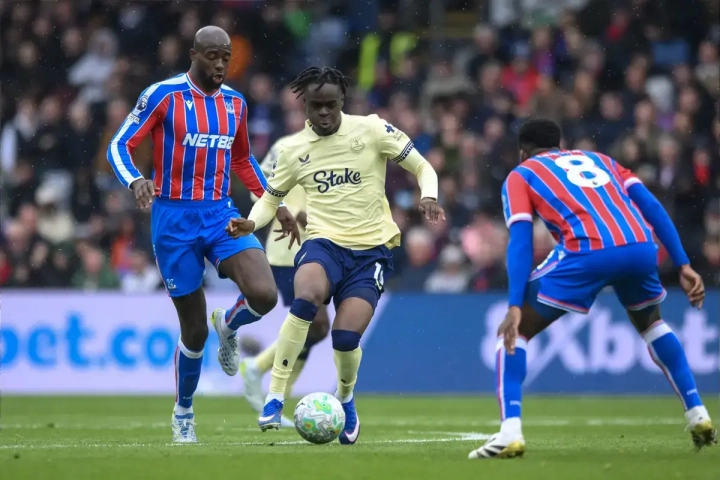
Everton came to Selhurst Park with Europe still flickering in front of them, but left south London with that flame guttering in the wind after a 2-2 draw that felt like two points dropped, two leads wasted and perhaps one opportunity too many squandered.
David Moyes’ side were in charge for important spells of the afternoon. They led early through James Tarkowski, led again through Beto straight after half-time, and created enough chances to leave Crystal Palace with nothing. Instead, familiar flaws returned at the worst possible moment. Everton were wasteful in front of goal, uncertain when they needed control, and unable to protect the sort of advantage that teams chasing Europe simply have to protect in May.
Palace deserve their credit. Twice they fell behind, twice they came back, and late on they looked capable of winning it themselves. For a team with a Conference League final against Rayo Vallecano still to come, and for a side operating under Oliver Glasner in the closing weeks of his time at the club, there was no sense of drifting towards the beach. They were competitive, sharp in the final half-hour and full of the belief that has characterised Glasner’s best work at Selhurst Park.
Everton’s frustration will be sharpened by the way the game began. They looked ready, aggressive and organised, and Palace were punished inside six minutes. A corner caused problems, Palace failed to clear with authority, and Tarkowski was left with the simplest of finishes at the far post. It was a classic Everton goal under Moyes: direct, physical, built on set-piece pressure and the willingness to attack second balls.
That early breakthrough should have settled them. Instead, it became the first missed chance to seize the match by the throat. Beto had already gone close, and Everton’s forward players repeatedly found space in promising areas. Iliman Ndiaye was bright, Kiernan Dewsbury-Hall offered energy and invention, and Beto was a constant nuisance to the Palace centre-backs. Yet Everton never found the second goal when they were on top, and that failure gave Palace a route back.
The equaliser arrived after 34 minutes through Ismaïla Sarr, who was alert when Everton could not properly clear the danger. Sarr, one of Palace’s main attacking threats all season, finished with conviction and dragged the home side level. It was not entirely against the run of play, because Palace had begun to stir, but Everton will still feel they invited it. At 1-0, they had the game in a useful place. At 1-1, it was suddenly loose, noisy and awkward again.
Even then, Everton had the chances to correct the story. Ndiaye headed wide before the break from a position that demanded more, and the visitors entered the interval knowing they had let Palace survive a half in which they had been there to be hurt.
When Beto restored the lead two minutes after the restart, Everton once again looked ready to take command. Tarkowski’s long clearance turned into a perfect pass, Beto showed strength and composure to roll away from Maxence Lacroix, and his finish through Dean Henderson gave Everton the advantage again. It was a proper centre-forward’s goal, full of power and purpose, and for a short spell it looked as though it might be the moment that reignited Everton’s European push.
But the problem was the same as before. Everton had the lead, not the match. They had the moment, not the control. Palace stayed alive, and Everton’s attacking work became more frantic than precise. The away side kept finding situations, but too often the final touch, pass or finish lacked the required calm.
Moyes did not hide from that afterwards. His disappointment was plain, and his message carried the tone of a manager who knows the table is beginning to harden against his team. He said good sides have to “do the business” at this stage of the season, and admitted Everton have not handled certain moments well enough. He also insisted Everton are not out of the European chase yet, but accepted they now need to “step up” if they are to force their way back into it.
That is the uncomfortable truth for Everton. This was not a performance without merit. In fact, that may be what makes it more damaging. They did plenty right. They caused Palace problems, scored twice away from home and had chances to win. But the difference between a side that gets into Europe and a side that nearly does is often found in exactly these games: the awkward away fixtures, the narrow leads, the moments when control must become punishment.
Palace, by contrast, grew into the afternoon and finished strongly. Glasner introduced Jean-Philippe Mateta midway through the second half, and his arrival immediately gave Palace a more direct threat. Everton dropped deeper, Palace found width, Adam Wharton started to influence the rhythm, and Selhurst Park sensed the game was turning.
The equaliser came in the 77th minute, and it had been brewing. Tyrick Mitchell’s work down the left helped open the space, and Mateta did what Everton had failed to do often enough: he finished a major moment cleanly. Palace were level for the second time, and suddenly they looked the side with more running in their legs and more belief in their football.
Glasner was delighted by that resilience. He called the “performance, effort, belief” of his players “incredible” and said Palace had earned a “highly deserved point”. He was especially pleased with the way his team finished the game, arguing that Palace looked the fresher side despite their recent European exertions. That was a telling observation, because Everton had been the team with the greater need, yet Palace finished with the greater surge.
The closing stages were chaotic. Wharton struck the post in the 90th minute, Mateta missed a late chance to complete the comeback, and Henderson had to make important saves to prevent Everton from snatching it at the other end. Jordan Pickford had also made key interventions for Everton, and by the end both goalkeepers had played major roles in keeping the scoreline at 2-2.
For Palace, this was another reminder of the standards Glasner has built. They are a team with structure, energy and fight. Their season is not fading quietly. With a European final still ahead, they continue to play with purpose, and their manager is heading towards the end of his Palace reign having done an outstanding job. Winning the FA Cup, taking Palace into Europe, reaching another final and leaving behind a side that now believes it can compete with far more established clubs is a serious body of work.
For Everton, the mood is different. They remain in the European conversation, but only just. The realistic route now is eighth place and a possible Conference League place, depending on how the final European qualification picture settles. After this draw, they sit 10th, behind Brentford and Chelsea, with Brighton also above them. That means Everton no longer have control. They need wins, but they also need help.
The remaining games now carry a sharp edge. Everton have shown enough under Moyes this season to suggest progress is real, especially after years in which the club’s ambitions were crushed by relegation worries and off-field uncertainty. But progress will not soften the frustration if Europe slips away through carelessness. Draws like this are the ones that linger.
Moyes has dragged Everton back into a more ambitious conversation, and that should not be dismissed. Yet this was an afternoon when the old hard-nosed Moyes standards were missing at key moments. Score when you are on top. Defend when you are ahead. Manage the game when the opposition are searching. Everton did parts of the job, but not enough of it.
Palace left with proof that Glasner’s side still have fire in them. Everton left with a point that may not be enough. They had the game in their hands twice, and twice they let it spill. In a European chase, that is not just wasteful. It can be terminal.