A new chapter in astronomy has begun with the launch of one of the most ambitious scientific projects ever undertaken – and researchers at the University of Hertfordshire are playing a pivotal role.
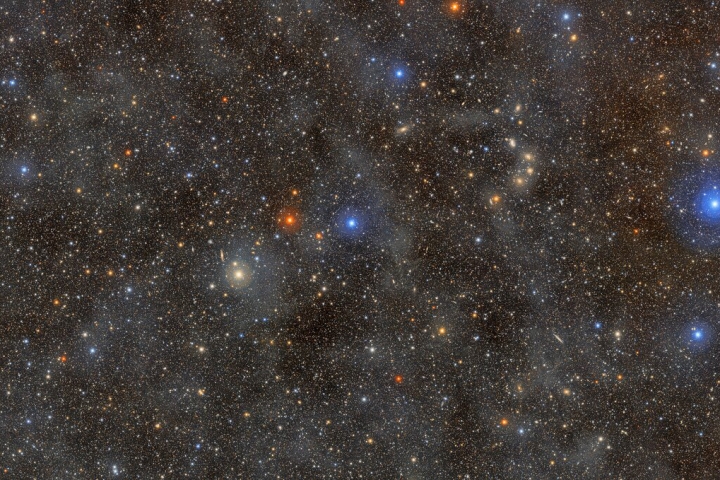
The Vera C. Rubin Observatory in Chile has officially begun its Legacy Survey of Space and Time (LSST), a ten-year mission that will create the most detailed, high-definition time-lapse record of the southern sky ever produced.
Every few nights, the observatory will capture vast swathes of the night sky using the world’s largest digital camera, collecting an extraordinary volume of data that will help scientists answer some of astronomy’s biggest questions.
By the end of the survey, Rubin is expected to catalogue around 20 billion galaxies, 17 billion stars and millions of changing cosmic events, creating an unparalleled resource for researchers around the world. Scientists hope the data will improve our understanding of everything from the formation of galaxies to the nature of dark matter and dark energy.
The UK is a major international partner in the project through the LSST:UK Consortium, funded by the Science and Technology Facilities Council (STFC). Bringing together 36 institutions, the consortium has spent more than a decade preparing the software, computing infrastructure and scientific tools needed to maximise the observatory’s discoveries.
Among those leading this work is Professor Sugata Kaviraj, Professor of Astrophysics at the University of Hertfordshire and co-Chair of the Rubin-LSST Galaxies Science Collaboration.
Professor Kaviraj and colleagues at the University of Hertfordshire, working with Liverpool John Moores University, have developed software that allows astronomers to detect and analyse some of the faintest structures in the universe. These extremely dim regions, known as the low surface brightness (LSB) regime, have largely escaped previous surveys because they are so difficult to observe.
Professor Kaviraj says:
“Our innovation enables Rubin’s data-processing pipeline to identify, process and catalogue these faint objects, significantly expanding the scientific potential of the survey.
“By enabling access to the low surface brightness regime, we have significantly boosted the scientific potential of the LSST. Much of the material that tells us how galaxies and galaxy clusters grow and evolve exists in these faint regions that have barely been explored by past surveys.”
The software developed by the Hertfordshire team will allow researchers worldwide to study how galaxies assemble over billions of years, opening up entirely new avenues of research into the evolution of the observable universe.
The University’s contribution forms part of a much wider UK effort. Researchers across the country have developed tools to combine Rubin’s observations with infrared surveys, identify previously unknown celestial objects and process the enormous flow of information that the observatory will generate. During its lifetime, the survey is expected to produce up to 500 petabytes of data, with UK facilities processing around a quarter of the entire dataset.
Professor Kaviraj’s work reflects the University of Hertfordshire’s growing international reputation for research in astronomy, data science and machine learning. By combining advanced computational techniques with cutting-edge astrophysics, Herts’ researchers are helping to ensure that one of the world’s most powerful telescopes can reveal parts of the cosmos that have remained hidden until now.
As the Rubin Observatory begins its decade-long exploration of the southern sky, the discoveries it makes will shape astronomy for generations. The expertise of Professor Kaviraj and his colleagues means the University of Hertfordshire will be at the forefront of those discoveries, helping scientists uncover a richer, more complete picture of how our universe has evolved over billions of years.