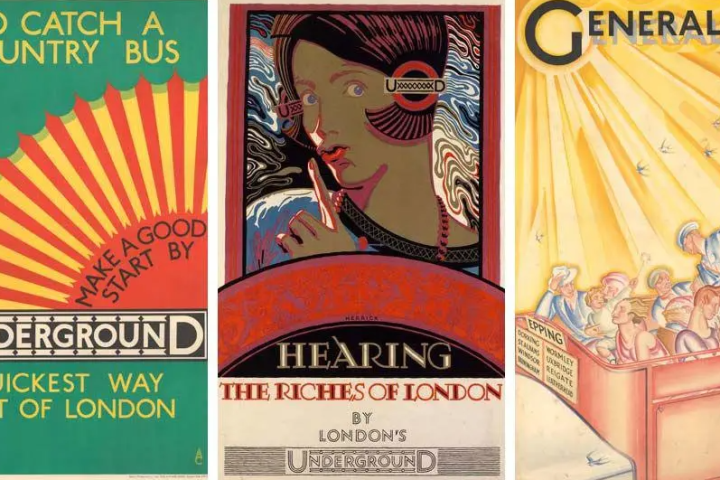
Some of the first graphic art posters displayed on the London Underground in the 1920s and 1930s have gone on show at the London Transport Museum. Created in a distinctive Art Deco style at the height of the design movement, the posters were originally put up at Tube stations to encourage Londoners to travel across the network and explore the city.
The artworks often feature London landmarks and depict aspirational scenes of high living and glamorous pastimes that the era is famed for. London Transport Museum said the posters had become part of London Transport’s world-famous visual identity. The exhibition, Art Deco: The Golden Age of Poster Design, in the Global Poster Gallery, features more than 100 posters from this period, around a third of which have never been displayed in public, according to the Covent Garden museum.
The posters typically carried simple messages, bold fonts, and bright colours. One, for example, uses green, yellow and orange and bears the word “Underground” in the middle, alongside the text: “To catch a country bus…The quickest way out of London.”
As the main form of advertising at the time, the posters were intended to entice passengers to explore the city’s leisure hotspots, shop the latest fashions, indulge in evening entertainment and embrace the thrill of modern travel.
“It really showed how modern London transport was, how progressive they were,” exhibition curator Georgia Morley told BBC London. She said that, although a century old, the posters retained a “glamourous and opulent feel.”
“A lot of the things these posters are advertising we still want to do in London today – going to the theatre, shopping, going to the zoo, or the riverside – they’re still really exciting,” Ms Morley added.
While posters promoting the network were first introduced in the early 1900s, Ms Morley said the Art Deco designs were the most captivating. “Art Deco was really effective in transport posters because it had bold lines, simple geometry, and really bright colours and when you’re travelling on the Tube, you need to understand the message and the imagery immediately,” she explained.
The artworks often depicted high living and glamorous leisure pursuits. One poster shows a woman in a dress standing among crowds at a racecourse, carrying a bunch of pastel-coloured balloons. The text reads: “By tram from Hammersmith Wimbledon or Shepherd’s Bush.” Another shows a stylised man eating in a restaurant, with the words: “Tasting the riches of London.” Others featured locations outside London to encourage train travel, such as a poster of a woman in a red swimming dress in the sea with a Victorian building in the background, captioned: “Southend-On-Sea. By Underground LMS and LNE Railways.”
The posters were the first graphic art commissioned by former London Transport chief executive Frank Pick, who led publicity from 1908. Matt Brosnan, the museum’s head curator, said the network needed to attract more passengers and ticket sales. “He (Frank Pick) saw the opportunity for commissioning pictorial posters for the first time, which was quite a new thing at that point in history,” Mr Brosnan said. “That became a really useful and dominant marketing tool that the Underground used for decades afterwards, and it was also part of a much wider art and design aspect of the Underground’s identity.”
The exhibition marks the centenary of the 1925 International Exhibition of Modern Decorative and Industrial Arts in Paris, which helped cement mass appeal for the Art Deco style. Dr Emma Bastin, a historian specialising in the early 20th century, said the posters were “enduring.”
“The art is 100 years old now but it still feels modern… they have an aspirational feel to them, so we can relate to these artworks, we can dream that we want to be in some of them,” Dr Bastin said. “I think a lot of it’s down to the dreamlike vision these posters show and the art shows. It allows you to imagine yourself in another world and they still look like they could have been produced today so that’s why people still love to put them on their walls.”
The Art Deco: The Golden Age of Poster Design exhibition provides an opportunity to see these century-old artworks in person, celebrating both the legacy of London Transport’s visual identity and the enduring appeal of the Art Deco movement.