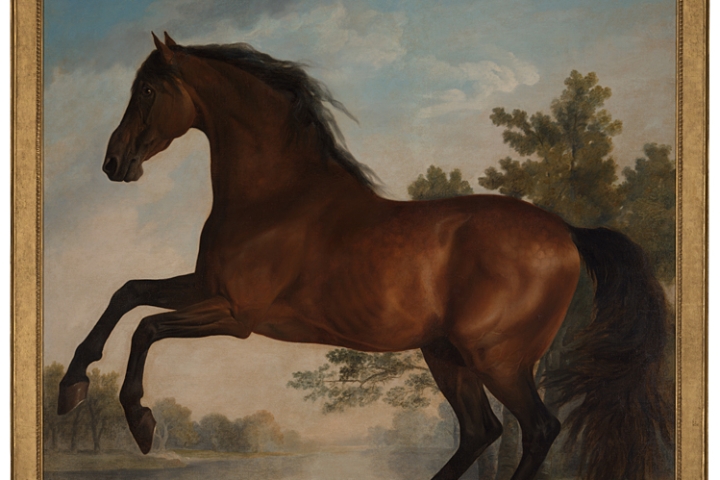
This spring, the National Gallery brings a rarely seen masterpiece into the public eye: Scrub (c.1762), a monumental life-size portrait of a rearing bay horse by George Stubbs. Shown publicly only once before, the painting will headline a focused exhibition devoted to the artist who revolutionised how Britain looked at horses.
Scrub is the only life-size horse portrait by Stubbs still held in a private collection. Painted for Charles Watson-Wentworth, 2nd Marquess of Rockingham, it will be displayed alongside paintings and works on paper that show Stubbs’ extraordinary understanding of equine form and character.
Just a short walk away, visitors can encounter its celebrated counterpart: Whistlejacket (c.1762), Stubbs’ most famous work and one of the National Gallery’s great icons. Painted in the same year for the same patron, the two former racehorses mark a turning point in British art – the first large-scale portraits of horses depicted without riders, and with no narrative distraction.
Together, they reveal how Stubbs transformed equine painting in the second half of the 18th century through rigorous observation and anatomical precision, combined with a striking sense of individuality.
Rockingham, a passionate horse breeder, racing enthusiast and twice Prime Minister, likely encountered Stubbs through Sir Joshua Reynolds. Whistlejacket was originally intended as the basis for a royal equestrian portrait of George III. Yet once completed, its sheer visual power persuaded patron and artist to leave the horse unmounted, its energy unleashed against a bare canvas. Scrub followed soon after, intended for the same royal purpose – but Rockingham ultimately declined the painting, perhaps abandoning the commission altogether.
Stubbs retained Scrub, later selling it to the dealer William Wynne Ryland. Damaged during a failed attempt to ship it to India, the painting returned to Stubbs and was eventually sold from his studio after his death – disappearing from public view for centuries.
The exhibition places Scrub within the broader arc of Stubbs’ career, beginning with his astonishing anatomical studies. Between 1756 and 1758, the artist secluded himself in a Lincolnshire barn, dissecting horses with forensic care. The resulting drawings formed the basis of The Anatomy of the Horse (1766), the most comprehensive study of its kind for almost a century. The exhibition includes the published treatise alongside six rare working drawings and finished studies, lent by the Royal Academy.
Later works reveal Stubbs’ deep association with the racing world. In the 1790s, he embarked on an ambitious – and ultimately unfinished – project to document Britain’s most famous racehorses, including Eclipse and Gimcrack. Two paintings from this Turf Project will feature in the exhibition, capturing the artist at the height of his mature style.
Stubbs’ legacy lies not just in anatomical accuracy, but in his ability to convey presence, temperament and power – portraits that feel as alive as they are exacting.
As Dr Mary McMahon, Associate Curator (NG200 Collections), explains:
“Stubbs fundamentally changed the approach to depicting the horse in late 18th-century British art, combining his hard-earned knowledge and understanding of their anatomy with a desire to capture a distinct individual character.”
Details:
12 March – 31 May 2026
The H J Hyams Room (Room 1), National Gallery
Admission free