15 October 2026 – 7 February 2027
The H J Hyams Room (Room 1)
Admission free
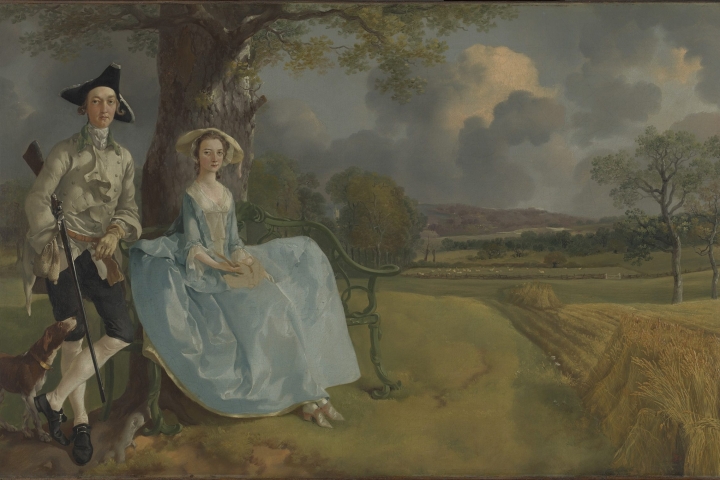
For the first time since its creation, Yinka Shonibare’s Mr. and Mrs. Andrews without their Heads (1998) will go on display with the painting which inspired it, Thomas Gainsborough’s Mr and Mrs Andrews (about 1750). Yinka Shonibare and Thomas Gainsborough: A Conversation will take place in the H J Hyams Room at the National Gallery from October 2026.
Bringing together these two works on the eve of the 300th anniversary of Gainsborough’s birth, the National Gallery will show Shonibare’s vibrant re-evaluation of a very English depiction of privilege and identity through sculpture. This will mark a once in a generation opportunity to see Mr. and Mrs. Andrews without their Heads in the UK, on loan from the National Gallery of Canada, Ottowa.
Mr and Mrs Andrews is the first historic work which British-Nigerian artist Shonibare responded to in his celebrated sculpture style. Mr and Mrs Andrews are separated from their land and their heads. The life-sized headless figures, a common motif in Shonibare’s work are playful and provocative, evoking the decapitations which took place following the French Revolution from 1789. The pastel palette of Gainsborough’s sitters’ clothing is replaced with the vibrant African print Dutch wax cotton, characteristic of Shonibare’s artworks. African print Dutch wax cotton, or ankara, is best known for its use in West African clothing, although it was introduced to the continent by Dutch merchants in the 19th century.
Yinka Shonibare says: ‘I first came across Gainsborough’s Mr and Mrs Andrews at art college, and I never expected my work to be shown alongside it. I was drawn to it as an icon of Britishness and interested in how the status of the sitters is represented through their clothes and relationship with the land. My response removes their identities and the landscape and replaces their costumes with West African Dutch wax cloth. I’m fascinated by trade routes and the interconnectedness of places and the idea of hybridity and impurity because racism is usually based on the notion of the pure race. My work challenges that.’
Thomas Gainsborough (1727–1788) was one of the pre-eminent English portrait painters of the 18th century. In Mr and Mrs Andrews, he combined his skill at portraiture with his interest in realistic depictions of nature, still unusual at the time. Mr and Mrs Andrews shows the wealthy couple in front of the rolling hills of south-east England. It has been described as not just a double, but a triple portrait of Mr Robert Andrews, his wife Frances and his land.
The portrait remained with the Andrews family until it joined the National Gallery Collection in the 1960s. It has since become emblematic of 18th-century English painting, and its sitters symbols of the English country gentry. It is one of the most celebrated paintings in the National Collection.
Rab MacGibbon, Bernays Associate Curator of British Paintings says: ’Dialogue between artists, and between art and people, lies at the heart of the National Gallery. Artists have always emulated, challenged or rivalled the art that came before them. This exhibition invites us to participate in a conversation across time that is both humorous and thought-provoking. Yinka Shonibare’s witty response to Gainsborough raises questions about identity and the interconnectivity of cultures and encourages us to look again at this familiar and well-loved painting with fresh eyes.’
The H J Hyams Exhibition Programme
Supported by The Capricorn Foundation