Ecuador delivered one of the defining results of their modern World Cup history as they came from behind to beat Germany 2-1 at MetLife Stadium in East Rutherford, New Jersey, securing their place in the knockout stage and transforming a tense Group E finale into a night of national celebration. Germany had already done enough to finish top of the group before kick-off, but Ecuador arrived knowing that only a victory would give them a realistic chance of extending their tournament. By the final whistle, after goals from Nilson Angulo and Gonzalo Plata had overturned Leroy Sané’s early opener, the South American side had achieved exactly that, producing a performance built on resilience, bravery, set-piece sharpness and emotional control under pressure.
The match could hardly have started in a worse manner for Ecuador. With barely two minutes on the clock, Germany cut through the Ecuadorian defence and took the lead through Sané, whose first-time finish gave Manuel Neuer’s side the early command their quality had threatened to impose. Aleksandar Pavlović and Florian Wirtz were involved in the build-up before Sané found the space and composure to guide the ball into the bottom corner, leaving Ecuador with the immediate feeling that the match was slipping away before it had properly settled. There was frustration among Ecuador’s players, with complaints about a possible high boot in the move, but the goal stood and Germany were ahead almost instantly.
For a team carrying the weight of a must-win scenario, such a start could have been devastating. Ecuador had already endured frustration in the group, losing narrowly to Ivory Coast and then being held by Curaçao, results that left Sebastián Beccacece’s side with little margin for error. Against a Germany team that had scored freely earlier in the tournament and entered the match with two wins from two, Ecuador needed to show not only quality but nerve. Their response was immediate and impressive.
Only seven minutes after falling behind, Ecuador were level. Nilson Angulo seized on uncertainty in the German defence and produced a composed finish in the ninth minute, restoring belief both on the pitch and in the stands. The equaliser changed the entire emotional temperature of the evening. What had briefly looked like a comfortable German exercise became a genuine contest, with Ecuador suddenly playing with sharper conviction and Germany looking less assured than they had during the opening stages.
Angulo’s goal was more than just a technical moment. It altered the psychology of the match. Ecuador no longer looked like a side chasing survival from a position of desperation; they looked like a team that recognised Germany could be unsettled. The South Americans pushed higher, contested second balls with greater aggression and refused to allow Germany to dictate the rhythm. Moisés Caicedo became increasingly influential in midfield, breaking up attacks, covering ground intelligently and giving Ecuador the platform to build forward with purpose. Pedro Vite also grew into the contest, offering energy and delivery in the areas where Ecuador needed precision.
Germany still carried danger. Wirtz continued to drift between lines, Sané remained a threat whenever he could isolate defenders, and the experience of Neuer, Joshua Kimmich and Antonio Rüdiger gave Julian Nagelsmann’s side a base from which to manage the match. Yet their possession lacked the authority expected of a group winner. Ecuador’s compactness denied Germany easy routes through the centre, and when the European side tried to accelerate, they were often forced into rushed decisions or crowded out by Ecuadorian pressure.
The first half developed into a battle of tempo. Germany wanted control, Ecuador wanted intensity. At times, Germany moved the ball with polish but without penetration. Ecuador, by contrast, carried a more direct urgency, knowing that a draw would not be enough. Their supporters, who made up a huge and vocal presence inside MetLife Stadium, responded to every tackle and every forward run as though the match were already deep into stoppage time. That energy mattered. It helped Ecuador keep their belief alive after a brutal start and created an atmosphere that made Germany’s task increasingly uncomfortable.
The second half brought further drama. Germany thought they had an opportunity to regain the lead when a penalty was initially awarded, but the decision was overturned after a video review, with a foul by Sané identified in the build-up. It was a crucial moment. Had Germany gone back in front from the spot, Ecuador’s route to the knockout stage would have become far more difficult. Instead, the reprieve reinforced Ecuador’s sense that the night might yet belong to them.
Beccacece’s side then began to play with the urgency of a team that understood time was running out but refused to panic. They did not throw bodies forward recklessly; instead, they searched for moments where they could hurt Germany with direct running, set-piece pressure and quick transitions. Gonzalo Plata, who had taken a heavy blow earlier in the match, remained involved and alert, and his persistence would eventually decide the contest.
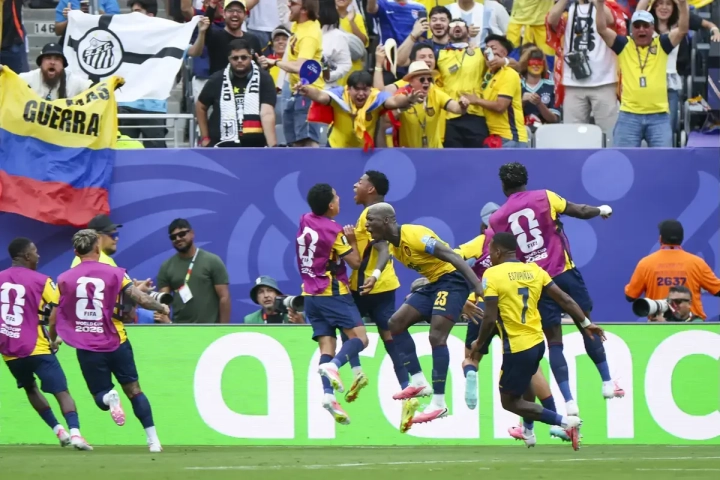
The winning goal arrived in the 77th minute. A corner from Pedro Vite caused problems inside the German penalty area, Kevin Rodríguez helped the ball on, and Plata reacted quickest to force it beyond Neuer. It was not a sweeping team goal or a moment of elaborate construction, but it was exactly the sort of decisive intervention that tournament football so often rewards. Ecuador had attacked the set piece with desire, Germany failed to deal with the danger, and Plata showed the instinct to finish from close range when the chance appeared.
The celebrations were explosive. Players sprinted towards the corner, substitutes poured forward, and Beccacece’s reaction on the touchline reflected the release of pressure that had built across the group stage. For Ecuador, this was not simply a goal to beat Germany; it was a goal that changed the direction of their tournament. It took them from the edge of elimination to the brink of the knockout phase and gave their supporters a moment that will be replayed for years.
Germany’s response was strangely flat. Nagelsmann made changes, and his team pushed for an equaliser, but they lacked the clarity and conviction required to rescue the match. Ecuador defended with discipline, bodies were placed in front of shots, clearances were attacked with conviction, and the back line remained compact even as the pressure increased. Neuer’s opposite number and the Ecuador defence held firm, while Caicedo and his midfield partners continued to scrap for every loose ball.
The closing stages were filled with tension rather than fluency. Germany had the technical ability to create one more clear chance, but Ecuador’s organisation denied them the space they wanted. Every throw-in, every free-kick and every clearance carried weight. When the final whistle arrived, the contrast was striking. Ecuador’s players celebrated wildly, while Germany’s walked away knowing that, although their place at the top of Group E was safe, their momentum had been checked at exactly the wrong time.
For Ecuador, the result was historic in context. It secured their progression to the knockout stage for the first time since 2006, when they also faced Germany in the group phase. This time, however, the emotional balance was very different. Rather than being defeated by one of the great European powers, Ecuador had beaten them, and had done so after conceding almost immediately. That comeback element made the achievement even more impressive. It showed character, not just quality.
The performance also changed the tone around Beccacece. Before the match, criticism had followed Ecuador because of their lack of cutting edge in earlier games. The defeat to Ivory Coast had left them chasing the group, and the draw against Curaçao increased pressure on the manager and players. Against Germany, however, Beccacece’s team delivered the kind of response that can redefine a campaign. His post-match thoughts, based on the way he reacted and the performance his team produced, centred around pride in the group’s courage, the importance of belief after the early setback and the satisfaction of seeing Ecuador maintain their identity under extreme pressure. With no verified direct quotations available immediately after the game, it would be wrong to invent his exact words, but the message from Ecuador’s night was clear: they had suffered, adjusted, fought and earned their place.
Nagelsmann, on the other hand, will know that Germany cannot simply dismiss the defeat because qualification was already secure. His likely reflections will focus on the poor defensive moments, the loss of rhythm after the bright start and the need to sharpen the team before the knockout rounds. Again, without confirmed post-match quotes, direct words should not be attributed to him, but Germany’s performance presented obvious issues for the manager to address. The early goal should have given his side control, yet they allowed Ecuador back into the match almost immediately and later failed to defend a decisive set piece. For a team with ambitions of winning the World Cup, those lapses are significant.
Sané’s goal was a reminder of Germany’s attacking threat, but the rest of the evening raised familiar questions. They struggled to turn possession into sustained pressure, their defensive concentration wavered, and they were unable to respond convincingly once Ecuador went ahead. Germany still finish as group winners and remain dangerous, but this defeat ended their winning run and introduced a note of uncertainty before the knockouts. Tournament success is often built on timing, and Nagelsmann will want this performance treated as a warning rather than a pattern.
Ecuador’s key players deserve credit for the maturity of the comeback. Angulo gave them the lifeline with his early equaliser, showing calmness at a moment when panic might easily have spread. Plata provided the decisive touch when the stakes were highest. Caicedo anchored the midfield with authority, repeatedly disrupting Germany’s rhythm and giving Ecuador the physical presence needed to compete. Vite’s delivery from set pieces became a major weapon, and Rodríguez’s involvement in the winner underlined the value of Beccacece’s changes.
The victory also belonged to Ecuador’s supporters. The crowd of more than 80,000 created a vivid backdrop, with yellow shirts dominating large sections of the stadium and the noise rising as Ecuador sensed the upset. After the winner, the match felt less like a neutral-venue World Cup fixture and more like a home occasion for Ecuador. That support helped carry the team through the difficult final minutes, when Germany were searching for a way back and every defensive action was celebrated like a goal.
From a tactical perspective, Ecuador’s success came from refusing to let Germany’s early strike define the game. They pressed with intelligence rather than chaos, kept numbers around central areas, and recognised that Germany could be vulnerable when forced to defend direct balls and set-piece situations. Their second goal was a perfect example: pressure, delivery, contact, reaction. In tournament football, those details often decide everything.
Germany will move forward, but not with the clean, unbeaten group-stage record they wanted. Ecuador move forward with something more powerful: belief. A team that had looked in danger of leaving the tournament early has now beaten one of world football’s giants and booked a place in the round of 32. Their next challenge will be different, but the confidence gained from this result could be enormous.
When the story of Ecuador’s 2026 World Cup campaign is told, this match will stand as the turning point. They were behind after two minutes, level after nine, and ahead with 13 minutes of normal time remaining. They survived German pressure, trusted their structure and found a winner through a player willing to attack the decisive moment. It was a victory of courage, timing and collective belief.
Germany may still have deeper ambitions in the tournament, but this was Ecuador’s night. At MetLife Stadium, against a side packed with pedigree and expectation, they produced a result that carried both immediate consequence and lasting significance. Ecuador did not simply beat Germany 2-1; they rescued their World Cup, rewarded their supporters and announced that their tournament was still very much alive.