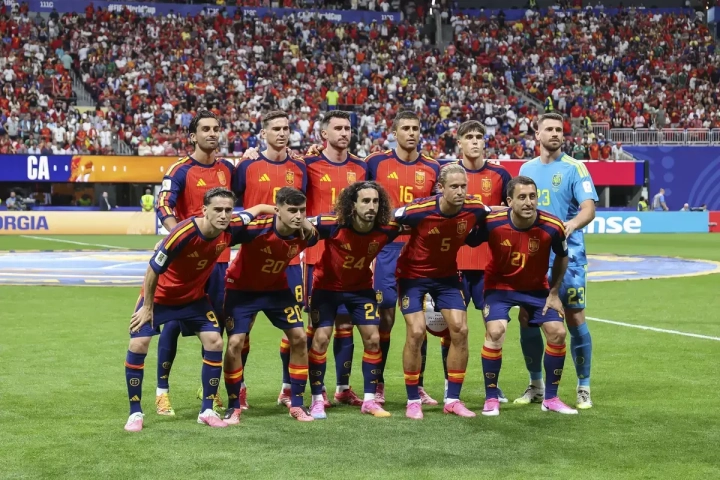
The 2026 FIFA World Cup has already provided significant drama, and Group H is proving to be no exception as the tournament moves into its crucial second round of fixtures. This Sunday, 21 June 2026, the global spotlight turns to the impressive Mercedes-Benz Stadium in Atlanta, Georgia, where European heavyweights Spain will clash with a resilient Saudi Arabia. Scheduled for a 17:00 BST kick-off, this encounter has rapidly transformed from a seemingly routine group-stage assignment into an absolute must-win scenario for both nations following a surprising sequence of opening-day results.
Group H Permutations and the Pressure Cooker
In the expanded 48-team tournament format, the path to the newly introduced Round of 32 theoretically offers slightly more breathing room, with the top two teams from each group and the eight best third-placed finishers advancing. However, the current landscape of Group H has left all four competing nations nervously calculating their prospects. Following Matchday 1, the standings are completely deadlocked, with every team sitting on a single point.
The European champions were heavily backed to dominate the group but suffered a highly unexpected 0-0 stalemate against debuting African minnows Cape Verde. Despite hoarding a staggering 74 percent of the possession and consistently peppering the opposition penalty area, La Roja completely failed to convert their overwhelming territorial dominance into a tangible result. Meanwhile, the Asian representatives secured a highly creditable 1-1 draw against Uruguay, with defender Abdulelah Al-Amri heading home a crucial goal before the South Americans snatched a late equaliser through Maxi Araujo.
Consequently, Sunday’s fixture carries immense, potentially tournament-defining significance. Securing three points in Georgia would catapult either side to the verge of knockout qualification, providing their respective managers with the luxurious option to carefully rotate key personnel in the final group match. Conversely, a damaging defeat would leave them staring down the barrel of a disastrous, premature exit from international football’s grandest stage.
La Roja Seeking a Clinical Edge
Arriving in North America as the reigning European champions, Spain carried the immense weight of expectation that inevitably accompanies their golden footballing heritage. Head coach Luis de la Fuente has meticulously cultivated a unified, family-oriented culture within the squad, steering them to UEFA Nations League and Euro 2024 glory. Yet, the opening performance in this World Cup raised familiar, lingering questions regarding their ability to effectively break down disciplined, low-block defensive structures.
The recent form of the Iberian nation paints a slightly mixed picture. While their tournament preparation included convincing victories such as a 3-0 win over Serbia and a 3-1 triumph against Peru, frustrating goalless draws against both Egypt and Cape Verde highlight a recurring vulnerability. Dominating the ball without providing a clinical, decisive edge in the final third has proven to be an enduring Achilles heel for the three-time European champions.
Addressing this glaring inefficiency is undoubtedly De la Fuente’s primary focus ahead of the weekend. The tactical system relies heavily on the midfield orchestration of captain Rodri, whose vast experience and peerless distribution dictate the overarching tempo of the match. Ahead of him, the spotlight will inevitably fall upon 18-year-old sensation Lamine Yamal. The Barcelona prodigy injected much-needed directness and flair during his second-half cameo against Cape Verde, completing more dribbles than any of his teammates. Accompanied by the dynamic pace of Nico Williams, the vision of Pedri, and seasoned forward Álvaro Morata, the attacking unit possesses undeniable world-class quality; the challenge lies simply in executing under the suffocating pressure of a major tournament. Fortunately for the coaching staff, the squad has reported a completely clean bill of health with no confirmed injury concerns or suspensions, allowing for total tactical flexibility.
Green Falcons Aiming for Another Upset
On the opposite side of the halfway line, the Green Falcons approach this daunting fixture with a fascinating blend of profound respect and quiet, unyielding confidence. The Saudi Arabian footballing landscape experienced a significant managerial earthquake merely two months prior to the tournament, as the federation mutually parted ways with Herve Renard, the esteemed architect of their famous 2022 victory over Argentina. In his place stepped the highly experienced Greek tactician Georgios Donis, tasked with immediately consolidating a squad predominantly drawn from the domestic Saudi Pro League.
Donis has swiftly instilled a remarkable level of defensive organisation and tactical discipline. The opening draw against a formidable Uruguayan outfit demonstrated their capability to absorb immense pressure and strike efficiently on the counter-attack. Recent friendly results, including a commanding 3-0 victory over Puerto Rico and a hard-fought goalless draw with Senegal, further underline their structural solidity.
The Asian heavyweights will rely heavily on the vast international experience of their talismanic captain, Salem Al-Dawsari. The dynamic winger remains the undisputed creative heartbeat of the national side, capable of producing moments of individual brilliance that can completely alter the complexion of a match. Operating within Donis’s compact framework, Al-Dawsari will be explicitly tasked with exploiting the transitional spaces left behind by the aggressively advancing Spanish full-backs. Similarly to their European counterparts, the Saudi Arabian camp enters the crucial weekend fixture entirely free from any immediate injury worries or disciplinary suspensions.
Tactical Battlegrounds
When analysing the granular details of this impending matchup, a truly compelling clash of overarching footballing philosophies emerges. De la Fuente’s men will naturally seek to monopolise the possession statistics, constructing patient, intricate passing networks to systematically manipulate the opposition’s defensive block. Through the relentless overlapping runs of full-backs such as Marc Cucurella, they will actively attempt to stretch the pitch, deliberately forcing the Saudi defence to expand and creating central pockets of space for Pedri and Fabián Ruiz to operate within.
In stark contrast, the Saudi Arabians will likely embrace a far more pragmatic, reactive posture. Acknowledging their opponents’ elite technical superiority in sustained possession, Donis will instruct his team to remain highly compact, completely denying the Spanish playmakers any inviting spaces between the lines. Once possession is inevitably recovered, the explosive pace of Al-Dawsari and the physical presence of their forwards will be immediately weaponised to launch rapid, devastating vertical transitions.
The central midfield battle promises to be particularly brutal and decisive. Rodri’s elite ability to dictate the rhythm and expertly break up counter-attacks will be severely tested by a tireless, combative Saudi engine room eager to disrupt his passing lanes. Furthermore, the physical aerial duels inside the penalty area will be fiercely contested. Centre-backs Aymeric Laporte and Pau Cubarsí must maintain absolute, flawless concentration to neutralise the threat of set-pieces, which notably provided the Green Falcons with their opening goal of the tournament.
Historical Context and the Weight of Expectation
Encounters between these two distinct footballing cultures offer an intriguing historical backdrop that heavily favours the European heavyweights. In fact, Spain boast a completely flawless head-to-head record against Saudi Arabia, having emerged victorious in all three of their previous senior international meetings, scoring a combined total of nine goals while conceding just two.
The most prominent chapter of their shared history remains their clash during the group stages of the 2006 World Cup in Germany, where a slender 1-0 victory was enough to secure maximum points for La Roja. Subsequent international friendlies saw the Spanish secure a highly entertaining 3-2 win in 2010, followed by a resounding 5-0 thrashing in 2012 at the absolute peak of their golden generation. While those historical footnotes provide little tangible insight into the modern tactical landscape, they highlight the significant psychological hurdle that the Asian representatives must overcome to secure a historic result.
As the vibrant, passionate supporters from both nations converge on the impressive architecture of the Mercedes-Benz Stadium, the extensive theoretical planning and exhaustive video analysis will immediately give way to raw, competitive tournament survival. For the European powerhouse, it is a golden opportunity to emphatically rediscover their clinical edge and definitively justify their pre-tournament billing as heavy favourites. For the ambitious Saudi challengers, it represents a monumental test of character against elite opposition, offering the rare chance to register a historic upset that would undoubtedly send major shockwaves throughout the global footballing landscape. Millions tuning in across the world can readily anticipate a fiercely contested, high-stakes encounter where fleeting moments of individual genius, unwavering tactical discipline, and sheer mental resilience will ultimately determine the vital outcome of Group H.