There are final-day fixtures, and then there are final-day fixtures that feel as though English football has developed a taste for theatre with a sharpened knife.
Tottenham Hotspur against Everton should, in ordinary circumstances, be a Premier League closer with pride, prize money and places to settle. Instead, it arrives carrying something far heavier. Spurs, one of the great permanent fixtures of the modern top flight, are one bad afternoon from the unthinkable. Everton, under David Moyes, could be the club that pushes them there. West Ham United, the club Moyes once rescued, rebuilt and led to European silverware, are waiting on the other side of London hoping the man many of their supporters eventually tired of may yet save them one last time.
The equation is brutal in its simplicity. West Ham must beat Leeds United at the London Stadium. Everton must beat Tottenham in north London. Anything less, and Spurs should survive. But if both results fall the right way for the Hammers, Tottenham would be dragged below the line and into a relegation that would shake the Premier League.
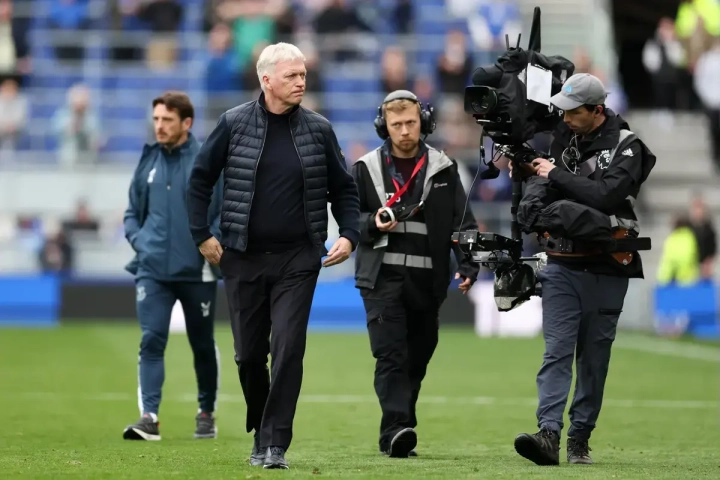
For Moyes, it is a strange old circle. He has made clear that his first responsibility is Everton, and rightly so. There is still a league placing to chase, money to earn, standards to protect and momentum to carry into the summer. But he did not hide the human edge to this game. Moyes admitted he would love to help keep West Ham in the Premier League if he could. That line alone gives Sunday its own electricity.
It is rich with irony. West Ham supporters were not always grateful for Moyes. Many were vocal in their opposition to his football, his methods and what they believed the club should look like. The old argument about the “West Ham way” returned, as it always seems to in east London whenever practicality begins to offend romance. Yet here they are, on the final day, requiring a favour from the same manager who steadied the club, returned for a second spell, delivered European glory and gave them a night in Prague that will outlive almost every complaint.
Now the favour they require is not small. They need Moyes to send Everton into Tottenham Hotspur Stadium with purpose, edge and no hint of end-of-season softness. They need Everton to treat Spurs not as a club fighting for survival, but as a side to be beaten because Everton themselves are still trying to finish this season properly.
That matters to Moyes. His press conference made that clear. He spoke not like a manager ready to pat the season on the head and let it wander into the garden, but like one who has been irritated by the way Everton’s challenge faded over the last six games. He admitted recent results had changed his thinking a little. He wanted Everton “right in there”. He believed they were. Late goals and narrow margins went against them, but the message was not one of excuses. It was one of appetite.
Everton need more. Moyes said it plainly. More quality. More players who can raise the level. Not necessarily another enormous turnover, not another summer of ten or twelve bodies through the door, but a more targeted, ambitious window. A “big summer”, he warned, does not always mean six signings. It might mean one outstanding signing who changes the team. It might mean adding the right quality, the right experience, the right fresh blood.
That is why Sunday still matters for Everton. The season has not become meaningless simply because Europe has slipped away. The best clubs, and the clubs trying to become serious again, do not treat final-day fixtures as ceremonial bunting. Moyes has spent the season trying to change the language around Everton. For most of the campaign, he said, they were talking about Europe rather than relegation. That alone is a shift from the dark days the club has endured in recent years.
There was a time when Everton were the side living on the trapdoor. There was a time when every May seemed to bring another emotional wrestling match with the bottom three, another afternoon of cold sweat and calculator football. Tottenham now find themselves looking into that same pit. The difference is that Spurs were not meant to be anywhere near it.
That is what makes the Thames Gazette angle so compelling. How has a club like Tottenham reached this point? How does a modern stadium, a global fanbase, Champions League history, elite facilities and a squad packed with expensive talent end up needing a final-day result simply to avoid relegation?
The answer is not one thing. It rarely is. Spurs have drifted through too much turbulence, too little certainty and too many false resets. They have had the look of a club constantly trying to change identity while never quite deciding what the new one should be. The league table has been the cruelest witness. Nine wins from thirty-seven games is not bad luck. Seventeen defeats is not a wobble. A negative goal difference tells its own story. For a club of Tottenham’s scale, 17th place going into the final weekend is not a position. It is an indictment.
Their last relegation came in 1977, when they dropped out of the old First Division. That was a different football universe. The Premier League did not exist. The money, the stadiums, the global broadcast machine and the modern commercial monster had not yet arrived. Spurs went down then and came back quickly, but the scar remains part of the club’s history. To fall now, in this era, with the financial and reputational consequences that would follow, would be something else entirely.
Roberto De Zerbi knows that. He has not tried to dress this up as an ordinary final-day assignment. He has called Sunday “the final for Tottenham”, but not in the shiny, celebratory sense. This is not Bilbao, not another European occasion, not a night when Spurs can chase silverware and write themselves into highlights packages. This is more primal. For De Zerbi, this is about pride, history and dignity. He has made the point that trophies can be won or lost, but a club’s standing, its self-respect and the way its players carry themselves into the summer matter even more when survival is on the line.
That was a striking admission from a manager who inherited chaos and has had to apply order in a hurry. De Zerbi has improved Spurs since taking charge, but improvement is not the same as safety. Tottenham have shown more structure, more bite and more belief in recent weeks, yet the table still has them standing on the rim of disaster. His message has been consistent: Spurs are not safe yet. That is the phrase that should be pinned on every dressing-room wall at Hotspur Way this week.
De Zerbi’s challenge is not simply tactical. It is emotional, psychological and cultural. He has to convince a group of players that a draw may be enough without allowing them to play like a team hoping a draw will fall into their lap. He has to make Tottenham brave without being reckless, controlled without being passive, alert without being paralysed. That is a thin old tightrope, and Everton will be trying to shake it from the first whistle.
The psychological burden on Tottenham is immense. They know a draw should be enough. That can be a comfort, but it can also become a dangerous whisper. Playing for one point is one of football’s great traps. It invites hesitation. It turns centre-backs into accountants and midfielders into men checking the clock after twenty minutes. If news filters through that West Ham have scored against Leeds, Tottenham Hotspur Stadium could change temperature very quickly.
De Zerbi has already warned against that kind of nervous drift. He wants his players to show the right mentality, to play with pride, to work on the pitch and to go after the result rather than merely hide behind the mathematics. He spoke before the Chelsea game about trying to make the points Spurs needed, but after that derby defeat the challenge has become even sharper. There is no spare fixture now. No extra door. No little escape hatch in the corner. Everton is the game. Everton is the wall.
The Romero situation only adds another awkward layer. Cristian Romero, injured and unavailable, will not be at Tottenham Hotspur Stadium for the relegation decider after travelling to Argentina. De Zerbi was careful in his language, but his comment that “not all leaders are the same” landed heavily. He contrasted Romero’s absence with Ben Davies wanting to remain with the group, work with the squad and stay close to his team-mates. In a week when Spurs need unity, the optics are brutal.
De Zerbi has defended Romero as a player and as a person, saying he has been correct with him during his time in charge, but he also admitted he understood the frustration from supporters. That matters. Tottenham fans are not merely worried about one injured player being absent. They are worried about what it says. Leadership is not only armbands and contracts. It is presence. It is choosing the collective when the club is wobbling. In a survival week, symbolism becomes substance.
There is team news too. Guglielmo Vicario is available, giving De Zerbi a major decision in goal, while Dominic Solanke remains a concern and may only be available for part of the game if he makes it at all. James Maddison’s fitness has also been carefully managed, with De Zerbi aware that Tottenham need creativity but cannot gamble wildly in a match of this size. Spurs need their footballers, yes, but they also need their adults.
Everton’s job is to make all of that matter. Moyes’ side must bring discomfort. They must make Spurs defend their box, defend their nerve and defend their status. Everton are not in the emotional position West Ham are in, nor the desperate position Spurs are in, but that can be a weapon. They can play with clarity. They can attack the anxiety. They can turn every Tottenham mistake into a public announcement.
And for Moyes, there is another layer. This is not only about West Ham, but it is impossible to ignore West Ham. The club he once managed now needs him. The fans who once questioned him now need his Everton side to do them a favour. The same manager who was accused by some of not embodying the “West Ham way” could become the man who keeps West Ham in the Premier League without even standing in their technical area.
Football enjoys these little cruelties. It stores them carefully, then releases them on the final day.
At the London Stadium, West Ham must do their own work against Leeds. There is no romance without a win. No escape without taking care of business. They cannot simply hope for Everton to provide the drama while they fail to provide the result. Leeds arrive safe, awkward and capable of ruining the script, but West Ham have no room left for complaint. They have spent months stumbling towards this cliff edge. Now they have one afternoon to step back from it.
At Tottenham, the stakes are even more extraordinary. Spurs do not need miracles, but they do need composure. They need to behave like a club that understands danger without becoming swallowed by it. One goal for Everton, one roar from east London, one nervous passage of play, and suddenly history begins to creak open.
De Zerbi has described it as a big day for Spurs, but that barely covers it. This is a judgement day on a season of mismanagement, instability and decline. It is a judgement day on players who have worn the shirt through one of the strangest campaigns in the club’s modern history. It is a judgement day on a club that has had too much talent to be here and too many problems to pretend this is some freak accident.
For Everton, this is a test of professionalism and of the mentality Moyes has been trying to build. He has spoken about improvement, ambition and the need for the ownership to show they are ready to go again. He wants supporters excited by what comes next. But before the summer comes Sunday, and Sunday offers Everton a chance to make a statement. Not a trophy statement. Not a European statement. A standards statement.
They can finish the season by showing that they are no longer a club drifting towards the beach once the danger has passed. They can show that every point still matters, every place still matters, every performance still matters.
For West Ham, Moyes could become the unlikely rescuer from afar.
For Spurs, Everton could become the executioner at the gate.
And for De Zerbi, this is the first defining test of what his Tottenham is going to be. He has spoken of blood, character and spirit. On Sunday, those words must become legs, tackles, clearances, runs, decisions and courage. If they do not, Tottenham will not merely have lost a football match. They will have stumbled into one of the darkest chapters in their history.
And for the Premier League, the final day has been handed a plotline almost too sharp to be believed: David Moyes, the former West Ham manager, taking Everton to Tottenham with the power to help save the club that once turned its back on him and condemn Spurs to a relegation not seen since 1977.
Football does not always write fair endings. But it does write memorable ones.