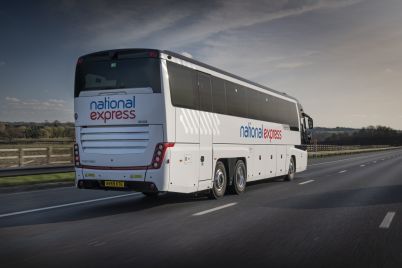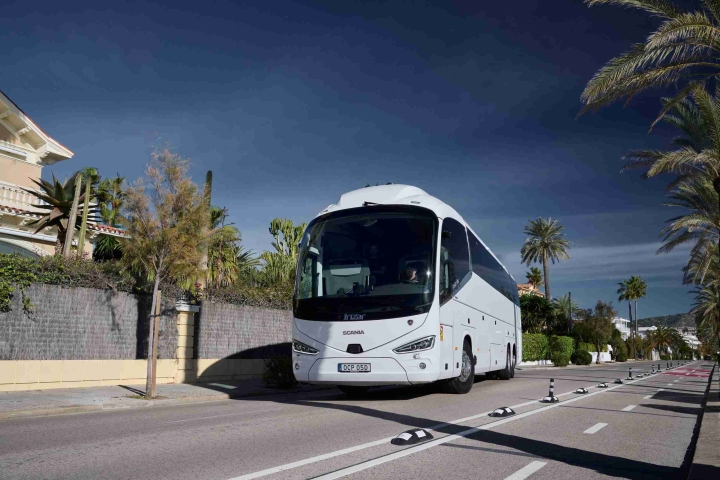
The Scania Irizar i6S Efficient PHEV wins award in the coach category at the Sustainable Bus Awards 2027.
The Scania powered coach was recognised for its innovative plug-in hybrid platform that can reduce fuel consumption by up to 47%, and emissions by up to 94%, when used in longdistance coach operations.
The Sustainable Bus Award is a European award recognising sustainability in the bus and coach industry. It assesses a variety of sustainability criteria, including vehicle performance, safety, comfort, environmental impact and the manufacturer’s overall approach to sustainable transport. The Scania Irizar i6S Efficient was highlighted for its originality and the opportunities it introduces to tourist transport and long-distance coach operations. The judging panel was also impressed by the coach’s ability to use electric-only mode in urban areas, at transport terminals and zero-emission zones, while retaining enough range required for longer journeys. They acknowledge this is a solution to sustainable transport while public charging infrastructure catches up.
Anders Liss, Global Head of Business Solutions for People Transport Solutions at Scania, said: “Long-distance coach operations need solutions that work across very different parts of the journey.
“With this plug-in hybrid platform, operators can use electric driving where it is required or creates customer value, while retaining and extending the range their operation demands and drastically reducing costs and emissions.”
The Irizar i6S Efficient PHEV sees Scania combine its 13-litre Super engine, producing 460hp with two 145 kW electric machines and an 89-kWh lithium-ion battery.
At the driver’s disposal is four drive modes: Electric, Hybrid, Charge Sustain and Forced Charging, allow energy to be managed according to the route and planned charging opportunities. This means the 3-axle version of the coach can drive up to 70 km in electric only mode, while the 2-axle variant’s range increases up to 80 km. The battery can be charged from 20 to 80% in approximately 45 minutes. While the use of regenerative braking and intelligent energy management can contribute to reducing overall energy consumption too. In favourable operating conditions, including en-route charging and an operation suited to making effective use of the electric powertrain, the plug-in hybrid solution can reduce fuel consumption by 47% compared with a conventional diesel powertrain.
The Super engine also works with renewable fuels – such as hydrotreated vegetable oil (HVO) – further reducing the CO2 emissions produced.
Anders Liss adds: “These are two complementary possibilities. The plug-in hybrid powertrain reduces fuel consumption by using electricity efficiently throughout the operation.
“Renewable fuels can then further reduce the CO₂ emissions associated with the fuel that is still needed.”