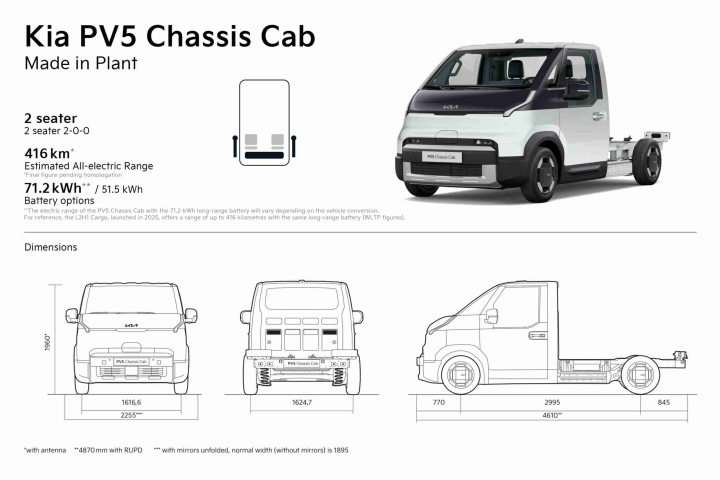
Kia has revealed details of the PV5 Chassis range, including confirmation of its 71.2kWh battery pack. In The UK this will be the sole option, whilst some other regions will offer PV5 Chassis with a 51.1kWh Standard Range battery pack. The Long Range battery option is designed particularly for businesses and fleets that need to cover longer distances between charging stops while retaining the adaptability of the Chassis platform.
The introduction of the Long Range battery option on the PV5 Chassis extends the specification choice available to professional customers while retaining the model’s established role as the conversion-focused member of Kia’s Platform Beyond Vehicle (PBV) lineup.
The wider PV5 lineup encompasses Cargo, Passenger and Chassis models. As Kia’s first fully electric dedicated chassis-cab platform, this highly adaptable variant provides the foundation for a wide range of professional conversions. It enables businesses to configure the vehicle for different routes, applications and working environments.
Expanded battery choice caters to diverse operating needs
The 71.2kWh Long Range variant supports DC fast charging and has a power output of 120kW, enabling the battery to be recharged from 10-to-80% in approximately 30 minutes. Using an 11kW AC supply, a 10-to-100% recharge takes approximately 6 hours and 30 minutes.
The larger battery allows operators to balance route length, charging access and vehicle configuration more closely when defining their vehicle. For fleets with longer or less predictable daily routes and operations with fewer convenient charging opportunities, it provides greater battery capacity within the same compact Chassis base-vehicle package.
Final range and payload will depend on the completed conversion, vehicle specification, equipment, load, route and operating conditions.
“Commercial-vehicle customers need solutions that reflect how they actually operate,” said Erhan Eren, Director PBV at Kia Europe. “The 71.2kWh Long Range battery extends the flexibility of the PV5 Chassis, giving businesses greater scope to balance distance, charging access and conversion requirements in one compact electric platform.”
Compact base vehicle, broader operating scope
The 71.2kWh version retains the qualities central to the Chassis proposition: compact, sub-five-metre dimensions, urban manoeuvrability and extensive conversion potential.
Its best-in-class 5.5-metre turning radius supports operation in city streets, depots, building sites and other constrained environments, while the exposed rear chassis provides the basis for a wide variety of professional bodies.
A foundation for professional conversions
Built on Kia’s PBV-dedicated Electric-Global Modular Platform for Service (E-GMP.S) architecture, the PV5 Chassis is engineered to accept application-specific bodies.
For the UK market, official Kia PBV Conversion Partner TGS Automotive Group can provide Lightweight Tipper, Dropside and Box solutions fitted to the PV5 Chassis, with a range of modular options including Mesh Cage, Fall Arrest Systems, Chapter 8, and Beacons. The vehicles will offer a claimed best-in-class payload. These conversions are planned for launch in Q4 2026.
Customers can therefore begin with a Kia-engineered, fully electric base vehicle and work with a conversion specialist to define the completed vehicle for its intended task.
Strong momentum for the wider PV5 lineup
The battery expansion follows strong early European demand for the wider PV5 lineup. In the first half of 2026, PV5 recorded 13,116 registrations* and accounted for 37% of electric C-segment van sales in Europe, making it the segment’s top-selling model.
By extending the battery selection, Kia is broadening the range of routes, duty cycles and specialist applications that the PV5 Chassis can support.
The 71.2kWh Long Range PV5 Chassis will be introduced across European markets during 2026, with market-specific timing, specifications and conversion availability varying by country.
The PV5 Chassis is covered by Kia’s seven-year/100,000-mile vehicle warranty, with separate battery coverage for eight years.