The Asphalt Industry Alliance 2026 ALARM survey has reported that there is a £18.62 billion backlog in road maintenance across the country, rising from £16.8 billion in 2025. Councils are under growing pressure to deliver lasting road repairs while also facing underinvestment and budget constraints. Here, Adam Thomas, infrastructure engineering manager at geotechnical expert Geobear, explores how advanced ground engineering technologies are freeing up tight budgets.
Road works cost the economy £4 billion annually due to delayed deliveries and commuters unable to get to work. Lengthy delays from traditional engineering treatments attract public scrutiny, pushing councils to search for quick, cost-effective alternatives for underground voids, weak ground, or potholes in high-traffic areas.
While other technologies are available, councils are limited for time and resources to research alternative options, making it challenging to convince financial decision-makers to try something new.
The hidden issue of evolved roads
Many of our modern A roads were constructed on top of centuries-old, historic routes. Referred to as evolved roads, these tracks were originally used by horse and cart and are now unsuitable for tonnes of modern traffic. In contrast, properly constructed motorways are designed to bear millions of cars and HGVs with stronger foundations.
Consistent loading on evolved roads causes the tarmac to flex on top of shallow foundations, leading to cracks in the road, underground voids, and potholes which worsen over time.
Traditional solutions
Traditionally, road maintenance is completed with deep engineering treatments involving cement, concrete, and steel. Usually requiring large-scale excavation and reconstruction, traditional methods have long project timelines, causing significant delays within the area.
Conventional remediation also carries negative environmental impacts from carbon-intensive manufacturing processes, diesel emissions onsite from heavy machinery, and transport and disposal of excavated material.
Additionally, councils are encountering long-term reliability concerns with traditional methods, as they rarely fix sub-surface issues. Without addressing the foundations, resurfaced roads can fall back into disrepair within three to four years, increasing the asset ownership costs and worsening delays.
“Limited and often short-term funding allocations hinder strategic investment in road maintenance,” suggests the Local Government Association. “High inflation has meant authorities face cuts in their maintenance budgets.” The hidden costs associated with traditional remediation contribute to rising costs of road maintenance.
Modern solutions with geopolymers
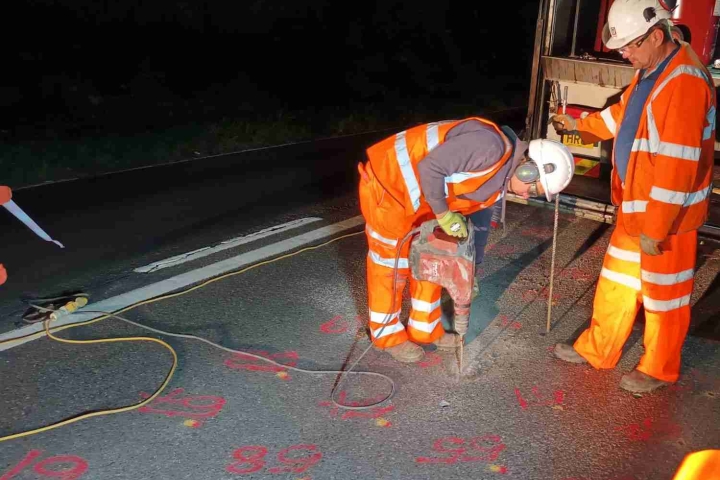
Geopolymer treatment offers an alternative option for road maintenance issues. Technicians drill from the surface and deploy quick and non-disruptive injections, which expand to fill irregular underground voids and stabilising foundations.
The drill holes used for geopolymer injections are 12-16 mm in diameter, meaning work can be completed by small teams with handheld equipment. Overall timelines are faster than traditional cement or steel methods as no large-scale excavation or heavy machinery is required, alleviating disruption delays by allowing many projects to keep traffic flowing while works take place.
On a section of the A22, geopolymers were used to stabilise slabs to reduce vibration felt in nearby properties. Technicians injected geopolymer resin across 20 locations, expanding to fill the voids and compact the base beneath the slab. The project was completed in one shift with no excavation or road closure required and resulted in a 83 per cent reduction in vibration.
Strong candidate for net-zero commitments
For councils with net-zero pledges, geopolymer projects have minimal waste generation, do not require water usage, and have lower carbon emissions compared to concrete excavation methods. Geopolymers are also environmentally neutral and verified by Environmental Impact Assessments (EIA) as safe to be used around waterways, limiting pollution offsets. A report by Carbon Footprint found 75% less carbon emissions were produced on the A22 compared to traditional methods.
Geopolymers increase the life cycle of roadways by addressing foundational problems, limiting reoccurrence of voids or holes. Geopolymers offer long-term effectiveness for 50 years, aligning with the Department for Transport’s Well-Managed Highway Infrastructure: A Code of Practice, which highlights a ‘right fix, first time’ philosophy. If retreatment is required, it can be completed simply and quickly unlike complete re-excavation projects with traditional methods.
The pressure on councils to handle the maintenance backlog is mounting, but ground engineering solutions do not have to be expensive and time-consuming. To discover more about Geobear’s advanced geopolymer projects like the A22 London Road case, read its project references here.