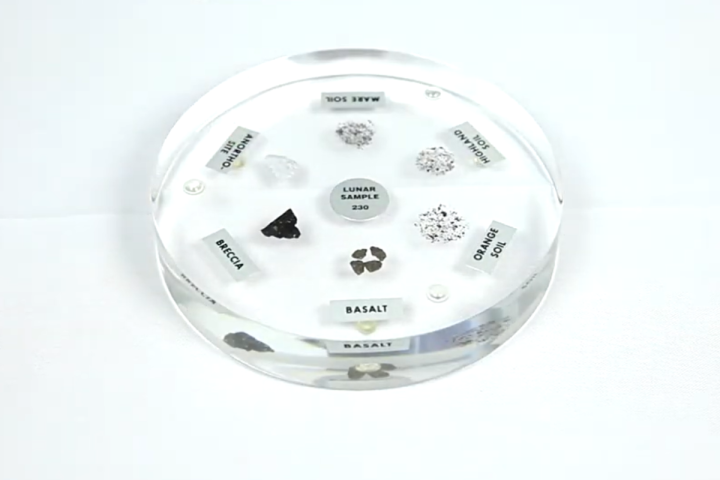
Samples of the Moon will be available to view up close at the University of Reading as stargazers get set for an evening of celebrating Earth’s nearest neighbour.
Rocks recovered from the NASA Apollo Moon missions will be displayed at Whiteknights campus on Saturday, 24 October, accompanied by outdoor stargazing and a series of talks for International Observe the Moon Night 2026.
This is the third time the University has hosted the event, which was originally organised by NASA and is replicated in various events all over the world.
Dr James O’Donoghue, the University of Reading planetary scientist spearheading this year’s event, explained: “Having real Apollo Moon samples on campus is a genuine once-in-a-lifetime moment for our visitors. These are actual pieces of another world, brought back by astronauts decades ago, and now people in Reading can stand right next to them. Pair that with a telescope view of the Moon overhead, and you get a rare chance to connect the history you can hold with the sky you can see.”
Sign-up for talks
The afternoon will commence with ticketed indoor talks from leading academics spanning multiple disciplines, from Archaeology and Classics to Meteorology and Planetary Science, running from 3pm to 6pm, before outdoor stargazing activities take place from 6pm to 8pm, weather permitting. Running alongside the main programme, the Ure Museum will be open from 2pm to 8pm, displaying the lunar samples and other space materials.
Registration for the event is open to everyone and is not limited, but those wishing to attend the indoor talks must request a talk ticket by selecting the option on the registration form. These talk tickets are limited to 350 and will be allocated on a first-come, first-served basis. Registration without a talk ticket still provides access to the Ure Museum display and outdoor stargazing activities.
Registration is now open: Book tickets for the Observe the Moon Night 2026
The talks will be recorded and made available online on the University of Reading’s International Observe the Moon Night event page. Visitors who cannot attend the main event on Saturday can still view the Apollo Moon samples at the Ure Museum, with no registration required, on Friday 23 October and Sunday 25 October, from midday to 4pm.
Programme
14:30 – 15:00
Registration / check-in for talks
Ticket holders sign in before entering G10.
Palmer Building, foyer and room G10
15:00 – 15:05
Event introduction
James O’Donoghue welcomes guests.
Palmer Building, room G10
14:00 – 20:00
PARALLEL: Ure Museum display
Lunar samples and space materials. Open throughout the talks and observing; no talk ticket needed.
Ure Museum, Edith Morley
Session 1 – The Past
15:05 – 15:25
Prof. Duncan Garrow (Archaeology; UoR)
What was the purpose of Stonehenge? The sun, the moon, and much, much more
Palmer Building, room G10
15:25 – 15:45
Dr. Sam Agbamu (Classics; UoR)
Romans and the Moon: The Scientific, the Sacred, and the Spooky
Palmer Building, room G10
15:45 – 16:05
Prof. Anne Lawrence-Mathers (History; UoR)
Viewing the Moon in the Middle Ages
Palmer Building, room G10
16:05 – 16:25
Prof. Amy Smith (Classics; UoR)
From Mercury to Artemis: What’s in a name?
Palmer Building, room G10
16:25 – 16:40
Break – 15 minutes
Palmer Building
Session 2 – The Present and Future
16:40 – 17:00
Prof. Mike Lockwood (Space; UoR)
Using the Moon to Study the Sun’s Atmosphere Through History
Palmer Building, room G10
17:00 – 17:20
Dr. Katherine Shirley (Space; U. of Oxford)
Searching for Water on the Moon
Palmer Building, room G10
17:20 – 17:40
Prof. Suzanne Gray (Meteorology; UoR)
The Weather’s Response to a Solar Eclipse
Palmer Building, room G10
17:40 – 18:00
Prof. Chris Scott (Space; UoR)
About the Moon Samples on Campus (recorded talk)
Palmer Building, room G10
18:00 – 20:00
Outdoor Moon observing — weather permitting
University and Reading Astronomical Society telescopes. General registration required. No talk ticket needed.
Palmer Quad
20:00
Event closes