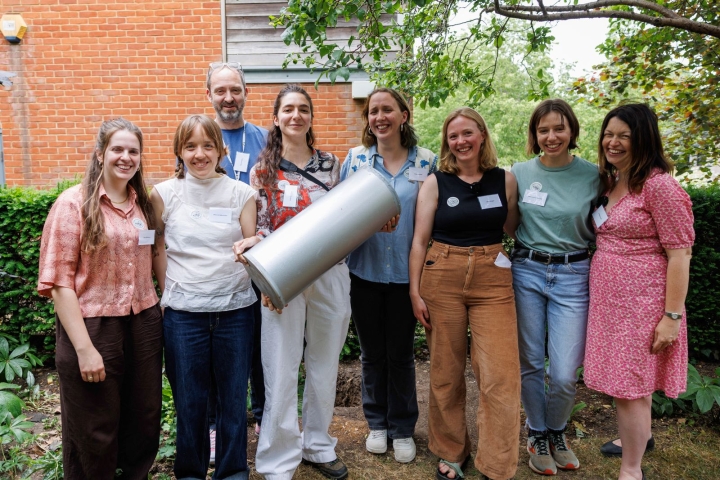
A time capsule packed with visions of the future of food and farming has been buried at the University of Reading, marking its centenary with a powerful message to generations yet to come.
The Farming the Future project celebrated the University’s global leadership in agrifood research and ties in with its Agrifood Futures Strategy, which is supporting research and teaching that work towards sustainable future farming systems.
The capsule captures a snapshot of education and research at Reading today, alongside contributions from staff, students and local communities that imagine what farming might look like a century from now.
The capsule was buried in the garden of the Museum of English Rural Life (The MERL), at the University’s London Road campus, on 1 June 2026.
Inspired by environmentalist Rob Hopkins and his emphasis on the role of imagination in shaping better futures, the project sought to create an optimistic narrative about the years ahead.
Blending science, creativity and personal reflection, the capsule brings together research outputs alongside more intimate contributions that might otherwise be lost.
Items in the capsule
A total of 62 items were buried in the capsule. Among the items are letters written by staff to the future, a jar of honey produced by the University’s beekeeping team at Sonning Farm and recipes from University chefs and colleagues.
Also in the capsule are postcards by schoolchildren at New Christ Church Primary School in Reading. These feature drawings and messages with creative ideas of future food systems.
Rosy Scholes, a PhD researcher in sustainable agriculture at Reading, who co-led the project, said: “It has been a joy to be a part of this project, co-creating a vision with our local community on what we want the future of food and farming to look like. By burying this time capsule, we’re sending a small message to the future, not just about what we know today, but about the futures we hoped for, the questions we were asking, and the world we are trying to leave behind.”
Phillippa Heath, Head of Learning and Engagement in the University’s Museums and Special Collections, said: “For The MERL, being involved in this project was incredibly exciting. It allowed us to explore farming practices past and present through the museum collections and to invite our communities to contemplate what farming might look like in a hundred years’ time.
“For our visitors, it is the perfect project through which they can trace the lines from our heritage collections, to our present day and then towards our imagined futures.
“It is incredibly moving that some of these ideas will have a permanent home for the next 100 years in this time capsule in The MERL garden and to speculate how many of those ideas might be realised.”
The capsule is intended to be reopened in 2126, offering future generations a window into the University’s centenary year.
An archive of its contents will be preserved at The MERL, with a public exhibition planned to open in September.University of Reading Centenary Time Capsule MERL