New research1 suggests a generational shift in when parents begin considering their children’s future working lives – from the later years of secondary school to the first years of primary school.
Two surveys, commissioned by BMW Group UK, questioned 2,500 UK parents in total, comparing the experiences of parents raising children today with those whose children have already reached early adulthood.
Among 2,000 parents who have already begun considering their child’s future working life, nearly six in ten (58%) started during the primary-school years, between ages four and 11. Ages four to six, when children are at the start of their educational journey in Reception and Year 1, was the single most commonly selected age band, chosen by three in ten (30%).
By contrast, half (50%) of the 500 parents whose children are now aged 19–24 said they began when their child was aged 15–18. Almost two fifths (38%) now wish they had started thinking about their child’s career options earlier.
The findings come as BMW Group UK launches Apprentice 2036, a campaign designed to inspire children and help families navigate the changing world of work. As the UK’s third largest vehicle manufacturer, developing future talent across its four UK production sites (Oxford, Swindon, Hams Hall and Rolls-Royce at Goodwood), as well as its Farnborough headquarters and nationwide retailer network, is a long-term business priority.
Children starting school today could be applying for their first apprenticeships in 2036, following a pathway currently taken by nearly 500 BMW Group UK apprentices in roles spanning automotive technology, manufacturing and engineering, marketing and communications.
At the heart of the campaign is The Spark Lab, a hands-on electric-vehicle engineering workshop created for five and six-year-olds – the age at which career thinking most commonly began among surveyed parents.
The research found strong support for giving children earlier experience of the working world. More than three quarters of parents (76%) agree that primary school children should have more opportunities to visit workplaces and try practical activities such as engineering and technology.
The demand comes as rapid technological change creates both opportunity and uncertainty for families. More than three quarters (78%) believe artificial intelligence will significantly change the jobs available to their child, while almost half (49%) say they don’t know which skills their child will need to succeed in the future workplace.
Nearly two thirds (63%) believe it will be harder for children to find a job in ten years than it is today. Almost three quarters (72%) say they would feel more confident about their child’s future career if employers provided more information.
Parents nevertheless see practical education and training as an important route into employment. Almost four in ten (39%) would like their child to consider an apprenticeship when finishing secondary education, making it the second most-selected route behind university (48%) and ahead of full-time employment (35%).
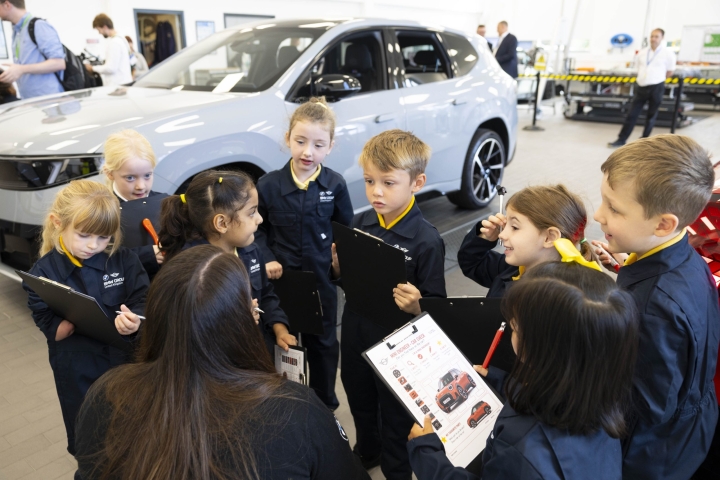
Created by BMW Group UK, The Spark Lab welcomed Year 1 pupils from Grazeley Church of England Primary School to the BMW Group Academy UK in Reading.
Through age-appropriate practical activities, pupils explored electric vehicles, batteries, charging technology and even designed their own EVs of the future. The workshop also encouraged problem solving, communication and creativity – the three skills parents most commonly said they want their children to develop from a young age.
The Spark Lab connects this early inspiration with BMW Group UK’s established investment in skills and employment. BMW Group UK apprenticeships offer career opportunities spanning accident repair and automotive technology to manufacturing, engineering, marketing and communications. Apprentices earn a salary from day one, while Level 6 degree apprentices can earn their degree without taking on student debt.
BMW Group employs around 9,000 people in the UK and supports nearly 50,000 jobs across the wider economy.
Sam Jarvis, HR Director for UK & Ireland at BMW Group UK, said: “Parents can see that technology is changing working life, so it is understandable that many are beginning to think about their children’s futures earlier.
“The vehicles today’s five and six-year-olds could one day help to design, build, maintain or explain will be very different from those we know now. What we do know is that we will need curious, creative and highly skilled people to help create and sell the cars of the future.
“Apprenticeships combine recognised qualifications with practical experience and the opportunity to earn a salary from day one. They give young people skills that can serve them throughout their careers while helping businesses develop the talent they will need in the future.
“Through Apprentice 2036 and The Spark Lab, we want to make engineering and technology feel exciting and accessible – and show children that they can have a place in their future.”
Christine Armstrong, Future of Work expert, said: “Introducing children to the world of work at five or six seems early, but it isn’t about asking them to choose a career. It’s about them and their parents seeing different kinds of jobs and workplaces, noticing what fascinates them and broadening their understanding of the opportunities available to them.
“People joke that younger generations all want to become YouTubers or influencers, but it makes sense when those are some of the careers they see most often. There are thousands of jobs and routes into work that children, and parents, simply may not know exist.
“As the world of work changes, one of the most useful things parents and employers can do is broaden children’s horizons by helping them explore what different careers can look like. Trying to choose a job is a dauting challenge. But initiatives like BMW Group UK’s Spark Lab can help make that thinking feel tangible from an early age.”
Millie Strongitharm, Underwriting Apprentice at BMW Group UK Farnborough HQ, said: “Choosing an apprenticeship is the best decision I’ve ever made. I was planning to go to university but realised getting straight into the workplace to build my future was the best decision for me.
“My apprenticeship means I can earn a salary, gain a degree and build real-world experience without taking on debt. It’s given me a head start financially and I’m already working towards life goals like buying my own house.
“I’m also passionate about inspiring other young people and have even visited a local school and my old college to ensure they know how beneficial an apprenticeship can be. University can be a brilliant option, but it shouldn’t feel like the automatic next step.”
For more information, to watch The Spark Lab in action and discover practical resources for parents and teachers to help inspire children’s curiosity around engineering, technology and future careers, visit www.bmwgroup.jobs/gb/en/apprentice-2036.