The vibrant, multicultural backdrop of Florida prepares to host a true blockbuster encounter as the 2026 FIFA World Cup group stages race towards their dramatic conclusion. Scheduled to kick off at exactly 00:30 BST on Sunday, 28 June 2026, European heavyweights Portugal will clash with South American powerhouses Colombia. Staged beneath the spectacular, modern architecture of the Miami Stadium in Miami Gardens, this highly anticipated Matchday 3 fixture will definitively settle the absolute summit of Group K. With both proud nations already showcasing moments of genuine, world-class quality during their respective North American adventures, the upcoming ninety minutes promise an intoxicating blend of tactical intrigue, fierce physical battles, and breathtaking individual brilliance. Millions of fans tuning in across the globe can readily anticipate a fiercely contested affair that perfectly encapsulates the unforgiving essence of tournament football.
The Group K Equation
Navigating the immense complexities of the newly expanded tournament format has yielded a fascinating, high-stakes scenario for these two ambitious sides. Currently, the South American outfit sits majestically at the top of the group standings with a flawless six points from their opening two assignments, boasting a highly impressive goal difference of plus three. Roberto Martínez’s European champions trail closely in second place on four points, having recorded a heavily improved goal difference of plus five following a record-breaking recent performance.
The mathematical reality heading into the weekend is straightforward but heavily impactful. A hard-fought draw is entirely sufficient for Néstor Lorenzo’s Colombian squad to guarantee progression as group winners. Securing the top seed theoretically offers a much more forgiving pathway through the newly introduced Round of 32, ensuring they avoid other heavyweight group leaders in the immediate knockout phase. For the Portuguese, nothing less than an outright victory will suffice to successfully leapfrog their upcoming opponents. If they fail to secure three points, they will have to settle for the runner-up spot, though their dominant goal difference ensures their place in the knockout rounds is effectively untouchable regardless of the final result.
Portugal’s Search for Rhythm and Ronaldo’s Legacy
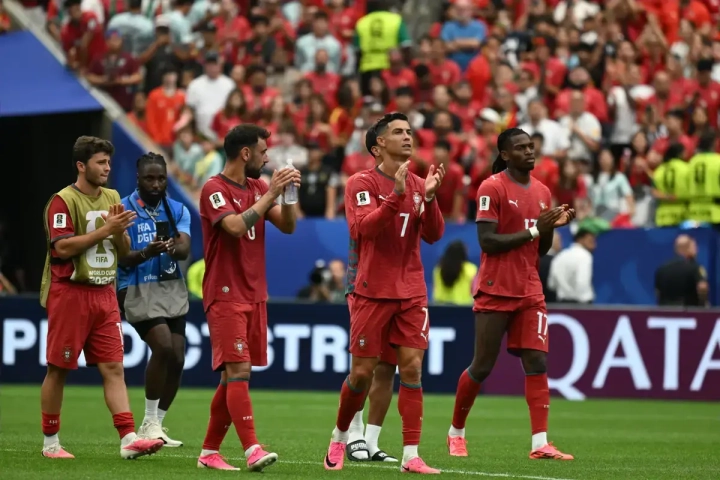
Arriving at the tournament heavily tipped as genuine title contenders, the Iberian nation experienced a slightly stuttering start to their campaign. A deeply frustrating 1-1 stalemate against an incredibly resolute DR Congo side immediately raised questions regarding their attacking fluidity against entrenched defensive blocks. However, their subsequent response was nothing short of emphatic. Taking out their frustrations on Uzbekistan, they delivered a breathtaking 5-0 demolition that immediately sent shockwaves throughout the global tournament.
The undisputed headline from that emphatic victory was the enduring, timeless brilliance of Cristiano Ronaldo. Competing in a record-breaking sixth World Cup at the age of 41, the legendary forward netted a phenomenal first-half brace, firmly silencing any lingering critics and proving his elite predatory instincts remain as sharp as ever. Supported by additional strikes from Nuno Mendes and Rafael Leão, the commanding performance served as a stark, intimidating warning to the rest of the competition.
Martínez has carefully cultivated a highly fluid, possession-based tactical system, demanding immense versatility from his exceptionally talented squad. Key figures like João Cancelo, Diogo Dalot, and Bernardo Silva frequently interchange positions, deliberately creating structural overloads to completely overwhelm opposition midfield units. However, the manager did make ruthless choices prior to the tournament, completely excluding midfield enforcer João Palhinha and promising defender António Silva from the final travelling squad. The distinct absence of a traditional, physical defensive midfielder places a significant, demanding burden on João Neves and Vitinha to entirely control the central zones against physically imposing opposition.
Colombia’s Impressive Resurgence Under Lorenzo
Standing resolutely across the tactical divide is a Colombian squad riding a massive wave of immense momentum and fervent national pride. Having agonizingly failed to qualify for the 2022 edition in Qatar, Los Cafeteros have returned to the global stage with a massive point to prove. Lorenzo has meticulously built a deeply resilient, perfectly balanced unit that excels at intelligently managing the overall tempo of international fixtures.
Their campaign commenced with a commanding 3-1 victory over Uzbekistan, a performance heavily defined by their clinical counter-attacking execution. They then displayed a completely different, highly impressive dimension to their game, demonstrating immense defensive fortitude to secure a gritty 1-0 victory against a physically demanding DR Congo side. The central defensive partnership of Davinson Sánchez and Jhon Lucumí has been particularly outstanding, providing a highly reliable, robust foundation that allows the dynamic full-backs to aggressively push forward.
The creative heartbeat of the team undoubtedly remains the evergreen James Rodríguez. The 34-year-old playmaker, whose sensational performances famously lit up the 2014 World Cup, continues to orchestrate proceedings with his trademark vision and pinpoint passing range. Further forward, the explosive pace and elite dribbling ability of Luis Díaz present a terrifying prospect for any right-back. Having recently completed a high-profile transfer to German giants Bayern Munich, Díaz is currently operating at the absolute peak of his powers, consistently stretching opposition defensive lines and providing the crucial final product.
Anticipated Tactical Battlegrounds
Analysing the granular details of this impending matchup reveals a fascinating clash of overarching footballing philosophies. The European representatives will undoubtedly seek to utterly monopolise territorial possession, utilising patient, intricate passing networks to consistently probe for defensive vulnerabilities. They will look to intentionally isolate Leão or Francisco Conceição against the Colombian full-backs, actively attempting to manufacture premium space for Ronaldo inside the congested penalty area.
Recognising their opponents’ sheer technical dominance in tight areas, the South Americans will likely embrace a slightly more pragmatic, reactive posture. Lorenzo will firmly instruct his side to deploy a rigorous, heavily congested midfield block, aiming to ruthlessly disrupt the crucial passing lanes leading to Bruno Fernandes and Bernardo Silva. Once possession is successfully recovered, the devastating transition speed of Díaz and Jhon Córdoba will be immediately weaponised to launch rapid, highly dangerous counter-attacks.
Area of the Pitch | Portugal Key Figure | Colombia Key Figure | Tactical Significance |
Central Midfield | Vitinha | Jefferson Lerma | A monumental battle for creative control. Lerma must aggressively disrupt the passing lanes, while Vitinha is tasked with dictating the overarching match rhythm. |
The Flanks | João Cancelo | Luis Díaz | Díaz’s devastating pace against the overlapping runs of the Portuguese full-back. Exploiting the vast spaces left behind by Cancelo could provide Colombia’s best route to goal. |
The Penalty Box | Cristiano Ronaldo | Davinson Sánchez | Elite attacking movement against highly experienced, physical defending. Sánchez must perfectly command the crucial aerial duels to entirely nullify the primary European offensive threat. |
Squad Availability and Final Preparations
Preparation for this monumental Group K finale has fortunately been largely unhindered by severe medical crises within either camp. Both managers currently boast remarkably healthy squads, allowing them the luxurious flexibility of confidently selecting their absolute strongest starting elevens.
Following the physically undemanding nature of their commanding victory over Uzbekistan, Martínez may carefully opt to retain the exact same starting lineup, banking heavily on the rapidly developing chemistry within the final third. However, given the famously taxing, humid climate of Florida, minor rotation in the wide areas cannot be entirely ruled out, with Pedro Neto and João Félix eagerly awaiting an opportunity from the substitutes’ bench.
Lorenzo faces similar, highly enviable selection dilemmas, albeit born entirely from luxury rather than necessity. Midfielder Kevin Castaño has heavily impressed with his immense work rate and could potentially be introduced to provide additional defensive solidity alongside Lerma. Furthermore, the highly reliable Camilo Vargas will undoubtedly retain his permanent position between the posts, having consistently provided calm organization and crucial saves under immense pressure throughout the opening two fixtures.
The Final Word
Encounters between these two distinct footballing cultures offer a fascinating historical perspective, typically characterised by high technical quality and intense competitive friction. For the passionate, vibrant supporters converging on the magnificent modern architecture of the Miami Stadium, the extensive theoretical planning and exhaustive video analysis will immediately give way to raw, competitive tournament survival.
For the seasoned European heavyweights, the late-night British fixture provides a golden, unmissable opportunity to definitively assert their absolute dominance, firmly secure top spot in Group K, and send a resounding, intimidating message to their future knockout opponents. For the ambitious South American challengers, it represents the ultimate test of character against elite international opposition, offering the rare chance to confirm their impressive resurgence on the grandest global stage. Millions of fans tuning in around the world can readily anticipate an intriguing, fiercely contested encounter that perfectly encapsulates the unforgiving, dramatic essence of the FIFA World Cup.