
The margins for error at the FIFA World Cup are famously non-existent, and for the Czech Republic and South Africa, the tournament has already reached a critical juncture. Scheduled for Thursday, 18 June 2026, with kick-off at 17:00 BST, this high-stakes Group A fixture will unfold beneath the spectacular, climate-controlled roof of the Atlanta Stadium in Georgia. Having both suffered deeply frustrating defeats in their opening matches, the two nations arrive in the American South knowing that another loss will almost certainly extinguish their hopes of progressing to the knockout phases of the competition.
The narrative surrounding this pivotal fixture is heavily dictated by the disappointments of the opening round. Making their long-awaited return to the global stage after a two-decade absence, the Czech Republic experienced a bitterly familiar tale of squandered advantages. Despite taking a promising lead through a trademark Ladislav Krejčí header, Miroslav Koubek’s side ultimately succumbed to a 2-1 defeat at the hands of South Korea in Guadalajara. The European outfit enjoyed periods of sustained territorial pressure and dominated the set-piece statistics, but failed to capitalise on their physical advantages, allowing their energetic Asian counterparts to snatch all three points.
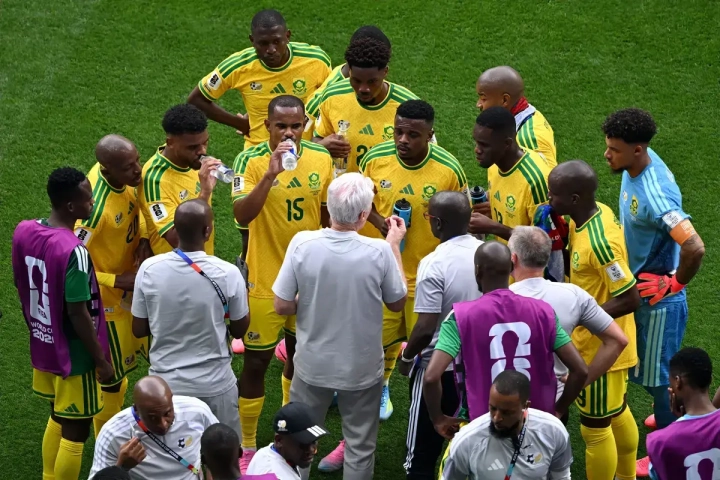
For South Africa, the start of the 2026 campaign was altogether more bruising. Facing co-hosts Mexico in front of a fiercely partisan crowd in Mexico City, Bafana Bafana were comprehensively outplayed in a 2-0 defeat. Hugo Broos watched his side struggle to retain possession or mount any meaningful attacking sequences, registering a mere two touches inside the Mexican penalty area throughout the entire ninety minutes. To compound their tactical misery, the African side completely lost their disciplinary composure during the second half, resulting in two devastating red cards that will have profound implications for this upcoming clash.
Addressing the sudden, glaring void in the centre of the park is undeniably the most pressing issue for the South African coaching staff. First-choice midfield anchor Yaya Sithole and veteran playmaker Themba Zwane are both officially suspended following their dismissals against the Mexicans. Losing two foundational pillars of the starting eleven forces Broos into an unwanted, extensive tactical reshuffle during an absolute must-win scenario.
In their absence, the heavy responsibility of dictating the tempo and shielding the vulnerable backline is expected to fall upon the shoulders of Jayden Adams and Thalente Mbatha. This newly formed, relatively untested midfield partnership faces a monumental task against a highly organised and physically imposing Czech engine room. Furthermore, the tactical focus must urgently shift towards providing adequate service to lone striker Lyle Foster. The Burnley forward cut an incredibly isolated figure during the opening fixture, starved of any creative distribution. To remedy this glaring issue, dynamic winger Oswin Appollis is widely anticipated to be recalled to the starting lineup, explicitly tasked with injecting vital pace, creativity, and width into a stagnant attacking unit.
Conversely, the European challengers possess a fully fit squad and are highly unlikely to deviate drastically from the systematic approach that secured their qualification. Operating primarily in a robust 3-4-2-1 formation, Koubek’s philosophy relies heavily on defensive solidity, aggressive wing-back play, and an overwhelming, constant threat from dead-ball situations. The squad arrived in North America in fine form, having recorded impressive warm-up victories over Kosovo and Guatemala, suggesting that their opening-day defeat was a momentary lapse rather than a structural failure.
The central defensive trio of Štěpán Chaloupek, Robin Hranáč, and the goalscoring Krejčí provides a formidable physical barrier that South Africa will find remarkably difficult to breach. In midfield, the towering presence of West Ham United’s Tomáš Souček serves as the undisputed heartbeat of the national team. Operating as captain, his elite ability to break up opposition counter-attacks and arrive late into the penalty box remains one of the most potent weapons in the Czech arsenal.
While the defensive structure appears structurally sound, persistent questions linger over their attacking fluidity from open play. Patrik Schick, the premier focal point of the attack, was expertly marshalled by the South Korean defence and will be absolutely desperate to open his 2026 account. Koubek faces a pleasant, yet complicated selection dilemma in the supporting attacking midfield roles. Bayer Leverkusen’s Adam Hložek is pushing intensely for a starting berth ahead of Pavel Šulc, following a highly impactful cameo appearance off the substitutes bench in the previous match.
The upcoming ninety minutes in Atlanta promise to deliver a fascinating stylistic contrast. The Czech Republic will naturally seek to monopolise possession, systematically utilising the relentless overlapping runs of Vladimír Coufal down the right flank to bombard the South African penalty area with early crosses. If the European side can successfully isolate the African full-backs and force a barrage of corner kicks, their significant height advantage could easily prove to be the defining factor of the contest.
South Africa, meanwhile, must embrace a more reactive, pragmatic counter-attacking blueprint. Acknowledging their physical disadvantages and heavily depleted midfield, Broos will likely instruct his team to sit in a compact, disciplined low block. The overarching objective will be to absorb the inevitable waves of pressure and ruthlessly exploit the vast spaces left behind by the advancing Czech wing-backs. Rapid, vertical transitions through Appollis and Relebohile Mofokeng will be absolutely critical to alleviating the defensive siege and offering Foster genuine goalscoring opportunities on the break.
Key Tactical Battlegrounds
Area of the Pitch | Czech Republic | South Africa | Tactical Significance |
Central Midfield | Tomáš Souček | Jayden Adams | Souček’s immense international experience and physicality against a newly formed, depleted South African midfield. Dictating the central tempo here is vital for territorial control. |
The Penalty Box | Ladislav Krejčí | Lyle Foster | An aggressive, highly physical duel. Krejčí must nullify Foster’s elite hold-up play to prevent South Africa from establishing any sustained attacking rhythm. |
The Wide Channels | Vladimír Coufal | Aubrey Modiba | Coufal’s relentless crossing ability will severely test Modiba’s defensive positioning and aerial competence at the back post during prolonged spells of pressure. |
Encounters between these two distinct footballing cultures are exceptionally rare. In fact, they have only crossed paths on one previous occasion in senior international football. That solitary meeting occurred nearly three decades ago during the 1997 FIFA Confederations Cup in Riyadh, resulting in a highly entertaining 2-2 draw. At the time, South Africa were the reigning African champions, while the Czechs were fresh off a historic appearance in the final of Euro 1996. While that historical footnote provides little tangible insight into the modern tactical landscape, it highlights the sheer unpredictability of intercontinental clashes on the grandest global stage.
Looking purely at the mathematics of Group A, the stakes simply could not be higher. In the expanded 48-team tournament format, the eight best third-placed teams will eventually advance to the newly introduced Round of 32 alongside the top two finishers from each group. However, securing zero points from the opening two fixtures usually requires a miraculous, highly improbable combination of results elsewhere to avoid early elimination.
A draw in Atlanta would keep both nations mathematically alive but leave them entirely reliant on goal difference and highly favourable outcomes in their final round of matches. Therefore, a cautious, tentative approach benefits absolutely no one. As the match progresses into the second half, desperation will inevitably dictate the tempo, forcing both managers to eventually abandon any lingering pragmatism and commit bodies forward in search of a crucial tournament lifeline.
When the players finally emerge from the tunnel into the controlled environment of the Atlanta Stadium, the extensive theoretical planning and exhaustive video analysis will immediately give way to raw, competitive survival. For the Czech Republic, it is a golden opportunity to validate their return to the World Cup and demonstrate the clinical edge that was glaringly missing in Guadalajara. For South Africa, it represents a monumental test of character and squad depth in the face of severe adversity. Millions tuning in globally can readily anticipate a tense, deeply physical, and ultimately decisive encounter where losing is simply not an option.