
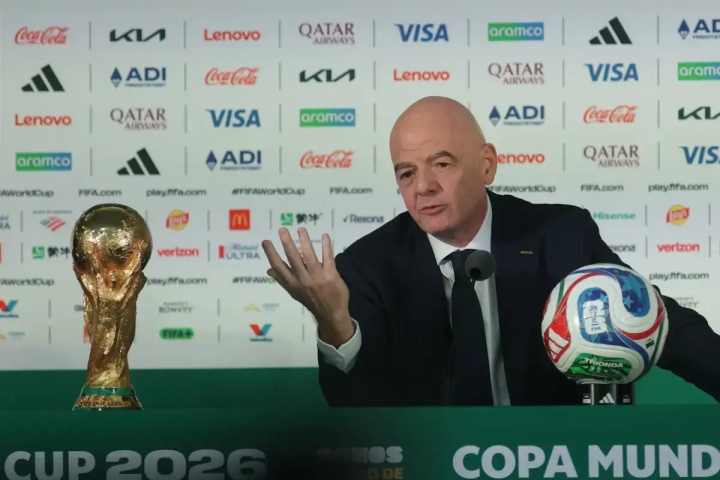
The political earthquake shaking the very foundations of global football shows absolutely no sign of subsiding. Following the spectacular collapse of FIFA’s proposed $20 billion commercial privatisation scheme on Friday, the intense backlash against President Gianni Infantino has officially transitioned from boardroom outrage into a formal electoral rebellion.
On Monday, the Football Association of Wales (FAW) became the first national federation to publicly withdraw its support for Infantino’s 2027–2031 re-election bid. Reports rapidly followed that the English Football Association is taking identical action, plunging the 56-year-old’s once-impregnable grip on the sport into unprecedented jeopardy. What initially appeared to be a diplomatic retreat over the weekend has now evolved into a highly coordinated, multi-continental campaign to remove the Swiss official from the helm of world football entirely.
The Home Nations Strike First
Infantino had previously announced his intention to seek a fourth effective term at the FIFA Congress in Rabat, Morocco, in March 2027. Having been re-elected unopposed in both 2019 and 2023, the upcoming ballot was widely viewed as a procedural formality. However, the disastrous handling of the recent investment proposals has fundamentally fractured his traditional power base.
The FAW delivered a scathing public assessment of the current administration on Monday morning. “The Football Association of Wales hereby confirms its withdrawal of support for the candidature of Mr Gianni Infantino, for re-election as FIFA President for the 2027–2031 term,” the governing body stated.
Outlining their rationale in stark terms, the statement continued: “The recent failures in good governance, processes, leadership, values, stakeholder management, communications and sound judgement have led us to a position where Mr Infantino has lost the confidence of the FAW to remain at the helm of world football. Failing to put the best interests of football first is a failure we cannot accept.”
The English FA is understood to have sent formal correspondence to Zurich echoing these exact sentiments, withdrawing their backing and demanding a “full and robust review” of FIFA’s leadership structures. The political pressure within the United Kingdom is also mounting rapidly. Speaking in Manchester over the weekend, Prime Minister Andy Burnham stated it was the right decision for FIFA to back down, having previously called the commercial plans “outrageous”. The Prime Minister boldly added that bringing such plans forward made it abundantly clear that Infantino was “the wrong man to lead the organisation”.
The Catalyst: A $4.2bn Miscalculation
The catalyst for this unprecedented mutiny was the covertly developed ‘FIFA Forward Enterprise’ (FFE) initiative. Infantino had championed a plan to sell an approximate 20 per cent stake in a newly created commercial entity that would directly manage the lucrative rights to the World Cup and other major global tournaments. Designed to raise up to $4.2 billion from private equity investors, the proposal was marketed to smaller member associations as a mechanism to drastically increase infrastructure funding and central payments.
However, the sport’s traditional powerhouses viewed the move as an unforgivable attempt to permanently privatise football’s most sacred cultural asset. Faced with a unified tournament boycott threat from UEFA and the sudden, fierce opposition of CONCACAF and the Asian Football Confederation (AFC), FIFA abruptly abandoned the scheme late on Friday evening. Yet, the swift capitulation was not nearly enough to salvage Infantino’s severely damaged reputation.
UEFA’s Wrath and Legal Posturing
Over the weekend, UEFA unleashed a blistering attack on the FIFA leadership, explicitly stating that Infantino had unequivocally lost the confidence of the European confederation. Condemning the initiative as a product of “secret schemes,” “shabby backroom deals,” and “faceless individuals,” European administrators made it perfectly clear that a simple withdrawal of the proposal would not end the hostilities.
The fiery rhetoric has been matched by aggressive administrative action. UEFA has reportedly issued a strict document preservation order to FIFA, legally demanding the retention of all emails, files, and relevant digital data pertaining to the FFE negotiations. While UEFA stopped short of officially confirming the immediate initiation of a lawsuit, the looming threat of intense legal scrutiny now hangs heavily over the Zurich headquarters in anticipation of future proceedings.
Compounding the crisis, Infantino is facing a severe internal revolt. His long-term adviser, Carlos Cordeiro, a highly influential figure within the organisation, chose to resign in protest over the initial privatisation proposals. Furthermore, FIFA’s chief operating officer reportedly claimed that Infantino “deceived” his own staff regarding the true nature of his commercial plans.
Desperate Measures in Washington
With his European and North American alliances in tatters, Infantino is reportedly scrambling to secure high-level political backing to save his presidency. According to sources familiar with the matter, the FIFA President has repeatedly attempted, and failed, to reach United States President Donald Trump by phone since the collapse of the investment plan on Friday.
Having failed to secure a direct line to the Oval Office, Infantino reportedly scheduled private, urgent discussions with US Secretary of State Marco Rubio for Monday morning. While the official agenda was delicately framed around discussing soccer as a tool for American “soft power,” insiders have cynically characterised the diplomatic outreach as a desperate bid for job protection. Relying on geopolitical heavyweights to salvage a sporting presidency underscores the sheer magnitude of Infantino’s isolation from his traditional footballing constituencies.
The Mechanics of an Ousting
The path to forcefully removing a sitting FIFA President is constitutionally complex, but the current climate makes it a highly tangible reality. There are primarily two mechanisms through which Infantino could be unseated before his term naturally expires or is renewed.
Firstly, member associations can trigger a formal vote of no confidence. To convene an Extraordinary FIFA Congress for this specific purpose, 43 of the 211 member associations must formally request the assembly. Given that UEFA alone possesses 55 voting members, this threshold has effectively already been surpassed if European unity holds firm. Such a congress often handles urgent decisions regarding leadership and governance.
Alternatively, Infantino could be legitimately defeated at the ballot box during the scheduled March 2027 elections. For this to occur, a credible challenger must be officially nominated by at least one member association before the strict November 18, 2026, deadline. To secure the presidency, a candidate requires 106 votes to ensure a majority in a contested election, conducted via a secret ballot.
The Contenders in the Shadows
As the scent of vulnerability surrounds Infantino, leading officials have already begun the delicate process of identifying potential successors to lead the post-crisis era. While no candidate has officially declared their intention to run, several prominent figures within the global game are being heavily monitored by the international press.
Victor Montagliani, the current CONCACAF president and a FIFA vice-president, is reportedly prepared to step forward. His confederation’s recent, highly public break from Infantino’s administration suggests a calculated distancing from the current regime, positioning him as a viable reform candidate from the Americas.
Paris Saint-Germain president and UEFA Executive Committee member Nasser Al-Khelaifi has also been touted as a highly influential potential challenger. Al-Khelaifi wields immense power as the chairman of the European Club Association and holds crucial ties to the Middle Eastern footballing infrastructure, having served on the organising committee for the 2022 World Cup.
Additionally, Mattias Grafstrom, the current General Secretary of FIFA, is considered a fascinating potential candidate. Although he has worked intimately alongside Infantino and has been a member of the FIFA Council since 2019, his deep understanding of the organisation’s internal mechanics makes him a viable alternative for federations seeking institutional stability without complete, chaotic upheaval.
A Legacy on the Brink
The current mutiny is merely the culmination of a disastrous summer for Infantino. The president was already facing intense scrutiny following the 2026 World Cup in North America, which was heavily marred by political controversies. Widespread outrage previously erupted over the handling of a disciplinary scandal involving United States forward Folarin Balogun. While Infantino avoided formal Olympic Committee sanctions over the incident, it severely eroded the trust of traditional footballing nations. When the $20 billion privatisation scheme was subsequently revealed, that lingering resentment immediately ignited into an open revolt.
Gianni Infantino swept to power in 2016, promising to usher in an era of absolute transparency and accountability following the catastrophic corruption scandals that decimated Sepp Blatter’s regime. A decade later, he is accused by UEFA of failing to deliver on those exact pledges, allegedly operating through opaque channels to force through highly controversial commercial restructures.
The withdrawal of support from Wales and England is highly unlikely to be an isolated incident. As the week progresses, it is entirely probable that other European and international federations will formally declare their lack of confidence, following the precedents set in Cardiff and London.
Global football is now engaged in a fierce, existential battle for its future governance. Whether through a forced emergency Congress or a fiercely contested election in Morocco, the consensus is rapidly solidifying: the current administration has irrevocably lost the dressing room, and the race to find the next leader of the world’s most popular sport has emphatically begun.