A Gruelling Finale in New Jersey
The sprawling expanse of the New York New Jersey Stadium in East Rutherford served as the grandiose theatre for the highly anticipated conclusion to the biggest tournament in football history. Kicking off exactly at 20:00 British Standard Time on Sunday, 19 July 2026, the FIFA World Cup Final delivered an encounter defined by immense psychological tension, tactical subjugation, and late drama. When the final whistle echoed across the humid American night, it was the reigning European champions who emerged victorious, securing a gruelling 1-0 triumph over Argentina after extra time.
For Luis de la Fuente’s masterful squad, the historic victory officially crowns them as global sovereigns, ending a 16-year wait for their second men’s world title. The achievement cements an unprecedented legacy, as they become the first nation to hold both the men’s and women’s FIFA World Cup trophies simultaneously. Conversely, Lionel Scaloni’s defending champions suffered a deeply agonising conclusion to their ambitious North American campaign. Depleted to ten men following a late red card and thoroughly outplayed for the vast majority of the contest, the South Americans were ultimately undone in the 106th minute by a clinical strike from substitute Ferran Torres.
Tactical Blueprints and Unwanted Records
Heading into the monumental fixture, the overarching tactical narrative presented a fascinating clash of distinct footballing ideologies. Aiming to establish immediate midfield supremacy, De la Fuente orchestrated his side in a fluid 4-1-2-3 system. The metronomic Rodri anchored the midfield pivot, granting Fabián Ruiz and Álex Baena the freedom to dictate the tempo and support a dynamic attacking trident of Lamine Yamal, Mikel Oyarzabal, and Dani Olmo.
Across the technical area, Scaloni adopted a more pragmatic, robust 4-4-2 formation. Emiliano Martínez started between the posts, securely protected by a defensive line featuring Gonzalo Montiel, Cristian Romero, Lisandro Martínez, and Nicolás Tagliafico. Operating with a midfield quartet of Rodrigo De Paul, Enzo Fernández, Alexis Mac Allister, and Nicolás González, the defending champions heavily prioritised defensive solidity, hoping to release Lionel Messi and Julián Alvarez on rapid counter-attacks.
From the referee’s opening whistle, the encounter descended into a remarkably one-sided affair. Dictating the rhythm with their trademark, suffocating possession-based football, the European giants pinned their illustrious opponents deep into their own territory. Astonishingly, the first 45 minutes produced an unwanted piece of World Cup history. The South American challengers failed to register a single shot before the interval, becoming the first team since detailed records began in 1966 to achieve such a dubious milestone in a final. Despite completing roughly twice as many passes and unleashing three attempts on goal, the dominant Iberian outfit simply could not breach an exceptionally resolute defence. Further complicating matters for the defending champions, Lisandro Martínez sustained a first-half injury, forcing an unplanned 43rd-minute substitution that saw veteran defender Nicolás Otamendi introduced into the fray.
Second-Half Frustration and Fernandez’s Dismissal
Emerging from the dressing rooms, the established pattern of suffocating pressure and deep defensive resistance continued unabated. Eager to inject a more clinical edge into the final third, both managers turned to their substitutes’ benches near the hour mark. Leandro Paredes and Nahuel Molina had already entered the match for Argentina, while Spain refreshed their attacking options by introducing Pedri and Ferran Torres in the 61st minute for Fabián Ruiz and Mikel Oyarzabal respectively.
The relentless territorial dominance eventually began to stretch the weary South American rearguard. Teenager Yamal proved to be an absolute menace on the right flank, consistently weaving past challenges and delivering dangerous crosses. Goalkeeper Emiliano Martínez emerged as a colossal figure, producing a string of phenomenal saves to keep his nation within touching distance. As the ninety-minute mark rapidly approached, frustration and physical exhaustion visibly seeped into the Argentine ranks.
The defining moment of regular time arrived deep into stoppage time. Battling desperately to contain a swift transition, Enzo Fernández committed a reckless, heavy challenge that sent Spanish defender Pau Cubarsí cartwheeling into the air. Having already been cautioned in the 81st minute, the midfielder was immediately shown a second yellow card by referee Slavko Vincic in the 90th minute (90+2′), reducing the defending champions to ten men for the impending extra-time period. Following a subsequent foul, Yamal curled a magnificent free-kick toward the right post in the 98th minute, but Martínez produced a breathtaking, diving intervention to push the ball away—his tenth save of the match, setting a new record for a World Cup final.
Extra-Time Breakthrough and Desperate Measures
Facing a numerical disadvantage and suffocating exhaustion, the ten-man Argentine outfit retreated completely, hoping to survive the final thirty minutes and force the dreaded lottery of a penalty shootout. Nico Williams and Mikel Merino were brought on for Spain, further amplifying the relentless wide pressure.
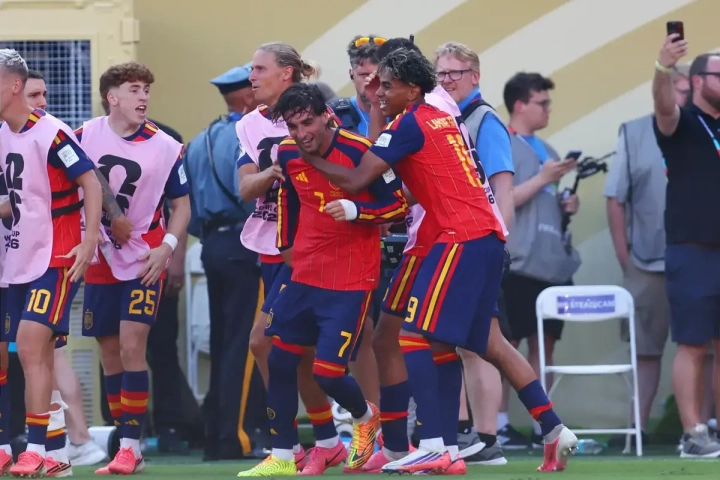
Ultimately, the persistent defensive wall was shattered in the opening minute of the second period of extra time. Initiating a sweeping, intricate passing move, Pedro Porro found space on the right wing and delivered a deep, tantalising cross into the penalty area. Surging unmarked at the far post, the recently introduced Williams intelligently headed the ball back across the face of the goal. Arriving perfectly on cue in the 106th minute, Ferran Torres pounced on the bouncing ball, lashing a fierce, left-footed strike that cannoned into the roof of the net. The spectacular finish sparked scenes of unrestrained, chaotic jubilation among the Spanish players and their travelling supporters.
Desperately throwing caution to the wind, Scaloni’s shattered squad abandoned their defensive structure and poured bodies forward in a frantic search for a miraculous equaliser. Marcos Senesi was introduced to add an aerial threat, but their attacking endeavours consistently lacked precision. Astonishingly, Lionel Messi’s first and only attempt on goal arrived deep into extra time, but the blocked effort perfectly encapsulated a deeply frustrating evening for the legendary forward.
Final Whistle and Tournament Legacy
When the full-time whistle eventually brought the colossal tournament to a close, the contrasting emotions were incredibly stark. Exhausted Argentine players collapsed to the turf in despair, fully processing the bitter reality of relinquishing their global crown. Conversely, the Spanish bench spilt onto the pitch in a state of absolute euphoria, celebrating a thoroughly deserved triumph built upon tactical mastery and unwavering patience.
When analysing the underlying statistical narrative, the 1-0 scoreline genuinely flattered the defeated finalists. The victors registered an overwhelming twenty shots to Argentina’s singular blocked attempt and completely monopolised possession. Goalkeeper Emiliano Martínez was heroic in defeat, but Ferran Torres deservedly claimed the headlines for providing the clinical, match-winning touch.
This monumental victory brings the curtain down on a historic, expanded 48-team World Cup that delivered a record 104 matches across the North American continent. Watched by a star-studded crowd in New Jersey, including global political figures and celebrities, the final served as a fittingly dramatic conclusion. For Spain, the triumph represents the dawn of a new golden era, definitively proving that their meticulous, possession-based philosophy remains the ultimate force in international football.
Official Match Facts
| Detail | Information |
| Competition | FIFA World Cup 2026 – Final |
| Venue | New York/New Jersey Stadium, East Rutherford, NJ, USA |
| Date | Sunday, 19 July 2026 |
| Kick-off Time | 20:00 BST |
| Final Score | Spain 1 – 0 Argentina (AET) |
Goalscorers:
Spain: Ferran Torres (106′)
Argentina: None
Discipline:
Argentina: Lisandro Martínez (Yellow Card, 40′), Leandro Paredes (Yellow Card, 51′), Enzo Fernández (Yellow Card, 81′; Second Yellow/Red Card, 90+2′), Cristian Romero (Yellow Card, 90+1′), Alexis Mac Allister (Yellow Card, 110′)
Spain: None
Key Match Events:
43′ – Injury/Tactical: Lisandro Martínez (Argentina) forced off and replaced by Nicolás Otamendi.
90+2′ – Red Card: Enzo Fernández (Argentina) sent off for a reckless foul on Pau Cubarsí.
90+8′ – Save: Emiliano Martínez (Argentina) makes a record-breaking tenth save of the match to deny Lamine Yamal’s free-kick.