

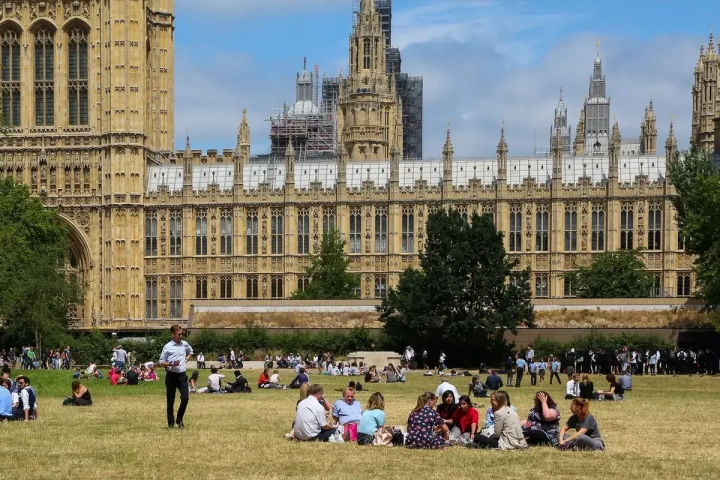
A marked change in the weather pattern is set to bring increasingly warm and settled conditions across the UK as we head towards the bank holiday weekend.
After a notably cool and changeable spell through much of May so far, temperatures are set to rise steadily, with many areas enjoying drier, sunnier weather by the end of the week.
For most people, the key message is straightforward: conditions are becoming more settled and significantly warmer than recent days. While there are still some finer details and uncertainties to consider, especially later in the weekend, the overall trend is towards more favourable weather for outdoor plans.
From unsettled to more settled conditions
At the start of the period, the UK remains under the influence of low-pressure to the northwest. This brings a continuation of showery conditions, particularly across northern and western areas. These showers are associated with a returning polar maritime air mass, which originates from colder regions such as Greenland and Canada before travelling across the Atlantic.
As this air moves over relatively warm ocean waters, it becomes increasingly unstable, picking up moisture and producing frequent showers, along with occasional heavier downpours or thunderstorms. This explains the unsettled feel early in the week, despite a gradual rise in temperatures compared to the previous northerly airflow.
As the week progresses, higher pressure begins to build from the south. This pushes the jet stream further north and gradually reduces the influence of weather fronts over much of the UK. While northern areas may still see some rain at times, southern and central regions will increasingly experience drier and brighter conditions.
Why it is turning warmer
Although winds are expected to turn more southerly by the end of the week, the rise in temperatures is not primarily due to hot air being transported directly from southern Europe or North Africa.
Instead, the main driver of the warming trend is the development of high pressure over and near the UK. As this high-pressure strengthens, it causes sinking air in the atmosphere. This descending air is compressed as it moves downward, leading to warming through a process known as adiabatic compression.
In simple terms, as air is compressed, its temperature increases. This process can significantly raise temperatures at the surface, even when the original air mass is not especially warm. In this case, much of the air over the UK still originates from the Atlantic, but it becomes warmer as it descends under high pressure.
This mechanism is a common feature of warmer spells in the UK and is often more important than the transport of heat from lower latitudes.
Temperatures on the rise
By Thursday, southern parts of the UK could reach the mid-20s, with 24°C possible in the southeast. Northern areas remain a little cooler, though still warmer than earlier in the week.
The most significant rise is expected by Friday, when many parts of England and Wales could see temperatures widely in the mid to high 20s. The highest values are likely in eastern and southeastern areas, while Scotland and Northern Ireland will generally be cooler, particularly in the northwest.
How hot could it get?
By Saturday, temperatures are likely to peak further, with 30°C possible in the southeast under the most favourable conditions. There is also a chance that temperatures could reach 30°C on Sunday, particularly in sheltered and sunny locations.
However, there is greater uncertainty at this stage. While the air mass itself has the potential to support higher temperatures, the development of showers or thunderstorms could limit how warm it feels in some places. Areas that remain dry and sunny are most likely to experience the highest temperatures.
In climatological terms, temperatures in the upper 20s during May are not unusual, occurring every few years. However, reaching 30°C is less common and only happens in a small number of years.
A risk of showers and thunderstorms
One of the key uncertainties for the weekend is the potential for showers and thunderstorms to develop, particularly from Friday night into Saturday.
This is linked to an approaching upper-level trough, which introduces instability into the atmosphere. At the same time, increasing warmth and humidity near the surface provide energy for convective activity.
Where these showers develop, they could be locally heavy and may bring cloud cover that suppresses temperatures. However, they are likely to be scattered in nature, meaning that some areas could remain dry and very warm.
Warm nights developing
Another notable aspect of the forecast is the rise in overnight temperatures. After a spell of chilly nights, minimum temperatures are expected to increase significantly.
By the weekend, some urban areas could see overnight temperatures remaining in the mid to high teens, with the potential for very mild or warm nights in places. Under certain conditions, this could approach record levels for May, although this will depend on local factors such as cloud cover and wind.
Outlook for the rest of the weekend
As we move into Sunday and bank holiday Monday, high pressure is expected to re-establish itself across the UK. This should bring a return to more settled conditions for many areas, with plenty of dry weather and sunshine.
The main uncertainty relates to how much of the warm air remains in place. Small shifts in the position of the high-pressure system could make a significant difference to temperatures, particularly in the south.
In some scenarios, temperatures remain in the mid to high 20s, while in others they drop back closer to average values. Despite this variation, the overall signal points towards largely fine weather for the majority of the UK.
Keep up to date with weather warnings, and you can find the latest forecast on MET office website, on YouTube, on X and Facebook.