The 2026 FIFA World Cup has officially transcended the boundaries of sport, plunging headlong into an unprecedented geopolitical crisis. In a staggering press conference from the White House on Monday, US President Donald Trump publicly claimed credit for overturning the mandatory World Cup suspension of American striker Folarin Balogun. By confirming his direct lobbying of FIFA President Gianni Infantino, Trump has transformed a contentious on-pitch refereeing decision into one of the most explosive and heavily scrutinised controversies in the 122-year history of global football’s governing body.
As the United States men’s national team finalises preparations for their highly anticipated Round of 16 clash against Belgium in Seattle, the narrative has been entirely hijacked by the Oval Office. European governing bodies are seething, legal challenges are being furiously drafted, and the fundamental integrity of the tournament has been called into serious question.
Here is a comprehensive analysis of the President’s extraordinary admission, his unprecedented attack on a FIFA match official, and the cascading global fallout.
The White House Admission: “A Really Brilliant Decision”
For days, rumours had swirled that the sudden, highly irregular suspension of Balogun’s one-match ban was the result of aggressive political maneuvering by the host nation. Any lingering doubts were obliterated on Monday morning when President Trump addressed the media at the White House, delivering a brazen confirmation of his involvement.
Far from distancing his administration from the disciplinary processes of an independent sporting body, Trump revelled in the reversal, explicitly taking credit for the outcome.
“I’m the one that got them to do it,” the President declared, referencing his direct telephone conversations with Infantino. Trump praised FIFA for what he described as a “really brilliant decision,” arguing that forcing the US to play without their leading scorer would have severely damaged the tournament’s credibility.
“I think it [the suspension] would have left a big stain,” Trump stated. “When they take your best player, or just about… and they say you can’t play, that’s very unfair.”
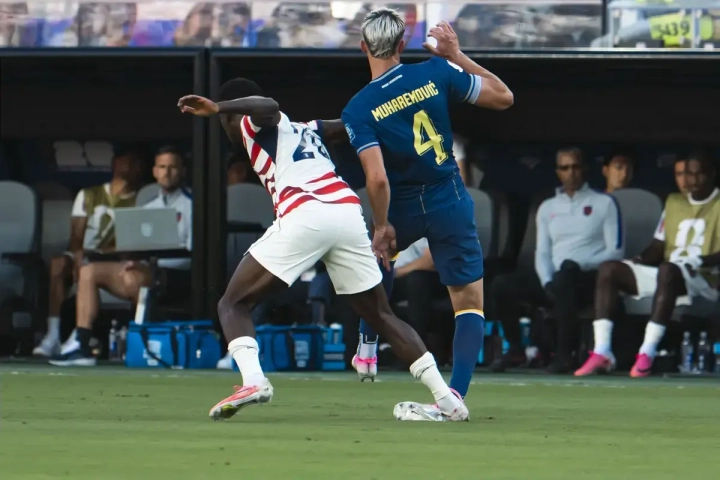
Balogun, who has been the talisman of Mauricio Pochettino’s energetic US side with three goals in the tournament, was shown a straight red card in the 64th minute of last Wednesday’s 2-0 Round of 32 victory over Bosnia and Herzegovina. The AS Monaco forward’s boot landed awkwardly on the upper ankle of Bosnian defender Tarik Muharemović, prompting Brazilian referee Raphael Claus to issue the dismissal following a Video Assistant Referee (VAR) review.
Trump, however, entirely dismissed the severity of the challenge, utilising his platform to provide his own tactical analysis of the incident.
“I’m a person that loves sports and was a good athlete and I understand sports really well, really well,” he told reporters. “That wasn’t a foul… that was two guys running full speed that happened to crash into each other. That wasn’t even an infraction.”
He continued: “Like, you can’t take your foot and properly place it on somebody else’s foot. These were two great athletes that got tangled up. I thought it was two great athletes who crashed into each other and got entangled.”
The Attack on the Referee and the “Suspect” Official
Perhaps the most alarming aspect of the President’s address was his direct, highly personal attack on the match official. Historically, political leaders have maintained a strict, diplomatic distance from the micromanagement of sporting fixtures. Trump shattered that convention by openly questioning the integrity of Raphael Claus.
“He made a call that nobody could believe,” Trump fumed. “He’s our best player, or one of our best players. And he gave him a red card. I didn’t know what that meant… Yes, I asked for a review by FIFA.”
The President then took his criticism a step further, hinting at deeper conspiracies without providing specific evidence. “This referee is a little bit suspect,” Trump remarked. “If you check his past, I don’t want to say that because I don’t like to create controversy, but but very suspect.”
While Trump boasted of his influence—”I’m the one that got them to do it”—he simultaneously attempted to shield himself from accusations of outright coercion, maintaining that the final ruling was ultimately FIFA’s responsibility.
“I can’t tell them what to do,” he claimed. “I don’t believe they made the decision; I believe it was the commission that made the decision. And it was the right decision… all I did was ask for a review.”
The Legal Maneuvering and FIFA’s Article 27 Loophole
Behind the scenes, the push to clear Balogun was heavily coordinated. Reports indicate that the White House World Cup task force, led by Andrew Giuliani, alongside Secretary of Commerce Howard Lutnick, actively communicated with FIFA executives. The US Soccer Federation reportedly mounted a legal challenge specifically targeting the use of slow-motion replays in the VAR decision-making process.
Faced with this immense, coordinated pressure from the host nation’s government, FIFA capitulated on Sunday night. The governing body invoked Article 27 of its disciplinary code, a broad provision that permits judicial bodies to suspend the implementation of a disciplinary measure.
Consequently, Balogun’s automatic one-match ban was deferred for a probationary period of 12 months. Should he commit a similar offence within the next year, the ban will be immediately triggered.
While FIFA defenders note that Portugal’s Cristiano Ronaldo received a similarly suspended sentence during the World Cup qualifiers, the European establishment views the Balogun ruling as entirely different. The Ronaldo decision was not preceded by the highly public, aggressive lobbying of a sitting head of state representing the tournament’s host nation.
European Outrage: UEFA and Belgium Draw a “Red Line”
The reaction from across the Atlantic has been instantaneous, furious, and united. The perception that a host nation can successfully leverage its geopolitical might to bend the fundamental laws of the game has provoked severe accusations of favouritism.
UEFA released a scathing official statement, making no secret of their outright opposition to FIFA’s ruling. The European governing body described the move as “incomprehensible and unjustifiable,” declaring that the decision “crossed a red line.”
“Football, like any other sports, relies on rules, which are the basis for fair, honest and transparent competition,” the UEFA statement read. “When the certainty of rules is no longer guaranteed by its guardians, the integrity of the game is at stake and the credibility of a competition is undermined.”
The Royal Belgian Football Association (RBFA), whose side must now face a full-strength American attack, was left seething. The RBFA expressed “disbelief” at the ruling, noting that it directly contradicts World Cup 2026 Circular No 16, which explicitly reaffirms the automatic, non-negotiable nature of red-card suspensions. The Belgian federation confirmed it is exploring all legal options, potentially including an appeal to the Court of Arbitration for Sport (CAS), to safeguard the principles of fair play.
Pundits and Legends Condemn the “Farce”
The outrage has cascaded into the broadcasting studios, where former professionals have universally condemned the presidential intervention.
Former Manchester United and England captain Wayne Rooney delivered a blistering assessment on the BBC. “I think it’s an absolute disgrace,” Rooney stated. “Infantino should be ashamed of this. The sportsmanship of this game is in question here. If I’m USA’s opponent, I’d be absolutely fuming.”
Gary Neville echoed those sentiments on ITV, pointing out the inherent unfairness of the ad-hoc appeals process. “It absolutely stinks,” Neville argued. “If there’s no process for it to be overturned, and then somehow FIFA, from nowhere, have decided to basically let a player play, the rules should be the same for everybody. I would be absolutely raging if I was Belgium.”
Former Manchester City defender Micah Richards went even further, calling the situation “an absolute farce” and suggesting that the suspension of the ban “makes a mockery of the whole tournament. All this is to keep the big stars in the competition.”
French legend Thierry Henry, while acknowledging that he felt the initial red card was a harsh judgement, questioned the timeline of the reversal. “I do not think it was the right call. It was the right decision [to overturn it], but why so late? If you’re Belgium and prepared for the game, it changes everything.”
The Ultimate Test in Seattle
As the United States and Belgium prepare to take the field in Seattle, the atmosphere promises to be suffocatingly tense. What was already a monumental fixture—with the USMNT seeking to reach their first World Cup quarter-final since 2002—has been irreversibly transformed into a global referendum on FIFA’s governance and the dangerous intersection of politics and sport.
US head coach Mauricio Pochettino has remained unapologetic, stating that his side had been “punished enough” by having to play with ten men against Bosnia. The players, who found out about the reversal via social media on the team bus, are simply relieved to have their star striker available.
However, Folarin Balogun will step onto the pitch carrying an unimaginable weight of expectation and scrutiny. Every challenge he makes, every foul he commits, and every interaction with the match officials will be meticulously analysed through the lens of a controversy that has pitted the host nation against the rest of the footballing world.
President Trump may confidently declare that “it was the right decision,” but the global footballing community remains unconvinced. The sport cares deeply about its independence, and the fallout from this extraordinary Oval Office intervention will undoubtedly reverberate through the halls of FIFA long after the World Cup trophy is lifted.