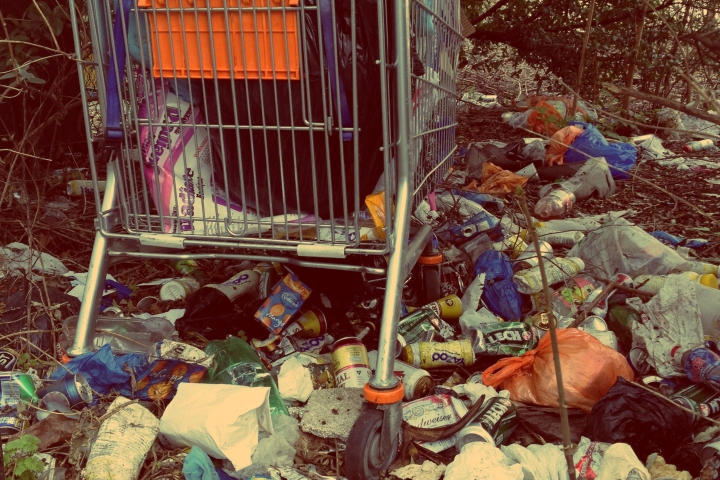
Recent shocking statistics from the Department for Environment and Rural Affairs (Defra) show a 9% increase in fly-tipping incidents. London boroughs are experiencing a high share of these crimes, putting pressure on local residents, the environment, and local authorities.
In light of new Defra statistics, commercial waste firm Waste Managed has conducted a nationwide poll of over 2,000 participants to analyse the public’s attitudes towards fly-tipping. This new poll reveals that 1 in 6 Brits admit to unknowingly fly-tipping.
Who is most responsible for fly-tipping in London?
Answer | Survey response (%) |
Local residents disposing of household waste | 26.15% |
Local councils (e.g. lack of bins or waste collection services) | 13.85% |
Criminal gangs or organised waste dumping | 12.69% |
People using unlicensed waste collectors (‘man with a van’) | 12.31% |
Visitors or people from outside the local area | 12.31% |
I am not sure | 10.00% |
N/A – I do not think anyone is most responsible / responsible at all for contributing to fly-tipping in my area | 6.54% |
Businesses disposing of commercial waste | 5.38% |
Other, please specify | 0.77% |
The survey of 2,000 UK respondents commissioned by Waste Managed highlights that the public believes multiple factors are driving fly-tipping offences. Although local residents disposing of waste are the most frequently blamed (21.10%), people using unlicensed waste collectors, also known as ‘a man with a van’, remain part of local discussions, with 19.15% highlighting that they are to blame.
As well as looking at nationwide trends, commercial waste firm Waste Managed also investigates how this varies depending on region, with Greater London respondents stating that:
- Local households disposing of household waste are the biggest contributor to fly-tipping
- More than a quarter (28%) admit to leaving items beside a bin, hoping someone else will collect it
- A quarter of Londoners admit to using unlicensed waste collectors
- Residents in rural areas (21%) are more likely to leave items vs residents in urban areas (20%) or suburban areas (16%)
Group Chief Commercial Officer, Kelvin Croney at Waste Managed, shares why it is so important to check the credentials of a waste carrier when using their service, rather than using an unlicensed waste collector:
‘Our findings show that lack of awareness is a real driver for fly-tipping. Part of the solution to the problem is simple: verify who handles your waste. Ensure collectors are licensed and following safe disposal practices that protect the community and the environment.’
The local authorities in London with the most fly-tipping incidents
Local authority | Incidents per 1,000 people (2025) |
Camden | 166.9 |
Croydon | 130.1 |
Hackney | 116.4 |
Lewisham | 111.1 |
City of London | 109.5 |
Westminster | 95.5 |
Hounslow | 84.1 |
Newham | 70.8 |
Merton | 68.1 |
Lambeth | 67.0 |
New fly-tipping data released by Defra suggests that London is the region with the highest number of reported fly-tipping incidents, with 52.9 cases per 1,000 people – placing the capital significantly ahead of other regions, with seven London boroughs topping the nationwide study for the local authorities experiencing the most fly-tipping incidents.
In light of this, Waste Managed, examined data across each London borough to analyse which boroughs are reporting the most cases of fly-tipping. Camden has an especially high rate of fly-tipping, with 166.9 incidents per 1,000 people in 2025. Some boroughs however experience far more incidents than others, with Kingston Upon Thames reporting just 13.8 incidents per 1,000 in 2025.
Is there a link between deprived areas and fly-tipping?
Rank | Local authority | Incidents per 1,000 people (2025) | Index of Multiple Deprivation (IMD) Rank – (where 1 is most deprived) | Average Band D council tax (£) |
1 | Newham | 70.8 | 7 | 1944.23 |
2 | Barking and Dagenham | 32.7 | 9 | 2198.5 |
3 | Hackney | 116.4 | 10 | 2060.3 |
4 | Tower Hamlets | 18.2 | 20 | 1837.78 |
5 | Brent | 46.3 | 22 | 2133.15 |
Keep Britain Tidy’s report: A Rubbish Reality suggest that the more deprived an area, the more fly tipping takes place. In light of this, using Government deprivation data (IMD rank), Waste Managed sought to investigate whether deprivation links to fly-tipping.
While deprivation levels can vary among London boroughs, more deprived areas such as Newham sees 70.8 incidents per 1,000 people, though this largely depends on each borough and doesn’t highlight a consistent pattern across more deprived communities.
The Keep Britain Tidy report highlights that in the most deprived areas of the country, just 2% of local areas were litter-free, compared with 14% in the least deprived areas, with seven in 10 people (71%) stating that litter is a problem in the most deprived areas.
The full study, which explores public opinion towards fly-tipping, the urban and rural split, and the causes and solutions on a national scale can be viewed here – https://www.wastemanaged.co.uk/our-news/news/why-is-england-fly-tipping-new-research-reveals-all/
Methodology:
Commercial waste provider, Waste Managed, conducted a poll to gather public opinion poll via Censuswide, among a sample of 2,000 nationally representative general respondents (aged 18+). The data was collected between 11.03.2026 – 13.03.2026. Censuswide abides by and employs members of the Market Research Society and follows the MRS code of conduct and ESOMAR principles. Censuswide is also a member of the British Polling Council.
The rest of the data presented and analysed in this report has been sourced via:
- Defra: Fly-tipping statistics for England.
- UK Government: Deprivation in England – 2025 Index of Multiple Deprivation. Note there is no IMD rank for Kingston upon Hull despite this local authority appearing in the Defra fly-tipping data we have presented. We have removed this area when discussing deprivation rates.
- Average band D council tax: Local authority websites, with the latest figures sourced from the 9th – 18th March 2026. Where we could not source data from local authority websites, we deferred to Homenicom, a comprehensive hub for property insights.
- Classification of rural vs urban areas: RUC of local authority districts. We then applied our own grouping to simplify areas into two categories (rural, urban) from the four Government categories (urban, immediate urban, intermediate rural, majority rural).