Over 22,000 tickets (22,033) have been booked for the National Gallery’s Renoir and Love exhibition opening 3 October 2026, beating previous box office records set by the Gallery’s 2024 blockbuster exhibition Van Gogh: Poets and Lovers (15,654 tickets booked over the same period).
The announcement follows the opening of Members’ advance booking on 4 August and the public ticket release on 25 August for the exhibition of paintings by one of the founding figures of Impressionism, Pierre-Auguste Renoir (1841–1919).
Renoir and Love comes to the Gallery following its run, ending this summer, at the Musée d’Orsay, in Paris, where it was one of the most visited exhibitions in the museum’s history.
With 45 works Renoir and Love (3 October 2026 – 31 January 2027) is the most significant exhibition of the French Impressionist’s work in the UK for 20 years. National Gallery Director Gabriele Finaldi commented “Our partnership with the Musée d’Orsay, Paris, and the Museum of Fine Arts, Boston is enabling us to bring the very best of Renoir to the UK in one of the most important exhibitions of his work in decades.”
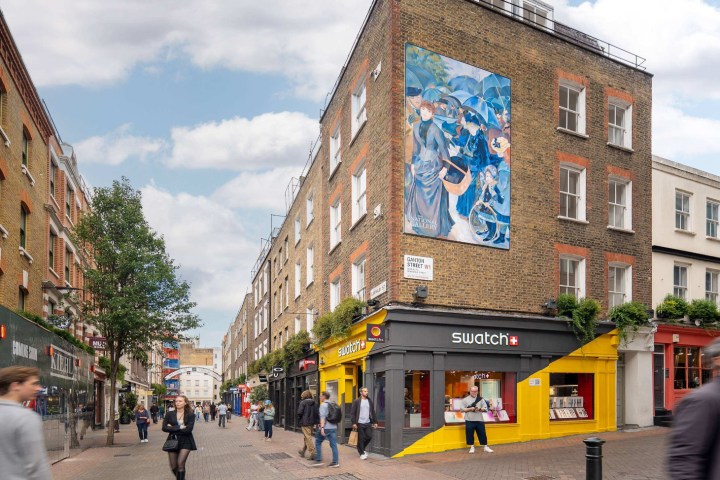
The upcoming exhibition has also extended beyond the Gallery’s walls and onto the streets of London, with Renoir’s iconic The Umbrellas becoming a giant landmark mural on Carnaby Street. Created as part of Murals reMastered, a nationwide collaboration between the National Gallery and Global Street Art, Shaftesbury Capital and Carnaby Street are the second mural commissioners in the series, joining Rousseau’s Surprised! In Camden.
The large-scale installation will bring one of Renoir’s most recognisable works into a new and unexpected public setting, transforming the iconic shopping destination into a vibrant space for art that is accessible to all. The mural will offer Londoners and visitors from around the globe the opportunity to experience Renoir’s work on a huge scale ahead of the exhibition’s opening.
Renoir and Love in detail
The first exhibition devoted to the artist at the National Gallery since 2007, Renoir and Love features some of his most experimental, ambitious and admired canvases including the iconic Dance at the Moulin de la Galette (1876, Musée d’Orsay, Paris), exhibited in the UK for the first time.
Organised in partnership with the Musée d’Orsay, Paris, and the Museum of Fine Arts, Boston, Renoir and Love focuses on the crucial years of the artist’s career, from the mid-1860s to the mid-1880s. More than one third of the canvasses he painted in these two pivotal decades are scenes of modern love and social interactions. Often staged in Paris’s new public spaces, these depictions are remarkable for their embrace of human sociability.
The exhibition traces the evolution of the imagery of love, desire, affection, flirtation, friendship and family bonds in Renoir’s art.
Exhibition co-curator Chiara Di Stefano says: ‘Eschewing anecdote, drama or sentimentality, Renoir sketches a joyful and light-hearted portrait of modern romance in 19th century Paris, where the celebration of youth, beauty and sensual pleasure takes centre stage.’
Exhibition co-curator Christopher Riopelle says: ‘More than any of his contemporaries, Renoir was committed to chronicling love and friendship and their informal manifestations as keys to modern life. Whether on Parisian street corners or in sun-dappled woodlands, he understood that emotion could be as fleeting, as evanescent, as blinding, as his other great and transitory subject, sunlight itself.’
Such themes are explored from intimate and personal works to beguiling multi-figure compositions of urban and suburban sociability. Several full-length figure compositions such as The Umbrellas (1881, reworked 1885, The National Gallery) show how Renoir often develops the theme on a large scale. His Dance compositions remain universally loved symbols of the French fin-de-siècle.
Loans come from private collections and museums around the world. The first room of the exhibition explores the artist’s early years and includes Mother Antony’s Tavern, 1866 (Nationalmuseum, Stockholm). Treating a scene of everyday life with the solemnity of large-scale painting (a format traditionally reserved for mythological and religious themes), Renoir makes a powerful statement about modern art and its new subjects.
The second room focuses on Renoir’s gallant scenes of the 1870s. Considering himself as the heir of French 18th century tradition, in the vein of Fragonard, Watteau and Boucher, Renoir updates the rococo iconography of the fêtes galantes (courtship parties). The Promenade, 1870 (The J. Paul Getty Museum, Los Angeles) and the Dance at the Moulin de la Galette, 1876 (Musée d’Orsay, Paris) are among the highest examples of this genre.
Highlights of the third section, focusing on street and café scenes include La Place Clichy, 1880 (The Fitzwilliam Museum, Cambridge) and Leaving the Conservatory, 1876–77 (The Barnes Foundation, Philadelphia).
Room Four is dedicated to depictions of life in the outskirts of Paris and features Oarsmen at Chatou, 1879 (National Gallery of Art, Washington), Dance in the Country, 1883 (Musée d’Orsay, Paris); Dance at Bougival, 1883 (Museum of Fine Arts, Boston),The Luncheon, 1875 (The Barnes Foundation, Philadelphia) and Lunch at the Restaurant Fournaise (The Rowers’ Lunch), 1875 (Art Institute of Chicago) are among the works on view in this section.
Room Five is devoted to scenes of family life. There, visitors are able to see Sketches of Heads (The Berard Children), 1881 (Clark Art Institute, Williamstown) and Children’s Afternoon at Wargemont, 1884 (Alte Nationalgalerie, Berlin). On display in this room is also an intimate painting of which Renoir was particularly fond, Motherhood, 1885 (Musée d’Orsay, Paris), capturing his future wife Aline Charigot nursing their first son Pierre.
The sixth room looks at Renoir’s depictions of intellectual intimacy and physical proximity. This section includes The Conversation, 1878 (Nationalmuseum, Stockholm) and At Renoir’s Home, Rue Saint-Georges, 1876 (Norton Simon Museum, Norton Simon Art Foundation, Pasadena). A small focus on Renoir’s theatre box scenes, featuring A Box at the Theatre (At the Concert), 1880 (Clark Art Institute, Williamstown) will also be presented.
From 1883 the artist moved away from Impressionist style with its fascination with the ephemeral play of light to more solid, sculptural compositions. At the same time, his favourite motifs shifted from scenes of modern Parisian life to classical, timeless themes. A highlight of the final room of the exhibition is The Great Bathers, 1884–7 (Philadelphia Museum of Art) which marks the end of Renoir’s Impressionist season and the beginning of a new phase in his career.
The exhibition was initiated by the Musée d’Orsay, Paris, and is organised by the Musée d’Orsay, the National Gallery and the Museum of Fine Arts, Boston. It is shown at the Musée d’Orsay, Paris (17 March – 19 July 2026); the National Gallery, London (3 October 2026 – 31 January 2027); and Museum of Fine Arts, Boston (20 February – 13 June 2027.)
The curators are:
Paris
Paul Perrin, Chief Curator and Director of Conservation and Collections at the Musée d’Orsay, Paris; with the participation of Lucie Lachenal-Taballet, Archival Research Assistant at the Musée d’Orsay, Paris.
London
Christopher Riopelle, former Curator of Post-1800 Paintings at the National Gallery, London, and Chiara Di Stefano, Associate Curator of Post-1800 Paintings at the National Gallery, London.
Boston
Katie Hanson, William and Ann Elfers Curator of Paintings, Art of Europe, Museum of Fine Arts, Boston; with the participation of Julia Welch, Arthur K. Solomon Assistant Curator of Paintings, Art of Europe, Museum of Fine Arts, Boston.