Drought conditions have been declared for half of England, following intense heatwaves through much of June and July. Climate scientists are warning that a super El Niño is influencing global weather patterns this year, threatening to bring colder, wetter winters later in 2026. Here, Craig Dean, residential director at ground engineering expert Geobear, explains that the growing frequency of extreme weather is threatening the stability of homes across the country.
In March 2026, The US National Oceanic and Atmospheric Administration (NOAA) declared that El Niño conditions had begun. Categorised by high sea surface temperatures across the central and tropical Pacific, El Niño brings dry, hot temperatures to much of Australia, Indonesia and the Philippines. Across the ocean, Europe will endure delayed impacts from an El Niño event with hot summers, but harsh winters expected into 2027..
The hidden threat from El Niño
Subsidence, referred to as the downward movement of the ground beneath foundations, can be worsened by volatile weather conditions. Many parts of the UK, particularly the Southeast, are built on top of clay-rich soils, which swell in volume when absorbing water and shrink when it dries out. Periods of heavy rainfall cause these soils to expand, increasing moisture level and weakening stability. In prolonged hot, dry spells, the moisture content reduces, causing the clay to contract and shrink.
The shrinking impacts homes can happen at different rates, referred to as differential settlement. Some areas with environmental factors such as tree roots may compete more for moisture, shrinking faster compared to other sections of soil. This results in an uneven overall settlement pattern, causing visible cracks in brickwork and render or sloping of interior walls, windows, and doors.
In summer 2022, record breaking heatwave temperatures caused a surge in subsidence cases across the UK, resulting in £219 million pounds worth of insurance claims. 2025 is also widely considered as a ‘surge year’, and there’s speculation 2026 will follow suit.
Advanced ground engineering mitigates climate risks
Extreme weather events do not arrive without warning, the same applies to ground movement. To monitor movement and the potential of subsidence, Geobear has created a UK subsidence surge forecast dashboard to accurately monitor soil moisture data, climate signals, and historic patterns.
The dashboard tracks key signals, allowing insurers, property managers and homeowners to monitor estimated ground moisture. When subsidence signs are identified the next step is to find a professional to conduct a foundation survey and assess remediation options. If left untreated, subsidence can worsen and further damage a property, increasing the need for foundation stabilisation.
Traditional underpinning often involves excavating beneath the foundation to install concrete or beam and base underpinning pillars. This method is time-intensive, requiring current foundations to be dug out and underpinning to be installed, often taking weeks.
Resin injection underpinning on the other hand is far less invasive and is planned in days. Typically, jobs are completed in 1-2 days, and no excavation is required. Geopolymer resin is injected into small diameter holes beneath foundations, creating polymer pillars without needed to excavate. Homeowners are typically able to remain in their properties while work is carried out
Ground injections save North London townhouse
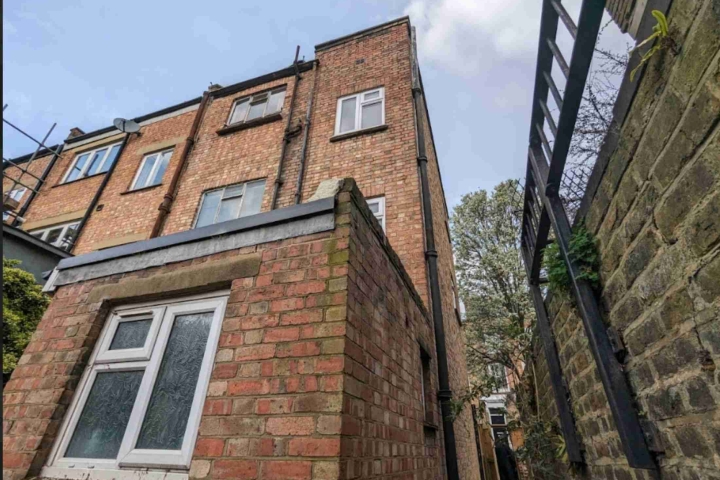
A homeowner of a 1960’s townhouse on Hamilton Park Street, Islington, reported severe structural issues caused by clay soil shrinkage.
After a visible gap formed between the townhouse and its neighbours, the homeowner sought out the efforts of Geobear to restore stability in the affected foundations. A site investigation revealed that clay beneath the house had dried out and shrunk five meters below the basement, resulting in weakened ground that could no longer support the property.
Non-invasive geopolymer injections were used to improve the stiffness of soil beneath the foundations, working to lift the building back into position. Across nine days, Geobear’s technicians relevelled the home, compared to an estimated eleven weeks of traditional underpinning.
“We were concerned about safety, access, and the disruption traditional methods would have caused,” said homeowner Lipa Friedman. “The project had minimal disruption to our property, I wouldn’t hesitate to recommend Geobear to anyone facing similar foundation challenges.”
The threat of subsidence and ground movement will only grow following record El Niño events, and extreme weather conditions expected to continue throughout 2026 and into the decade. Homeowners should prepare now for a changing climate to impact their homes, looking out for signs of settlement or cracking to ensure ground movement is identified and remediated quickly.
To learn more about how geopolymer resin injections could save your home, visit Geobear’s homeowner’s webpage.