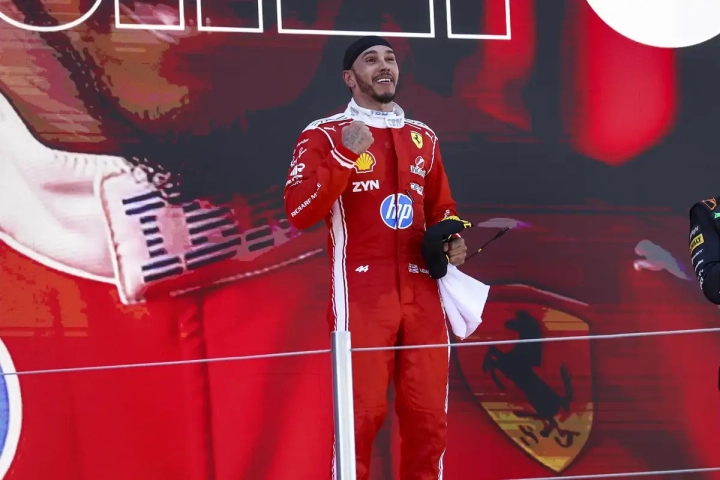
Lewis Hamilton rolled back the years on Sunday afternoon, delivering a flawless strategic masterclass to secure his 106th Formula One career victory and his highly anticipated first win wearing the famous red overalls of Scuderia Ferrari. The 2026 Barcelona-Catalunya Grand Prix, held at the notoriously demanding Circuit de Barcelona-Catalunya on 14 June 2026, saw the legendary seven-time world champion capitalise brilliantly on a perfectly timed Virtual Safety Car (VSC) intervention to execute an aggressive three-stop strategy to absolute perfection.
Starting at exactly 14:00 BST, the punishing 57-lap Spanish encounter concluded with Hamilton crossing the finish line a commanding 19.561 seconds ahead of his former teammate, Mercedes’ George Russell. McLaren’s Lando Norris completed the podium, inheriting third place following devastating late-race heartbreak for championship leader Kimi Antonelli. At 41 years of age, Hamilton becomes the oldest Formula One race winner since Jack Brabham triumphed in 1970, conclusively proving his enduring world-class pedigree behind the wheel of the ground-breaking 2026 technical machinery.
Lights Out and the Active Aero Battles
As the five red lights went out under the intense, blistering Spanish sun, pole-sitter George Russell launched perfectly on his medium compound Pirelli tyres, aggressively covering the inside line into Turn 1 to maintain his advantage. Hamilton, who started alongside his compatriot on the front row, deliberately opted for the soft tyres to ensure superior initial off-the-line grip, successfully fending off the pack behind him. Trailing closely in their wake, Mercedes youngster Kimi Antonelli and McLaren’s Lando Norris safely slotted into third and fourth positions respectively, avoiding any opening lap contact.
The early exchanges quickly became a fascinating, high-speed demonstration of the complex 2026 technical regulations in action. As the incredibly tightly packed field navigated the sweeping, high-speed corners of the Circuit de Barcelona-Catalunya, the newly mandated Z-Mode aerodynamic configuration kept the cars rigidly glued to the tarmac with maximum generated downforce. Emerging onto the long start-finish straight, the instantaneous transition into the low-drag X-Mode allowed the drivers to slipstream at astonishing, unprecedented speeds. Russell managed to break the crucial one-second aerodynamic tow relatively early, leaving Hamilton struggling in turbulent dirty air, while Antonelli prudently dropped back slightly to carefully preserve his delicate Pirelli rubber for the latter stages of the race.
Further down the fiercely competitive pack, Aston Martin suffered a premature disaster. Canadian driver Lance Stroll was forced into an early retirement on just the sixth lap, limping slowly back to the pit lane after reporting a terminal gearbox failure over the team radio.
Strategic Chess in the Searing Spanish Heat
Extreme tyre degradation has always been the ultimate defining factor in Barcelona, and the highly abrasive track surface mandated highly complex strategic decisions from the pit wall. Recognising their inherent pace advantage but tyre wear deficit, Ferrari committed Hamilton to an incredibly aggressive three-stop race. The Italian marquee confidently called the British veteran into the pits as early as lap 11, bolting on a fresh set of tyres to execute a powerful undercut. Mercedes, meanwhile, opted for a significantly more conservative two-stop game plan for both Russell and Antonelli, aiming to resolutely maintain vital track position and dictate the overall pace from the very front of the field.
Hamilton completed his second scheduled stop on lap 27, continuing to push the absolute limits of his fresh rubber while the Mercedes duo stretched their longer stints. The race remained finely poised and incredibly tense until lap 40, when a dramatic, unforeseen twist completely altered the entire complexion of the Grand Prix. Veteran Fernando Alonso, who had courageously started from the pit lane following a complete overnight power unit change, suffered a spectacular engine failure that left his Aston Martin stranded precariously on the side of the circuit.
The race stewards immediately deployed the Virtual Safety Car to safely recover the stricken vehicle. The timing of this neutralisation was nothing short of utter perfection for Ferrari. Holding a comfortable time cushion over the chasing pack, Hamilton dived directly into the pits for his final set of tyres under the strictly enforced VSC conditions, subsequently losing significantly less total race time than he would have under a normal racing-speed stop. Rejoining the track with a massive grip advantage over the Mercedes drivers, Hamilton seized absolute control of the narrative and was never seriously challenged again for the race lead.
Late-Race Drama and the Manual Override Mechanics
While Hamilton sailed off into the distance to claim the spoils, the desperate battle for the remaining podium positions violently ignited behind him. Struggling immensely on significantly older tyres, Russell suddenly found himself under immense, unrelenting pressure from his rapidly charging teammate, Antonelli. With a mere five laps remaining in the Grand Prix, the young Italian boldly deployed his Manual Override Mode—the radical 2026 regulation electrical energy boost designed specifically to aid overtaking—to blast cleanly past Russell down the main straight and temporarily secure second place.
However, the ecstatic jubilation within the Mercedes garage was incredibly short-lived. Just moments after executing the spectacular, crowd-pleasing pass, Antonelli suffered a catastrophic and terrifying front wing failure. The sudden, violent loss of front-end downforce rendered his car completely undriveable, forcing the devastated championship leader into a painful, instantaneous retirement. Russell immediately reclaimed second place, breathing a massive sigh of relief as he carefully guided his fragile car to the chequered flag.
Antonelli’s massive stroke of misfortune ultimately elevated McLaren’s Lando Norris into third place. The British driver had driven a notably quiet but brilliantly effective and mature race, managing his tyres expertly throughout the varying track conditions to secure a crucial, hard-fought podium finish for the Woking-based outfit.
The Midfield Scrap and Unprecedented High Attrition
Behind the leading trio, Max Verstappen delivered a highly steady and characteristically resilient drive to finish fourth for Red Bull Racing, eventually crossing the line 40.497 seconds adrift of Hamilton. Oscar Piastri followed his McLaren teammate home in a respectable fifth place, further solidifying the team’s highly impressive points haul for the weekend.
The midfield battle provided relentless entertainment from start to finish, with Red Bull’s Isack Hadjar putting in a stellar, eye-catching performance to finish sixth, albeit a full lap down on the dominant race winner. The Alpine garage enjoyed a highly fruitful afternoon, with Pierre Gasly crossing the line in seventh and teammate Franco Colapinto taking a well-deserved eighth place after a string of impressive overtaking manoeuvres. The Racing Bulls duo of Liam Lawson and Arvid Lindblad safely completed the highly coveted points-paying positions, crossing the line in ninth and tenth respectively.
The gruelling, punishing nature of the Spanish circuit, combined seamlessly with the inevitable teething issues of the brand-new 2026 power units, resulted in an exceptionally high attrition rate. A total of eight highly skilled drivers failed to see the chequered flag. Alongside Antonelli, Alonso, and Stroll, Ferrari’s Charles Leclerc suffered a deeply disappointing DNF early in the race. Haas’s Oliver Bearman, Williams’s Alexander Albon, Audi’s Nico Hülkenberg, and Cadillac’s Valtteri Bottas also eventually succumbed to severe mechanical gremlins over the course of the demanding afternoon.
Post-Race Championship Implications
Hamilton’s spectacular and historic victory carries massive, potentially season-defining ramifications for both the World Drivers’ and World Constructors’ Championships. Antonelli’s incredibly late retirement severely dents his previously commanding lead at the very top of the drivers’ standings, offering a vital, unexpected lifeline to the chasing pack of elite contenders. Meanwhile, the complex combination of Hamilton’s euphoric win and Leclerc’s highly unfortunate DNF leaves the Ferrari garage dealing with distinctly mixed emotions, though the full 25 points secured by their lead driver significantly bolsters their fierce campaign against heavyweights Mercedes and McLaren in the Constructors’ battle.
As the bustling paddock enthusiastically packs up and rapidly prepares for the next intense leg of the long European season, the strategic complexities of the revolutionary 2026 regulations consistently continue to provide thrilling, deeply unpredictable racing for the fans. Ferrari has emphatically proven they possess the necessary tactical acumen and raw race pace to consistently win, but the relentless, high-stakes development war amongst the top teams shows absolutely no signs of slowing down any time soon.
2026 Barcelona-Catalunya Grand Prix – Final Top 10 Classification
Position | Driver | Team | Time / Gap | Points |
1 | Lewis Hamilton | Ferrari | 1:32:28.105 | 25 |
2 | George Russell | Mercedes | +19.561s | 18 |
3 | Lando Norris | McLaren | +23.719s | 15 |
4 | Max Verstappen | Red Bull Racing | +40.497s | 12 |
5 | Oscar Piastri | McLaren | +58.661s | 10 |
6 | Isack Hadjar | Red Bull Racing | +1 Lap | 8 |
7 | Pierre Gasly | Alpine | +1 Lap | 6 |
8 | Franco Colapinto | Alpine | +1 Lap | 4 |
9 | Liam Lawson | Racing Bulls | +1 Lap | 2 |
10 | Arvid Lindblad | Racing Bulls | +1 Lap |