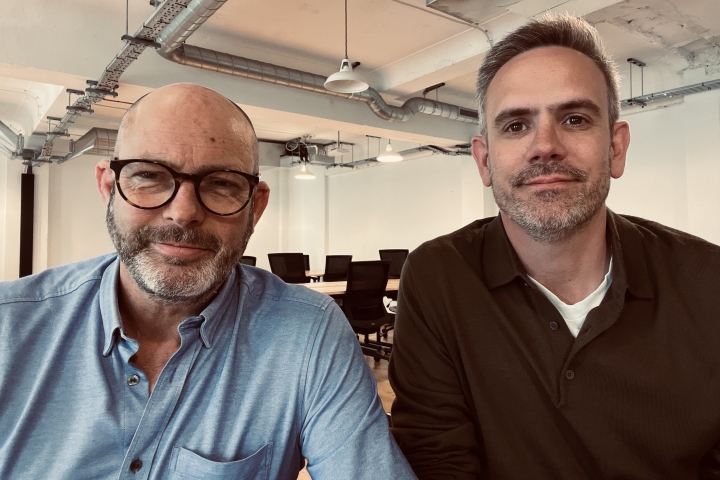
Stefan Parker previously spent fifteen years helping higher education providers recruit students. Then he lost his job and realised the sector had a problem nobody was fixing. Six months later he has a product, investors and students talking to his AI in Arabic at two in the morning.
Stefan Parker was playing with ElevenLabs on a Sunday evening in October, not for work but to make bedtime stories for his eight-year-old son. He was writing fairy tales and getting the AI to voice them. It was something to do.
Then he listened back, he said: “The voice was so natural. Not robotic at all. And I started thinking: I’ve spent fifteen years watching universities struggle to respond to students in time. What if you put this on a university website?” He had been made redundant just the Friday before.
Parker is not someone who went looking for a problem to solve. He spent fifteen years in senior student recruitment roles and watched, up close, the moment where everything an institution does to attract a student collides with a poorly organised first response.
Most student enquiries come in outside standard working hours. Most institutions still rely on contact forms and follow-up emails. Recent research from ICEF Monitor found that nearly six in ten prospective international students disengage when communication feels slow or unclear.
They are comparing options across multiple countries at once, and the institution that answers first is the one that stays in the running.
International tuition fees now account for around half of revenue at some universities, up from around 12% two decades ago. Losing a prospective student at the enquiry stage is not a minor inefficiency. It just does not show up in the data in an obvious way.
“Universities spend a lot of time and money getting students to that point,” says John Crick, Parker’s co-founder and someone who has spent twenty years in international student recruitment. “And then the experience just drops off.”
Parker built the first prototype in a weekend. Then, rather than sitting with it, he drove to Middlesex University and started talking to students.
“I parked up, walked onto campus with my phone, introduced myself, and asked people to try it. I gave them about two minutes with the agent and then asked what they thought. I wanted to know if it felt natural or awkward.”
It did not feel awkward. When Parker asked them directly whether they would use it if they could not get hold of someone at the university, the answer was yes, he says: “The students leaned in.”
That was enough.
He put together a basic pitch deck and went to Crick, a long-standing contact from the education world who had recently left Enroly, where he was part of the early team at a now highly successful EdTech service. Crick was, in his own words, semi-retired. He thought the idea had legs.
They moved quickly. AskEd was accepted into two EdTech accelerators: Tech Growth Lab in Brighton and Dohe’s Go-Together programme. ElevenLabs awarded the company a startup grant. Angel investors followed, raising a six-figure investment at a £2m post-money valuation.
The product operates across web and phone, handling enquiries in real time. It delivers fluent conversations in up to 70 languages, is trained on the provider’s own data for accurate responses, and qualifies leads and feeds data into existing CRMs.
When it went live with its first pilot at Central Film School, Parker listened to the overnight conversations: international students from different parts of the world, asking questions in Arabic, in African languages, in accented English, at two in the morning, with the sounds of their cities in the background.
“They weren’t shy or awkward about it. They just talked to it. Some came back for a second conversation later. That’s what you want to see.”
The comparison Parker resists most is the chatbot. Higher education has tried chatbots. Crick tested one recently at a major London university: it thought his name was Andy, the dropdown menus never contained what he wanted, and at one point it kept asking “are you happy?” until he said yes just to move on.
Voice changes things. It is faster than typing, more forgiving, and it works in any language without requiring the student to be confident in written English. The system draws on the institution’s own knowledge base, which limits the hallucination risk that makes universities nervous about AI generally. The basic widget takes one line of code to deploy. Parker estimates twenty minutes for an IT team of a small provider to add it to their website: “the bit that takes time is approvals and decision-making, not the actual doing of it.”
UK higher education is cutting jobs, watching international enrolments soften, and trying to grow a sector the government has said it wants to take from £32bn to £40bn. Those things are happening at the same time as most institutions are still using a contact form as their primary after-hours response to a student enquiry.
Parker and Crick think the timing is right, not because the sector is struggling (it is) but because the technology has finally caught up with the problem. Voice AI two years ago was not good enough to feel natural in a real conversation. Now it is.
Amazon’s decision last week to deploy voice AI so shoppers can ask questions about products and get conversational answers in real time confirms the direction of travel. Universities and colleges are sitting on the same opportunity. Most haven’t moved yet.
“This is something of a race,” says Crick. “We want to go all guns blazing, but with the expertise, not just the speed.”
AskEd launches its Essentials product this month (May), initially targeting universities, colleges and alternative providers.
Parker says the origin story has not got any less strange with time. He was made redundant on a Friday and by Monday he was building something. The bedtime stories for his son turned out to be a prototype for something else entirely. And that’s no fairytale.