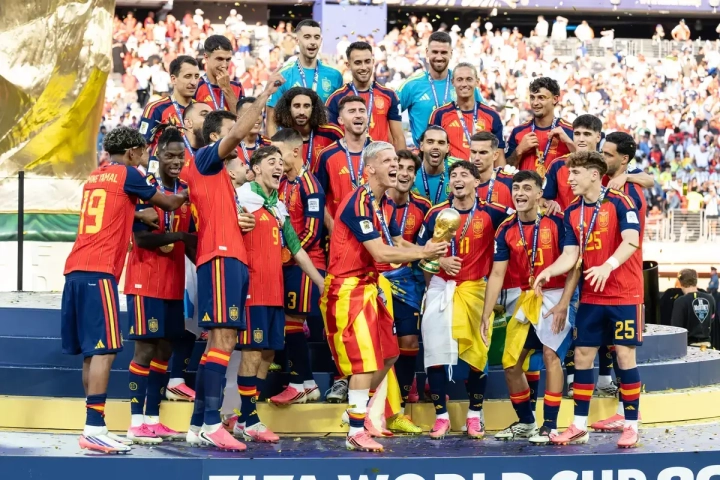
The ticker tape has been swept from the pitch at the New York New Jersey Stadium, and the Spanish national team has long since returned to Madrid to parade their newly acquired second star. Yet, for a significant contingent of the Argentine fanbase, the 2026 FIFA World Cup is far from concluded. Still reeling from a devastating 1-0 extra-time defeat on 19 July, thousands of supporters have mobilised online, launching a sprawling digital campaign demanding that football’s global governing body entirely annul the result and order a replay of the showpiece final.
The initiative, whilst capturing impressive numbers and generating widespread media attention, faces an insurmountable barrier: the rigid, unforgiving framework of FIFA’s official rulebook.
The Anatomy of the Petition
The focal point of this digital unrest is a petition hosted on the popular advocacy platform Change.org, initiated by Argentine supporter Gisela Sanchez. Born out of the intense frustration following the summit clash, the petition specifically targets the performance of Slovenian referee Slavko Vinčić.
As of Thursday, the campaign had gathered an impressive 80,200 signatures, accelerating rapidly as clips of contentious refereeing decisions circulated across various social media platforms. The core of Sanchez’s argument rests on the serious allegation that Vinčić’s officiating was fundamentally flawed and that severe “irregularities” during the 120-minute encounter directly influenced the final outcome.
Supporters harbour profound grievances regarding the general flow of the match, which saw Luis de la Fuente’s Spanish side execute a suffocating possession-based strategy that heavily neutralised Argentina’s attacking threats. The boiling point for many signatories was the 93rd-minute dismissal of Argentine midfielder Enzo Fernández, who was shown a second yellow card, forcing the defending champions to navigate the entirety of extra time with a severe numerical disadvantage.
This critical turning point laid the groundwork for Spain’s decisive breakthrough. In the 106th minute, Ferran Torres delivered the fatal blow, finding the back of the net to seal Spain’s second World Cup crown. For the 80,200 signatories, the goal and the preceding disciplinary decisions represent an unforgivable miscarriage of sporting justice.
“The demand is simple,” reads the narrative surrounding the petition. Fans want FIFA to formally review the calls made during the final. However, the campaign notably fails to present any concrete, solid evidence of systemic corruption or technical irregularities that would legally warrant such a dramatic intervention.
The Regulatory Reality: Why FIFA Will Not Act
The harsh reality confronting the tens of thousands of signatories is that platforms like Change.org possess absolutely zero regulatory power within FIFA’s established governance structure. In the realm of professional football, digital petitions serve entirely as symbolic vehicles for collective venting; they cannot force a governing body to alter an official competition result under any circumstances.
The Laws of the Game, stringently governed by the International Football Association Board (IFAB), are explicitly clear regarding the finality of refereeing decisions. A World Cup match can only be replayed under highly specific, exceptional circumstances explicitly established in football’s regulations. These rare scenarios typically involve fundamental technical errors in the application of the laws—for instance, if a referee mistakenly allowed a team to play with twelve men, or if a match was abandoned due to extreme weather or crowd violence before reaching a regulatory conclusion.
Subjective refereeing decisions, including the awarding of fouls, the issuance of yellow and red cards, and the interpretation of offside or penalty incidents, absolutely do not meet this rigorous threshold. Even in the era of Video Assistant Referees (VAR), where technology heavily assists the on-field official, the final decision rests solely with the referee on the pitch. Dissatisfaction with these subjective calls, regardless of how passionately supporters believe an injustice occurred, provides zero legal basis for a rematch.
Consequently, the result stands firmly in the history books. The trophy legitimately belongs to Spain, and Argentina’s campaign to reverse the outcome was effectively doomed before the very first signature was ever collected.
A Familiar Post-Match Tactic
The phenomenon of fans launching digital petitions to overturn high-stakes football matches is becoming an increasingly common byproduct of the modern game, driven by the intense emotional investment of supporters and the magnifying effect of social media echo chambers.
In fact, this is not even the first such protest to emerge from the 2026 World Cup tournament. The Argentine initiative follows an identical, equally futile online campaign launched by French supporters just days earlier. Following France’s 2-0 semi-final defeat at the hands of Spain, disgruntled French fans collected over 82,000 signatures demanding their match be replayed.
The French petition heavily argued that Spain’s opening goal stemmed from an incorrect refereeing decision that subsequently led to a penalty. Much like the current Argentine petition, the French campaign generated immense online traction and widespread news coverage but received absolutely no public response from FIFA, highlighting the governing body’s standard policy of entirely ignoring unofficial digital protests.
The Death of a Dream
To understand the sheer volume of signatures on the Argentine petition, one must accurately contextualise the profound emotional weight attached to this specific fixture. For Argentina, the 2026 World Cup final was not merely a chance to secure another piece of prestigious silverware; it was the ultimate opportunity to cement a modern dynasty and secure consecutive world titles.
More importantly, it represented the dying embers of Lionel Messi’s glorious international career. The 39-year-old captain, who miraculously dragged his nation through a demanding knockout bracket with eight goals and four assists, saw his dreams of lifting a second consecutive World Cup extinguished in New York. The sight of the legendary forward failing to orchestrate a final victory was a deeply traumatic, jarring experience for a fanbase that views football as a fundamental pillar of national identity.
When sheer sporting heartbreak violently collides with the perceived injustices of officiating, the resulting fallout is often chaotic. This petition is a direct manifestation of collective grief, offering supporters a highly structured outlet to process a defeat they simply refuse to accept.
A Compounding Crisis for the AFA
While the fans expend their energy on Change.org, the Argentine Football Association (AFA) faces significantly more pressing, tangible issues stemming from the final whistle. The petition operates against the backdrop of a highly severe disciplinary investigation currently being conducted by FIFA.
Following the conclusion of the match, a violent brawl erupted on the pitch, with several Argentine players clashing aggressively with the celebrating Spanish squad. FIFA’s Disciplinary and Ethics Prosecutor is currently reviewing the footage in detail. The AFA is staring down the terrifying prospect of massive financial penalties and severe retrospective bans for key personnel, adding genuine sporting consequences to their New Jersey nightmare.
Conclusion: The Inescapable Finality of Football
As the weeks pass and the global footballing calendar inevitably pivots back toward the resumption of domestic leagues, the noise surrounding the Gisela Sanchez petition will slowly dissipate. FIFA is not expected to consider the request, nor will they issue a formal comment acknowledging its existence.
The 2026 FIFA World Cup will be permanently recorded as a triumph of Spanish tactical discipline. The online petition, while an impressive, highly coordinated demonstration of Argentine passion and loyalty, ultimately serves as a stark reminder of the inescapable finality of sport. The referee’s whistle has blown, the medals have been awarded, and no amount of digital signatures can rewrite the history that was forged on the pitch.