Padel is the fastest-growing racket sport Britain has ever seen, with an increase of around 6,567% players today compared to when it was introduced to the UK seven years ago. The LTA reports player numbers hit 1 million in May of 2026 – that’s 985,000 more padel enthusiasts than in 2019, with around 385 new players joining the game on a daily basis.
Despite this unprecedented growth in popularity, a new Grassroots Gap Report from PDH Sports finds a sport short of courts, short of public funding, and increasingly out of reach for anyone outside the right postcode.
Key findings reveal:
Padel was omitted from the government’s flagship £125 million Multi-Sport Grassroots Facilities Programme (2024/25)
Sport England’s own grant data for 2020-2025 shows that padel received the lowest total public funding of padel, tennis, badminton and squash
A padel court booking in the UK costs £18 more per session than in Spain, and 10% more on average than the 13 international markets analysed
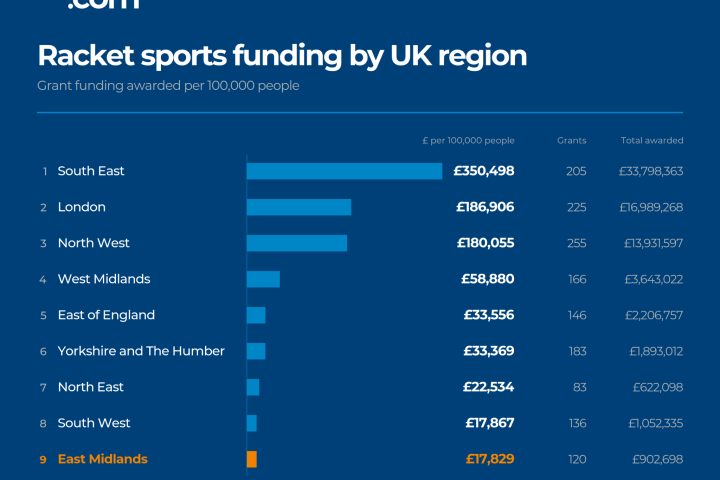
The South East receives almost 20 times more funding for racket sports per head than the East Midlands, the equivalent of around five additional padel courts
At around £39 per court booking, the UK is the fourth most expensive country to play padel in, costing players roughly 10% more than the global average, and almost twice as expensive as in Spain – the unofficial home of padel.
Headlines are quick to focus on the high personal cost to play the popular game, but don’t look at the supply vs demand issue which keeps costs out of reach for many.
The UK currently faces an estimated deficit of nearly 33,000 courts when compared to neighbouring European countries like Spain – which has officially recognised the sport since the early 90s – and will need to build roughly 19 times its existing capacity to match the global benchmark set by Spain’s court-to-population ratio.
Based on current construction costs, the research from PDH Sports indicates that the UK is not on track to bridge this gap until 2031.
Another factor making padel a costly game to pick up is the lack of public funding. Padel was completely omitted from the government’s flagship £125 million Multi-Sport Grassroots Facilities Programme (2024/25), with funding directed almost exclusively through the Football Foundation.
Sport England’s own grant data for 2020-2025 shows that padel received just £7.69 million – £7.5m funnelled from the LTA’s own grants and £193,191 directly to grassroots clubs – the lowest total public funding of the four racket sports compared.
Paul Hargrave, professional squash player and founder of PDHSports.com came up through Derbyshire clubs, achieving national ranking from junior level. Paul says:
“PDH Sports is based in Derby – our own region receives just £17,829 in racket sports funding per 100,000 people, the lowest of any English region – which is only a quarter of the cost of a new court – while the South East receives almost twenty times that.
“But padel’s growth isn’t a London and South East story, it’s growing everywhere, including right here at home, but the funding path hasn’t caught up with where people actually want to play. If grassroots access is going to mean anything, it can’t keep depending on which region you happen to be based in.”

At a grassroots level, the report reveals that racket sports funding across England is glaringly unequal, and it’s not London leading the way. Just three regions, the South East, London, and the North West, see £64.7 million of the total £75.04 million distributed across 1,520 grants.
A staggering 86% of all funding goes to a third of the country’s regions, and the imbalance is even more dramatic on a per-person basis:
Top Tier: The South East leads by a huge margin with £350,498 per 100,000 people (approx. £3.50 per head) – nearly double London (£186,906) and the North West (£180,055), which both receive around £1.80–£1.90 per head
Mid Tier: The South East gets over six times as much per capita as the West Midlands (£58,880 per 100k, or £0.59 per head). Meanwhile, the East of England and Yorkshire & Humber sit in the middle tier at roughly £33,000–£33,500 per 100k (~33p per head)
Bottom Tier: The North East, South West, and East Midlands represent the lowest tier in England, grouped tightly between £17,800 and £22,500 per 100k (just 18p–23p per head)
Beyond securing a higher volume of awards, the South East also secures significantly larger individual grants. At an average of £164,870 per grant, funding in the South East is more than double London’s £75,508 average and triple the North West’s £54,634.
In fact, the South East gets £332,669 more funding than the East Midlands, a financial gap equivalent to around five additional padel courts per 100,000 people for the region (LTA figures suggest average construction cost of £71k per court).
The remaining regions average under £22,000 per grant, with the North East, South West, and East Midlands receiving just £7,500–£7,700 on average.
For the full Grassroots Gap Report, please visit PDH Sports.