For decades, the FIFA World Cup has served as a psychological graveyard for some of the most prolific strikers in club football. The history books are littered with generational talents, players who scored for fun in Europe’s elite leagues, arriving on the global stage only to find themselves isolated, suffocated, and entirely neutralized by the unique pressures of international knockout football.
When Norway finally ended their 28-year World Cup exile to qualify for the 2026 tournament, the overriding question was simple: Would Erling Haaland, football’s ultimate modern machine, suffer the same fate?
After just 180 minutes of football on American soil, we have our answer. Not only has Haaland entirely bypassed the infamous ‘striker curse’, but he has also turned the greatest sporting event on earth into his personal playground. Following a devastating debut brace against Iraq, Haaland repeated the feat on Monday night in New Jersey, scoring twice to secure a thrilling 3-2 victory over Senegal and book Norway’s ticket to the Round of 32.
The Statement in New Jersey
If the opening 4-1 victory over Iraq was Haaland’s introduction to the global audience, the clash against Senegal was undeniable proof that his debut was no fluke. Facing the Lions of Teranga at the MetLife Stadium, a team boasting profound defensive physicality through the likes of Kalidou Koulibaly and Moussa Niakhaté, Norway faced a far sterner test.
The match exploded into life late in the first half. After replacing an injured Julian Ryerson, Marcus Holmgren Pedersen put the Norwegians ahead in the 43rd minute. But the true spectacle arrived immediately after the restart as Haaland ruthlessly imposed his will on the match.
In the 48th minute, a lightning-fast, end-to-end counterattack exposed the Senegalese high line. Latching onto a perfectly weighted pass from Arsenal’s Martin Ødegaard, Haaland accelerated into the penalty area and dispatched a clinical left-footed strike past the outstretched hand of goalkeeper Édouard Mendy.
Ten minutes later, he struck again. Tunneling his way through the congested defensive lines, Haaland met a delivery from Patrick Berg eight yards out, adjusting his body to volley the ball home with his supposedly weaker right foot.
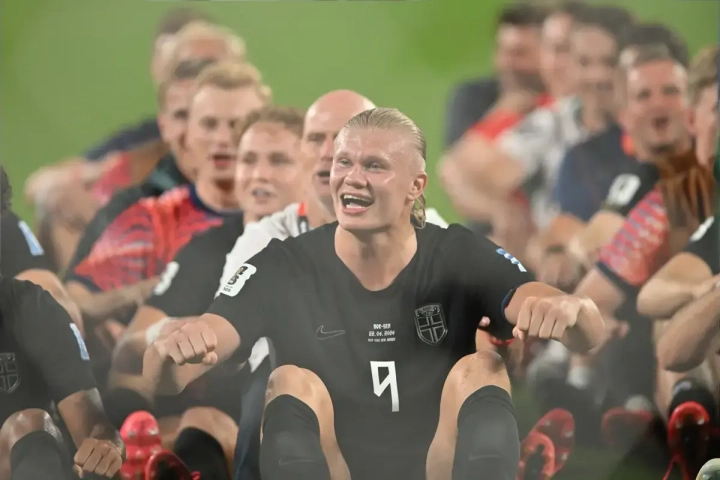
The celebration that followed was instantly iconic. Running toward the thousands of red-clad Norwegian supporters massed behind the north goal, Haaland raised a hand to his ear, orchestrating a thunderous rendition of the famous “Viking Row.”
Senegal, to their immense credit, refused to capitulate. Ismaïla Sarr produced a spectacular individual display, scoring in the 53rd minute and adding a second deep into stoppage time (90+3′) to set up a remarkably tense finish. However, Norway held firm, securing the three points and guaranteeing their progression from Group I.
A Historic Precedent: Joining the Elite
By scoring twice against Senegal, Haaland secured his place in an incredibly exclusive statistical club. He joins England captain Harry Kane (who achieved the feat in 2018) as one of only two players in the last 50 years to score two-goal games in both of their first two World Cup appearances.
The underlying numbers driving Haaland’s international career are genuinely staggering. He has now scored 24 goals in his last 12 international games, finding the back of the net at least once in every single one of those matches. His overall tally for Norway stands at an unbelievable 59 goals in just 52 appearances.
With four goals to his name in the 2026 tournament, he has already shattered Kjetil Rekdal’s previous national record of two World Cup goals. He currently sits firmly in the Golden Boot race, tied with France’s Kylian Mbappé and just one goal behind Argentina’s Lionel Messi.
Banishing the Ghosts of the Past
To truly appreciate the magnitude of Haaland’s explosive arrival, one must look at the legendary figures who failed to translate their domestic dominance into World Cup goals.
- Zlatan Ibrahimović: Across two World Cup tournaments, he played five matches and failed to register a single goal.
- Wayne Rooney: Required 11 matches across three tournaments to score his only World Cup goal.
- Sergio Agüero: Scored just two World Cup goals in 12 appearances across three different editions.
Why is Haaland succeeding where these giants of the game struggled? The answer lies in his unique physical profile and tactical independence. Strikers at the World Cup often suffer because national teams lack the intricate, highly drilled attacking systems of elite club football.
Haaland, however, does not require a complex tiki-taka system to thrive. He operates as an independent force of nature. He possesses a freakish combination of explosive pace, towering strength, and mechanical finishing efficiency. Against both Iraq and Senegal, his goals were the result of pure, unadulterated physical domination in transition. He thrives in the exact chaotic environments that typically break other forwards. He only requires a fraction of a second of space, and as Mendy discovered on Monday night, once Haaland is behind the defensive line, the outcome is inevitable.
The Road Ahead
With qualification to the Round of 32 secured, the pressure is entirely off Norway as they head into their final Group I fixture against France on Friday. That match, however, carries massive implications. A victory for the Vikings would secure first place in the group and a potentially easier path through the knockout bracket.
More importantly for the neutral fan, it sets up a mouth-watering direct clash between Erling Haaland and Kylian Mbappé, the two most destructive attacking forces in modern football, currently battling neck-and-neck for the Golden Boot.
Carrying the hopes of a smaller footballing nation is a heavy burden, but as the 2026 World Cup progresses, it is clear that Erling Haaland is perfectly built to carry it. The “striker curse” is officially dead, and the Norwegian cyborg is just getting started.