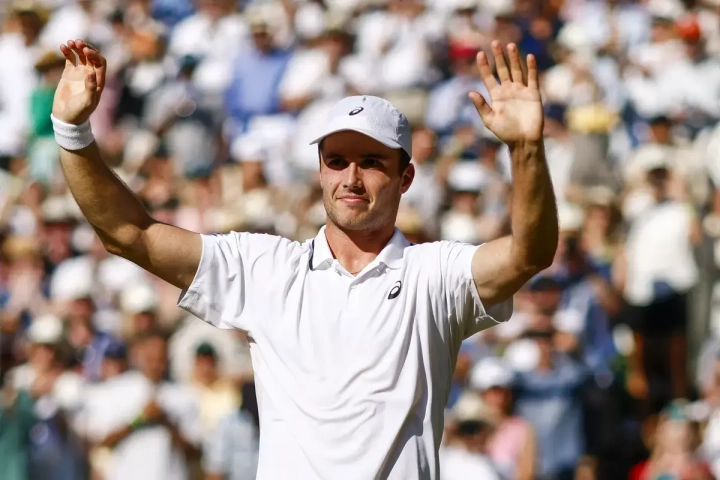
It was the fairytale that captivated a nation, a story of a local boy conquering the grandest stage in tennis, but on Friday afternoon, reality arrived on Centre Court in the formidable shape of Alexander Zverev. Arthur Fery, the 23-year-old British wildcard who grew up just a five-minute walk from the All England Club gates, saw his unprecedented run to the Wimbledon semi-finals brought to a clinical and definitive end by the German second seed.
In sweltering conditions in south-west London, the reigning French Open champion delivered a masterclass in power, precision, and big-match temperament, dismantling Fery 7-6 (7-0), 6-2, 6-4 in a match that lasted just under two and a half hours. The defeat marks the end of a magical fortnight for the world No. 114, whose remarkable giant-killing spree will nonetheless be remembered as one of the defining narratives of the 2026 sporting summer.
Zverev, operating at the absolute peak of his terrifying powers, now advances to his first Wimbledon singles final, where he will await the winner of the blockbuster second semi-final between Jannik Sinner and seven-time champion Novak Djokovic.
Here is a comprehensive, deep-dive analysis of how the German juggernaut finally broke British resistance, the tactical nuances of the contest, and what this historic run means for the future of Arthur Fery.
The Atmosphere: A Nation Expects
When Arthur Fery emerged from the Centre Court tunnel at 1:30 PM BST, the roar from the capacity crowd was deafening. He was stepping onto the hallowed turf not just as a competitor, but as a newly minted national hero. By demolishing Italian ninth seed Flavio Cobolli in the quarter-finals on Wednesday, Fery had become the first British wildcard in the Open Era to reach the last four of the men’s singles.
The weight of expectation was palpable. Fans draped in Union Jacks chanted “Here comes the Fery,” attempting to generate the same gladiatorial atmosphere that had successfully carried the young Briton through gruelling five-set marathons against Zizou Bergs and Grigor Dimitrov earlier in the tournament.
Across the net, however, stood a man who has made a career out of silencing partisan crowds. Alexander Zverev, seeded second and carrying the momentum of his maiden French Open triumph just last month, presented a monumental step up in weight class. Standing at 6ft 6in, the German arrived on Centre Court possessing one of the most devastating first serves in the global game and a baseline consistency that has routinely dismantled the world’s elite. The tactical question was simple: could Fery’s intelligent, varied slice-and-dice game disrupt the sheer, unadulterated power of the German?
The First Set: The Crucial Tiebreak Turning Point
For the first 50 minutes of the contest, the answer appeared to be a resounding yes. Fery displayed zero signs of stage fright in his maiden Grand Slam semi-final. Adhering strictly to the game plan orchestrated by his coach, Jeroen Benard, Fery utilised his trademark defensive slice to keep the ball low, attempting to force the towering Zverev to constantly bend and generate his own pace.
The opening set was a tense, high-quality affair that remained firmly on serve. Fery matched Zverev blow for blow, remarkably holding his own in the baseline exchanges and rushing the net with impeccable timing. The British crowd roared with every held service game, sensing that their local hero was genuinely capable of standing toe-to-toe with the world number two.
However, elite tennis is often decided in the finest of margins, and pedigree inevitably tells in the crucial moments. When the first set progressed to a tiebreak, the atmosphere reached fever pitch, but Zverev suddenly elevated his game to an entirely unreachable stratosphere.
The German played a flawless tiebreak, eliminating all unforced errors and painting the lines with ruthless aggression. Fery, perhaps feeling the immense pressure for the first time, tightened up. Zverev secured an early mini-break and never looked back, storming to a devastating 7-0 victory in the breaker. The psychological damage inflicted by that flawless tiebreak was profound; it was a brutal reminder of the gap between a rising star and an established Grand Slam champion.
The Second and Third Sets: Zverev’s Serving Masterclass
Having snatched the opening set in such emphatic fashion, Zverev entirely dictated the terms of engagement for the remainder of the afternoon. The second set began with the German immediately breaking Fery’s serve, capitalising on a sudden dip in the Briton’s first-serve percentage.
The statistical breakdown of the match perfectly illustrates Zverev’s utter dominance on his own delivery. The German landed 75 per cent of his first serves, firing down nine aces and winning 78 per cent of the points behind his first delivery. Most astonishingly, Zverev won a staggering 89 per cent of points on his second serve, a statistic that practically renders it impossible for an opponent to generate consistent break-point opportunities.
Fery, conversely, began to struggle under the relentless baseline bombardment. While he managed to land 70 per cent of his first serves, he won only 59 per cent of those points, and his second serve was aggressively punished by the German’s heavy returns, yielding a mere 48 per cent win rate.
Zverev secured a second break in the second set to comfortably take it 6-2. The Centre Court crowd desperately tried to rally their man at the start of the third set, hoping for a repeat of the heroic comebacks Fery had staged earlier in the fortnight. Fery fought valiantly, attempting to mix up the play with drop shots and serve-and-volley tactics, managing to secure a rare break of the Zverev serve. However, the German’s return game was simply too potent. Zverev broke the Briton twice in the third set, clinically closing out the match 6-4. In total, Zverev won an impressive 107 points to Fery’s 70, converting four of his eight break-point opportunities in a deeply professional performance.
Putting the Fery-Tale into Context
As Arthur Fery packed his bags and waved to the standing ovation from the Centre Court faithful, the immediate disappointment of the straight-sets defeat will undoubtedly be eclipsed by the sheer magnitude of what he has achieved over the past two weeks.
Before this tournament, Fery was a highly promising but relatively unknown prospect on the global stage. His journey to the semi-finals, navigating past Damir Džumhur, Otto Virtanen, a brutally physical five-setter against Zizou Bergs where he battled repeated nosebleeds, a monumental shock against Grigor Dimitrov, and a quarter-final demolition of Flavio Cobolli, has rewritten the modern history of British tennis.
He becomes only the second wildcard in the history of the Wimbledon men’s singles draw to reach the semi-finals, matching the legendary feat of Goran Ivanisevic in 2001. Furthermore, his run guarantees a seismic shift in his professional trajectory. Having started the 2026 calendar year ranked 185th, and entering Wimbledon at 114th, the ranking points accrued during this magical fortnight will see him surge into the world’s top 65 on Monday morning.
This astronomical rise instantly establishes Fery as the new British number two, leapfrogging the established guard and placing him firmly behind only Cameron Norrie. For the Stanford University alumnus, who spent his formative years playing in the US collegiate system, the financial rewards and the sudden, automatic entry into main draws for future ATP Tour events and Grand Slams will completely alter his career path.
What the Result Means for the Tournament
For Alexander Zverev, the victory represents the continuation of a sensational summer. The 29-year-old is playing the most complete, emotionally mature tennis of his career. Having finally conquered his Grand Slam demons by lifting the Coupe des Mousquetaires at Roland Garros last month, he is now just one match away from securing the elusive Channel Slam, winning both the French Open and Wimbledon in the same calendar year.
Zverev will be a formidable opponent in Sunday’s final, regardless of whether he faces the clinical baseline game of Jannik Sinner or the unmatched grass-court pedigree of Novak Djokovic.
Beyond the men’s draw, the Championships are building toward a phenomenal crescendo. In the women’s tournament, Karolína Muchová produced a breathtaking performance on Thursday to battle past American seventh seed Coco Gauff 6-2, 1-6, 7-6 (12-10), saving a match point in an epic third-set tiebreak. The Czech star will face Linda Nosková in Saturday’s final, ensuring a new name will be etched onto the Venus Rosewater Dish.
There is also continued British success to celebrate in the doubles formats. Henry Patten and Harri Heliovaara have stormed into the men’s doubles final for the second time in two years after winning a tight battle against Thanasi Kokkinakis and Aleksandar Kovacevic on No. 1 Court. Additionally, wheelchair tennis star Alfie Hewett has reached his tenth successive Wimbledon doubles final alongside Gordon Reid, ensuring the home crowd still has plenty to cheer for over the final weekend.
The Legacy of Arthur Fery’s 2026 Campaign
As the groundskeepers prepare Centre Court for the climactic final weekend of the 2026 Championships, the echoes of “Here comes the Fery” will linger long in the memory.
Arthur Fery did not win the Wimbledon title, nor did he manage to take a set off a generational talent in peak form during his semi-final debut. What he did achieve, however, was far more resonant for the British public. He injected a sense of unbridled joy, unexpected drama, and pure sporting romance into a tournament that desperately craves local heroes.
He proved that the US collegiate pathway can forge players with immense tactical intelligence and mental resilience. He proved that a wildcard is not merely a ceremonial gesture, but a genuine opportunity to disrupt the established order of the sport.
Friday afternoon belonged to the ruthless brilliance of Alexander Zverev, but the first two weeks of July 2026 will forever belong to the boy from down the road. Arthur Fery’s Wimbledon fairytale has officially ended, but his professional journey on the main stage of global tennis has only just begun.