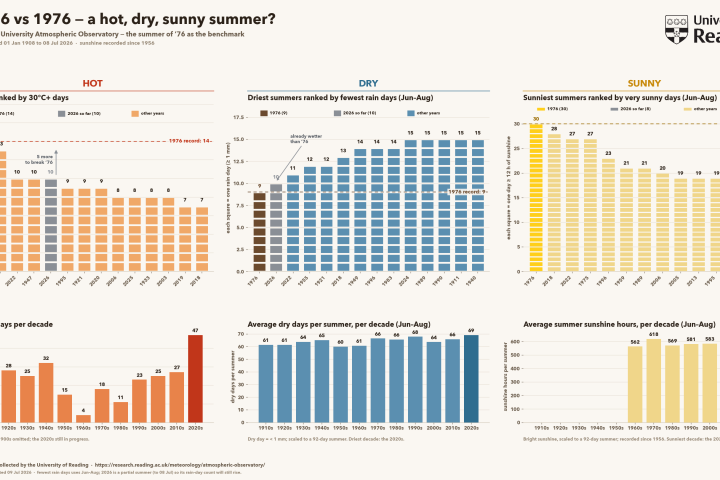
Eleven days in 2026 have reached 30°C or higher, according to observations from the Reading University Atmospheric Observatory.
With temperatures forecast to remain high over the coming days, this year could soon beat the current records for days 30°C and above. 14 days were recorded in 1976 and 13 days were recorded in 1911.
Thursday, 9 July was the University of Reading’s ninth-hottest July day on record, reaching 34.2 °C, meaning Reading has now observed 11 days of temperatures higher than 30°C in 2026.
A new analysis comparing 2026 with 1976 by Professor Andrew Charlton-Perez, University of Reading, also found:
- 2026 is lagging behind on the number of days with more than 12 hours of sunshine, compared to 1976, with 30 such days recorded 50 years ago, in comparison to just eight so far this summer.
- 2026 is already wetter than 1976, as 10 days with more than 1mm of rainfall have been recorded this summer. Summer 1976 only recorded nine days.
- The 2020s have so far recorded 47 30+°C days, compared to 27 in the 2010s, the next highest, and 18 in the 1970s.
- 69 dry days, in which less than 1mm of rainfall were recorded, have been observed in the 2020s. This eclipses all previous records.
Professor Andrew Charlton-Perez, Department of Meteorology, University of Reading, said: “Less than halfway through Summer 2026 we already seeing extreme heat and rainfall records being broken.
“If this year continues as it has started, 2026 could be remembered in the same way as 1976. But the reality is that climate change is likely to make summers like this one more frequent and more dangerous, even if they are not especially sunny.
“Meteorological data from long-term observatories like the one at the University of Reading helps us make sense of our personal experiences of this hot summer. As the Climate Change Committee recently noted, we will need to adapt to an increasing number of hot and dry days during the summer, which pose a serious threat to our infrastructure and public health.”