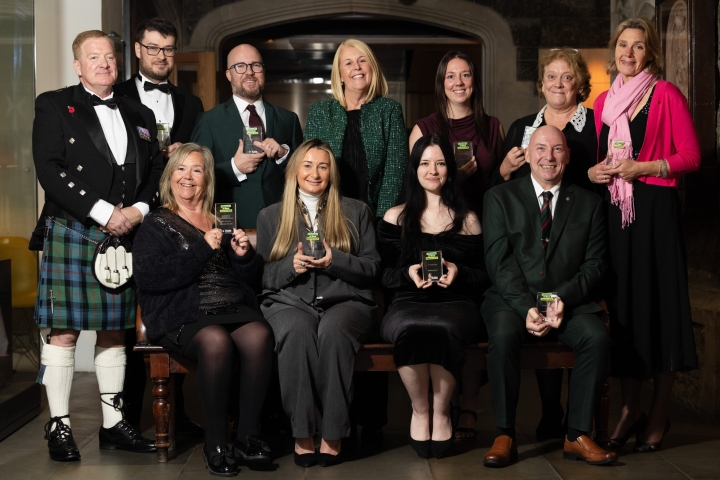
St John Ambulance today reveals the nation’s most inspirational lifesavers at work, following an intimate ceremony last night at The Museum of the Order of St John. Seven ordinary people, whose quick thinking and first aid training saved lives, have become the first in the UK to be honoured at the inaugural Lifesavers at Work Awards.
Stacey Charman, Chellie Messenger and Claire Agnew of Windlesham House School in West Sussex have been named joint Beyond the Workplace Heroes 2026 by St John Ambulance. The three first aid heroes saved the life of cyclist Kip Knowles, 57, after he collapsed in cardiac arrest near the school while Stacey and Chellie were out on a lunchtime dog walk. Kip, who had stopped breathing by the time the defibrillator arrived, came round after around 25 minutes of CPR and two shocks.
The trio were among seven winners honoured last night at St John Ambulance’s Lifesavers at Work Awards. The charity launched the initiative after its research found that four in five UK workers (83%) believe deserve more celebration than Oscar winners. GP and broadcaster Dr Nighat Arif presented each winner with an award recognising their swift, lifesaving action at a ceremony at the Chapter Hall at St John’s Gate, London, where several were reunited with the people they saved.
Shona Dunn, CEO of St John Ambulance says: “Every one of the winners was an ordinary person who refused to give up on someone whose life was slipping away. These people are alive today because someone nearby knew what to do, and that should be true for everyone in this country.”
“Cardiac arrest is the emergency that workers fear the most, yet two in five say they wouldn’t know how to perform CPR. That’s a gap we can close, and the workplace is where we can close it the fastest. St John Ambulance has almost 20,000 volunteers keeping communities safe across the UK, but by training more first aiders in the workplace we can create millions more lifesavers. Each of them takes those skills home to their family, onto the high street and into their community.”
“So today, I’m asking every employer in England to make first aid part of key part of working life, because the next lifesaver could be sitting at the desk next to you.”
The story of St John Ambulance’s ‘Workplace Hero’ 2026
Adrian Cummins, known as Ade, 41 is a Vehicle Data Manager at Holman UK in Wiltshire. He became a workplace first aider soon after his daughter was born, wanting skills that would help anywhere.
One morning in June 2026, a man collapsed in cardiac arrest outside Ade’s office. Ade quickly recognised the man’s laboured, snoring-type breathing as agonal breathing, a key sign of cardiac arrest he’d learnt in training and began CPR. He kept going even when he felt the man’s ribs crack, until a colleague arrived with the site’s defibrillator. Paramedics later told him that without his actions, the man would almost certainly have died.
Paul McGettigan, the man he saved said: “What Ade’s given me is more time. He’s given me time back with my family that I may have lost. I’m grateful I’ve got a second chance.”
The awards also recognise those who have used skills gained through workplace training to save lives beyond the office, including while working from home and in their communities. The story of Stacey, Chellie and Claire of Windlesham House School is one such example.
The story of St John Ambulance’s ‘Beyond the Workplace Hero’ 2026 co-winners
On Thursday 16 October 2025, PE teacher Stacey Charman and cookery teacher Chellie Messenger set off from Windlesham House School for a lunchtime walk when Chellie’s dog, Waffle, refused their usual route. Waffle’s new path led them to Kip Knowles, who had just collapsed on the side of the road after he’d been cycling alone on the South Downs.
Stacey and Chellie, who had both undertaken workplace first aid training with St John Ambulance only six weeks earlier jumped into action. Stacey began CPR while Chellie called 999 and used her walkie-talkie to radio the school for its defibrillator.
“Everything was a complete blur apart from Kip,” says Stacey. “I was in the zone, the training kicked in, and nothing around me could stop me from carrying on.”
For Chellie, it was the first time she had given CPR to anyone other than a training manikin. “It was horrible to see, but we didn’t stop,” she says. “It wasn’t a case of ‘that’s it, he’s gone’. I was thinking – this man is the age of my husband.”
School nurse Claire Agnew arrived with the defibrillator. “I thought he was dead,” she says. “I know what a dead body looks like; I’ve done this for 42 years.” She delivered two shocks, and after around 25 minutes of CPR, Kip took a deep breath and sat up.
“I was on my bike in the middle of nowhere; I hadn’t seen anyone for hours,” says Kip, now 58. “The ladies did CPR on me for around 25 minutes. I was going in and out of consciousness, and by the time Claire arrived with the defib, I’d stopped breathing, and they thought it was too late. But they didn’t give up on me, and I wouldn’t be here today without them.”
Exactly a year after the incident, Kip was reunited with the three women who saved him. Since that day, they have urged everyone they know to learn CPR.
His wife Lucy, who nominated them for the award, adds: “Our lives, and the lives of so many family and friends, would have crumbled had these angels not been there that day.”
Other winners include TotalEnergies, named a Leader in Workplace First Aid after an employee’s cardiac arrest prompted the company to overhaul its first aid training programme, and Manchester Metropolitan University, recognised as a Leader in Workplace Health and Wellbeing for a first aid and mental health programme that has trained nearly 3,000 students.
Dr Nighat Arif says: “As a GP, I know the minutes before an ambulance arrives can decide whether
someone lives or dies, and the most important person then isn’t a doctor; it’s whoever is nearby. I’ve
met people who used what they learnt at work to bring someone back to their family. I talk about
health on TV, but what these winners did with their own hands is the most powerful message of all. They have demonstrated the greatest act of humanity in real life.”
The awards follow eye-opening insights from St John Ambulance revealing that more than one in four UK workers (28%) have needed first aid at work. Cardiac arrest is the workplace emergency workers fear most (33%), yet almost two in five (39%) say they don’t know how to perform CPR.
Of those who have witnessed a medical emergency at work, just two in five (40%) were able to give first aid themselves. Worryingly, in some cases (3%), nobody at the scene was able to help at all. Yet 85% of workers say they would feel safer knowing their colleagues were first aid trained.
To find out more about the winners, and how to arrange first aid training for your workplace, visit http://shop.sja.org.uk/s/awards2611